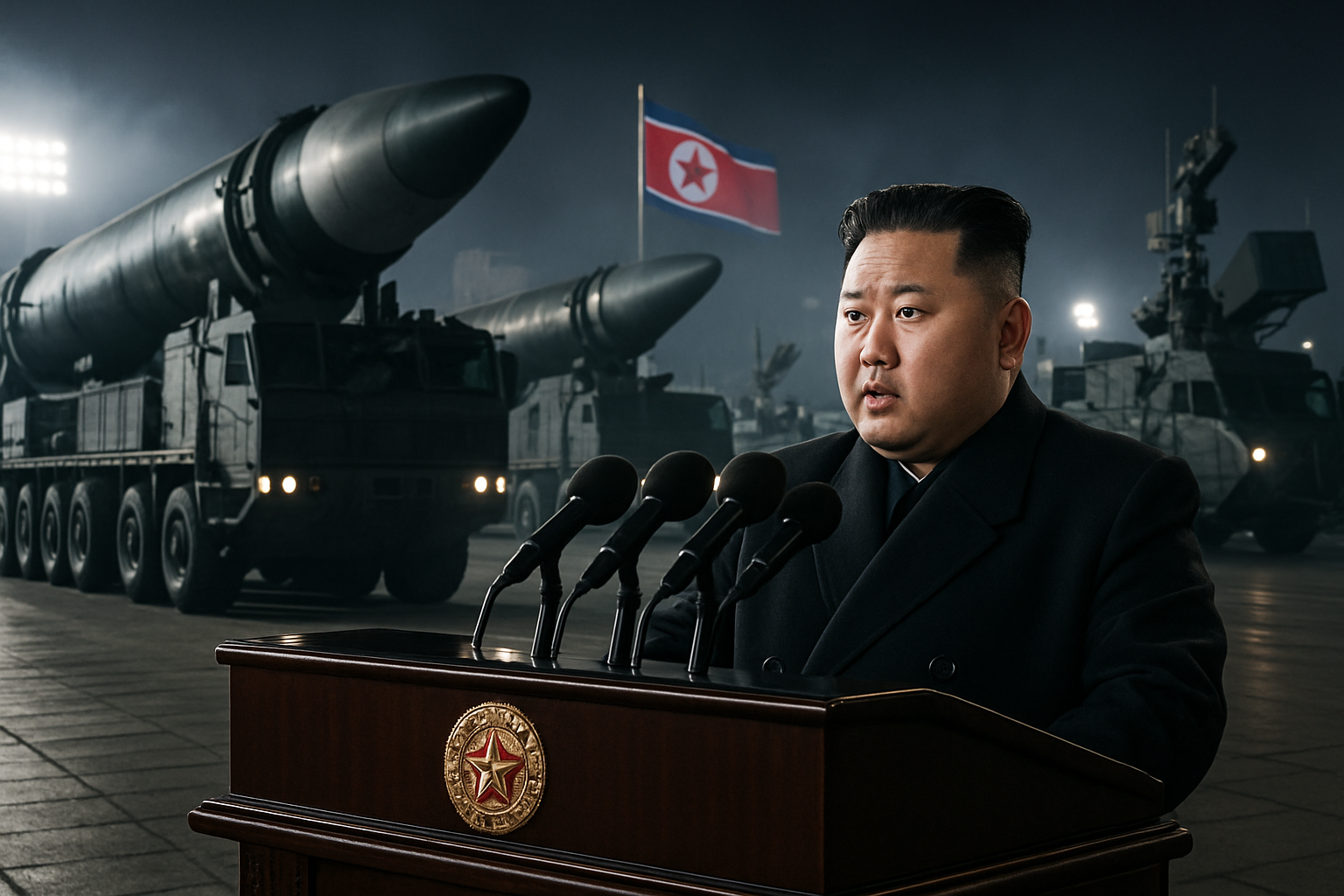
North Korean leader Kim Jong Un announced plans to dramatically expand the country's nuclear arsenal and develop artificial intelligence-based weapons systems during a major military parade on February 25, 2026, marking one of the most significant military escalations from Pyongyang in recent years.
The announcement came during a massive military demonstration featuring 14,000 troops, where Kim Jong Un declared that North Korea would continue expanding its nuclear weapons capabilities, intercontinental ballistic missiles, and develop AI-powered attack systems and unmanned drones. The parade notably excluded nuclear weapons displays, suggesting a calculated approach to military messaging.
Nuclear Arsenal Expansion Plans
Kim Jong Un's commitment to nuclear expansion comes at a critical juncture in global nuclear governance. Speaking before thousands of party officials and military personnel, the North Korean leader emphasized that the country's nuclear capabilities would continue to grow despite international sanctions and diplomatic pressure.
The announcement follows the unveiling of North Korea's 600mm nuclear-capable multiple rocket launcher systems in February 2026, described by state media as "unique in the world" and "suitable for special attack missions." These tactical nuclear weapons represent a significant shift from intercontinental deterrence to regional conflict capabilities, fundamentally altering the Korean Peninsula's strategic calculus.
Intelligence assessments indicate North Korea has sufficient enriched uranium for multiple weapons, with advanced centrifuge technology enabling continued weapons development despite extensive international sanctions. The regime's focus on nuclear capabilities over economic development demonstrates the central role these weapons play in Kim Jong Un's survival strategy.
AI Weapons Development Initiative
Perhaps most concerning to international observers is North Korea's announced development of artificial intelligence-based strike systems. This represents a significant technological leap for the isolated nation, suggesting either indigenous development capabilities or external technological assistance.
The AI weapons initiative includes plans for autonomous attack systems and advanced unmanned drones, potentially creating new categories of military threats that could operate with reduced human oversight. Military analysts note this development could lower the threshold for conflict initiation while complicating defensive planning for regional allies.
Historic Succession Planning
The military parade also featured a significant political development: Kim Jong Un's teenage daughter, Kim Ju Ae, appeared prominently alongside her father, wearing matching leather jackets as they observed the military procession. This appearance continues her systematic elevation within North Korean political structures.
According to South Korean intelligence confirmed in February 2026, Kim Ju Ae has been formally designated as Kim Jong Un's successor, representing unprecedented female leadership in the 78-year history of the Kim dynasty. She now provides "input on policy matters" beyond ceremonial appearances, marking substantive political involvement preparation.
"This succession planning represents the most significant adaptation in North Korean political culture since the regime's founding."
— Niklas Swanström, North Korea Expert
The succession planning occurs within the context of the regime's broader modernization efforts, including completion of the massive 50,000-unit Hwasong Area housing project in Pyongyang, demonstrating the dual strategy of maintaining military capabilities while providing tangible domestic benefits.
Regional Security Implications
The nuclear expansion announcement comes during a period of heightened tensions on the Korean Peninsula. North Korea's development of tactical nuclear weapons capabilities enhances first-strike possibilities and complicates defensive planning for South Korea, Japan, and United States forces in the region.
The timing is particularly significant given the global nuclear governance crisis following the expiration of the New START treaty between the United States and Russia in February 2026 - the first time in over 50 years without binding nuclear arms control between superpowers.
Regional allies face renewed challenges in addressing North Korea's advancing weapons programs through diplomatic channels. The combination of nuclear expansion, AI weapons development, and succession planning creates a volatile security environment requiring innovative international responses.
International Context and Response
The nuclear expansion announcement occurs against the backdrop of broader global nuclear tensions. With the collapse of traditional arms control frameworks and rising great power competition, North Korea's weapons development represents another complicating factor in international security architecture.
The regime's ability to continue weapons development despite comprehensive international sanctions demonstrates the limitations of current non-proliferation approaches. North Korea's indigenous production capabilities and alternative economic relationships, particularly with China and Russia, provide sufficient resources for sustained military modernization.
Cultural and Political Transformation
Kim Ju Ae's prominent role in military events signals the regime's confidence in unprecedented female leadership within the traditionally masculine Juche ideology system. Her systematic preparation since November 2022 has included weapons demonstrations, military parades, and diplomatic functions, including a significant Beijing visit in September 2025.
The success of this historic gender transition within North Korea's rigid political system requires sustained legitimacy building among the political elite and military hierarchy. International observers are monitoring this development as a potential template for authoritarian regime adaptation in the 21st century.
Looking Ahead
North Korea's nuclear expansion and AI weapons development plans, combined with historic succession planning, represent a critical juncture for regional security and international diplomacy. The regime's ability to maintain military advancement while managing internal political transition demonstrates sophisticated strategic planning despite external pressures.
The international community faces the challenge of addressing evolving North Korean capabilities through diplomatic engagement while maintaining deterrent credibility. Success in managing this complex security environment will require innovative approaches to nuclear governance, regional cooperation, and conflict prevention.
As Kim Jong Un consolidates power while preparing his successor, the combination of advanced weapons capabilities and unprecedented political transformation creates new dynamics that will shape Korean Peninsula security for decades to come.