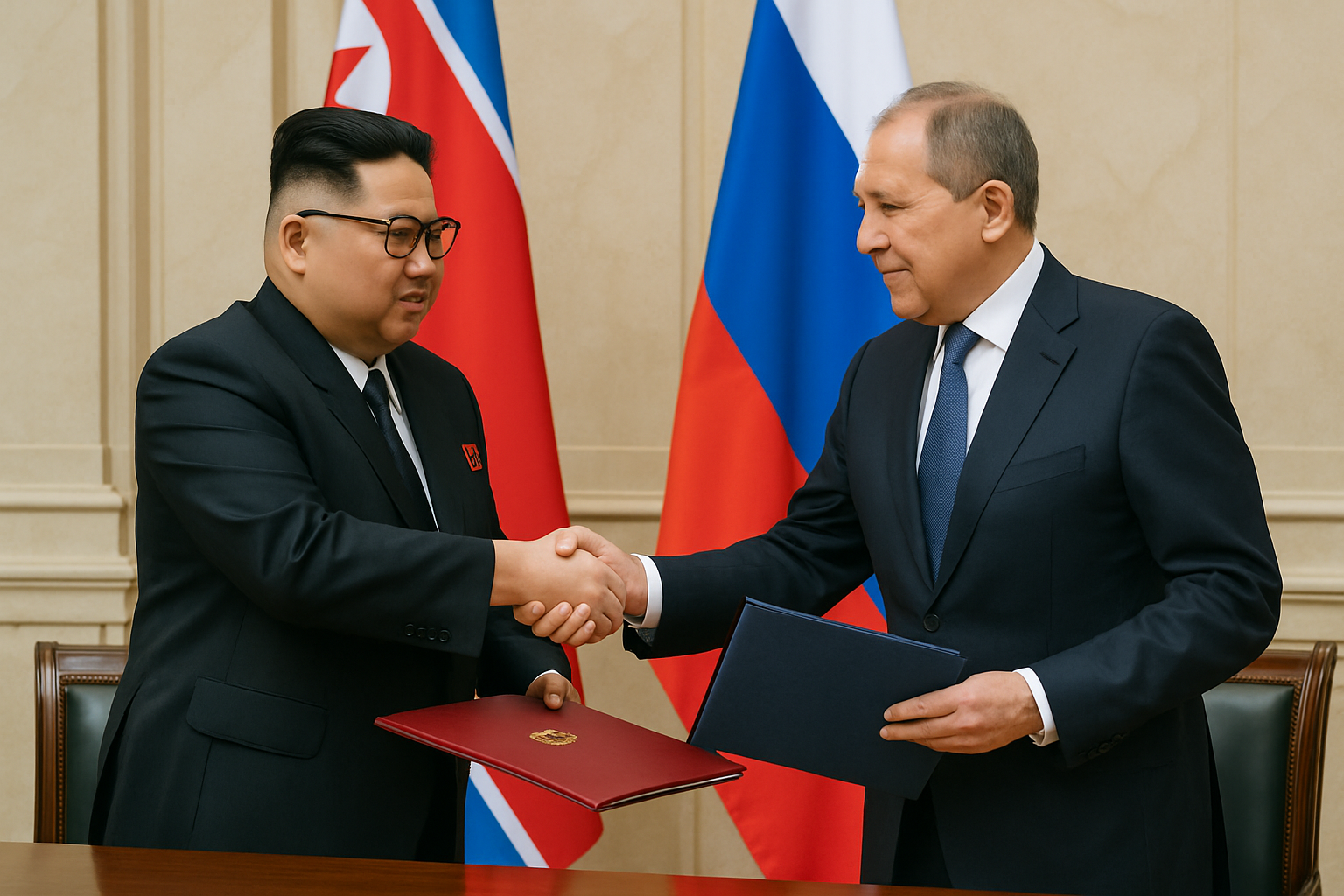
North Korea and Russia are strengthening their strategic partnership through deepening military cooperation and expanded commercial ventures, as evidenced by recent diplomatic activities and business developments between the two nations amid evolving global dynamics.
Recent developments highlight the multifaceted nature of North Korea-Russia relations, spanning military cooperation, commercial partnerships, and diplomatic coordination during a critical period for both nations. This strengthening partnership comes as North Korea undergoes unprecedented succession planning while maintaining its nuclear advancement programs.
Commercial Expansion and Sanctions Circumvention
A sanctioned North Korean firm has filed for trademark protection in Russia, demonstrating the practical expansion of commercial ties between the two nations. The Sobaekso Joint Venture Company from Pyongyang applied to register its trademark in Russia in late March, seeking to sell aphrodisiacs, traditional medicines, and beer in the neighboring market.
This commercial development represents a significant evolution from previous limited exchanges. The North Korean company's trademark application suggests systematic efforts to establish legitimate business operations in Russia, potentially circumventing international sanctions through bilateral trade arrangements.
Intelligence analysts note that such commercial partnerships serve multiple purposes: providing North Korea with alternative revenue streams, reducing dependence on Chinese markets, and creating practical frameworks for broader economic cooperation between the two nations under international pressure.
Military Cooperation and Strategic Coordination
The military dimension of North Korea-Russia relations has intensified significantly, as demonstrated by the first Russian military jet landing in Pyongyang since February 2026. The Russian Air Force Il-62M touched down in Pyongyang in early April, arriving from Moscow with a brief stop in Vladivostok, according to aviation tracking data.
This military aviation development coincides with North Korea's systematic nuclear advancement, including the February 2026 unveiling of 600mm nuclear-capable rocket systems described as "unique in the world" for "special attack missions." Military cooperation between the two nations has expanded beyond symbolic exchanges to practical coordination.
"The restoration of military aviation links represents a significant escalation in Russia-North Korea strategic cooperation amid global nuclear governance crisis."
— Regional Security Analyst
The timing proves strategically significant, occurring during the global nuclear governance crisis following the New START treaty expiration in February 2026 – the first time in over 50 years without US-Russia nuclear constraints. Both nations are positioning themselves within alternative security architectures outside Western-dominated institutions.
North Korean Succession Context
These developments unfold against the backdrop of unprecedented succession planning in North Korea, with Kim Ju Ae formally designated as heir – representing the first potential female leadership in the 78-year Kim dynasty history. South Korean intelligence confirmed that Kim Ju Ae now provides "input on policy matters" beyond ceremonial appearances, marking substantial political involvement preparation.
The strengthening Russia partnership provides international legitimacy for this historic political transformation. Russia's sustained engagement through practical military and commercial cooperation establishes foundations for long-term stability during the unprecedented female dynastic transition.
Kim Ju Ae's systematic elevation since November 2022 has included weapons demonstrations attendance, military parades, and her September 2025 Beijing visit marking her first international travel. The succession planning requires sustained legitimacy building within North Korea's traditionally masculine political and military hierarchy.
Strategic Implications for Regional Security
The deepening North Korea-Russia partnership creates complex triangular dynamics affecting regional security calculations. This cooperation provides both nations enhanced leverage in their respective strategic competitions while creating challenges for traditional alliance structures.
Regional allies including South Korea, Japan, and the United States face renewed challenges addressing this strengthening partnership through diplomatic channels. The combination of advanced weapons capabilities, succession planning, and international cooperation creates a volatile period requiring innovative diplomatic responses.
China's role remains significant, with Beijing-Pyongyang passenger rail service restored in March 2026 after a six-year suspension. This creates multiple leverage points for North Korea, reducing over-dependence on any single partner while maximizing strategic autonomy through diversified partnerships.
Global Context and Multipolar Dynamics
The North Korea-Russia partnership exemplifies broader international realignments as sanctioned nations develop alternative cooperation frameworks outside Western-dominated institutions. This occurs amid China's expanding partnerships, including zero-tariff access to 53 African countries, demonstrating systematic efforts to create alternative economic architectures.
Both North Korea and Russia face extensive Western sanctions and seek to demonstrate resilience through innovation despite international pressure. Their cooperation serves as a template for bilateral partnerships among countries excluded from traditional multilateral frameworks.
The partnership spans multiple dimensions: energy cooperation crucial for North Korean economic survival, military technology sharing advancing both nations' capabilities, and diplomatic coordination strengthening positions in international negotiations.
Implementation Challenges and Opportunities
Despite strengthening ties, both nations face significant implementation challenges due to limited financial and logistical capabilities under sanctions regimes. However, the partnership establishes frameworks for cooperation in sectors where both have demonstrated remarkable resilience and innovation.
Agricultural cooperation could enable food security improvements for North Korea while providing Russia with alternative markets. Educational and scientific exchanges might facilitate technology sharing and joint development initiatives reducing Western dependence in critical sectors.
The business and commercial dimension, exemplified by the trademark filing, suggests practical approaches to sanctions circumvention while maintaining plausible deniability regarding direct sanctions violations.
Future Trajectory and International Response
The strengthening North Korea-Russia partnership represents more than tactical cooperation – it signals ongoing reorganization of international relations toward a multipolar world order. Success or failure of this partnership will likely influence similar bilateral agreements among sanctioned countries globally.
International observers are closely monitoring this partnership for its potential to reshape regional security dynamics and global governance patterns. The template could influence other excluded nations to pursue similar bilateral cooperation arrangements, potentially challenging existing multilateral institutions.
For North Korea specifically, the partnership provides crucial support during the unprecedented political transformation of female succession planning. Russia's sustained engagement offers international legitimacy and practical cooperation essential for regime stability during this historic transition.
The full implications will unfold over years as both countries implement cooperation agreements amid international pressure, regional security challenges, and internal political transitions. The partnership demonstrates sophisticated diplomatic strategy for maintaining regime relevance through diverse international relationships during periods of unprecedented domestic change.