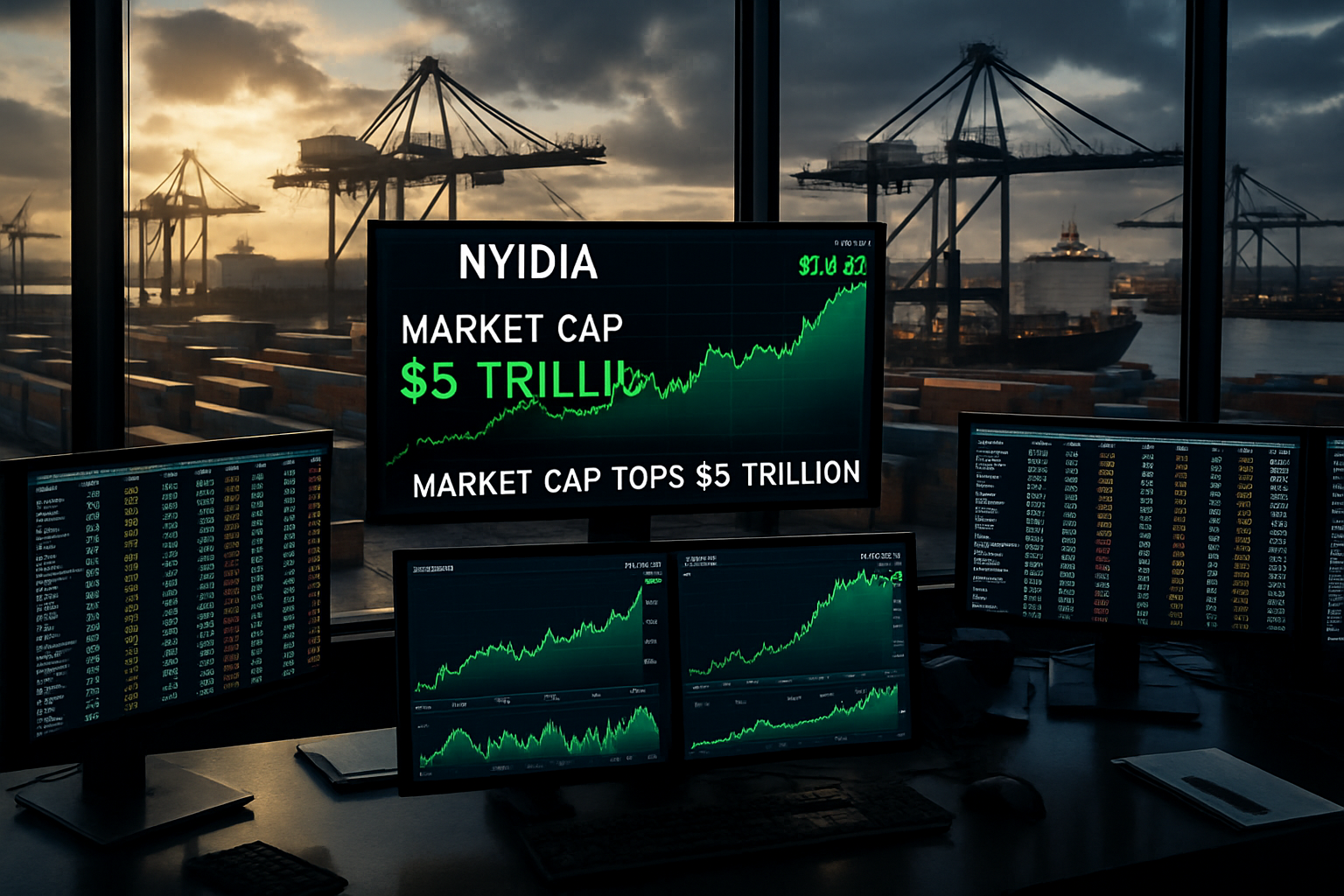
Nvidia Corporation achieved a historic milestone Friday, closing at record highs and pushing its market capitalization above $5 trillion for the first time since October 2025, while parallel developments in shipping and energy sectors underscore broader market momentum across critical infrastructure industries.
The semiconductor giant's stock surge comes as global markets demonstrate renewed confidence in artificial intelligence infrastructure investments, despite ongoing supply chain constraints that have characterized the technology sector throughout 2026. This achievement places Nvidia among an elite group of companies to reach the $5 trillion valuation threshold, reinforcing its position as the world's most valuable corporation.
AI Infrastructure Drives Unprecedented Valuations
Nvidia's market cap breakthrough reflects the company's dominant position in the rapidly expanding AI infrastructure market. The milestone comes as major technology corporations continue unprecedented investment commitments, with Alphabet allocating $185 billion for AI infrastructure in 2026—representing the largest single-year corporate technology investment in history—and Amazon planning over $1 trillion in AI development through the decade.
The achievement occurs against the backdrop of what industry analysts term the "experimental-to-essential" AI infrastructure transition, where artificial intelligence capabilities are moving from pilot programs to mission-critical business applications across virtually every economic sector. This transition has driven explosive demand for Nvidia's advanced semiconductor solutions, particularly in data center applications supporting large-scale AI model training and deployment.
Jensen Huang, Nvidia's CEO, has positioned the company as the primary beneficiary of this infrastructure transformation through an integrated approach spanning custom silicon, software frameworks, and development tools. This comprehensive ecosystem strategy creates competitive barriers that industry experts believe will be difficult for competitors to replicate in the near term.
Maritime Industry Signals Strong Recovery
Concurrent with Nvidia's historic achievement, significant developments in the shipping industry point to robust performance across European port networks and Greek maritime companies. The Seatrade Cruise Global 2026 exhibition has become a catalyst for major interregional cooperation initiatives, highlighting the strategic importance of European port alliances in supporting the cruise industry's continued expansion.
High-level meetings featuring European Port Unions and destination partnerships have emerged from the exhibition, emphasizing cross-regional collaboration as cruise tourism continues its post-pandemic recovery trajectory. Industry participants report strong booking trends and capacity utilization rates that exceed pre-2020 levels, suggesting the maritime tourism sector has not only recovered but is experiencing genuine growth momentum.
The timing of these developments coincides with broader supply chain stabilization efforts following the severe disruptions experienced during the March 2026 global energy crisis. The Strait of Hormuz closure, which affected 40% of global seaborne oil transit, demonstrated the critical importance of diversified shipping routes and resilient maritime infrastructure—factors that are now driving renewed investment in European port capabilities.
Greek Shipping Sector Expansion
Meanwhile, Greek shipping giant Danaos Corporation has announced its first major entry into the Newcastlemax bulk carrier segment through a strategic agreement with Chinese shipbuilder Dajin Offshore. This represents a significant strategic expansion for Dr. Ioannis Coustas's company, which has historically focused on container vessel operations.
The move into dry bulk shipping reflects broader industry confidence in global commodity trade recovery, particularly as supply chain disruptions have highlighted the importance of maritime transport capacity. Newcastlemax vessels, among the largest dry bulk carriers globally, are specifically designed for efficient iron ore and coal transport, suggesting Danaos anticipates sustained demand for these commodities.
This expansion aligns with broader trends in Greek shipping, where major operators are diversifying their fleets to capitalize on multiple market segments. The strategic timing of Danaos's announcement—concurrent with positive developments in European port cooperation—suggests coordinated efforts to strengthen Europe's maritime infrastructure and capacity.
Global Market Context and Infrastructure Investment
The convergence of Nvidia's valuation milestone with positive shipping sector developments reflects broader themes in global financial markets during April 2026. Despite ongoing challenges including the global semiconductor crisis—which has driven memory chip prices up sixfold and created supply constraints expected to persist until 2027—major corporations and governments continue substantial infrastructure investments.
The World Bank's projection that AI operations will require 4.2-6.6 billion cubic meters of water annually by 2027 for data center cooling—equivalent to four to six times Denmark's total annual water consumption—underscores the massive scale of infrastructure transformation underway. This demand is driving parallel investments in renewable energy systems, efficient cooling technologies, and distributed computing architectures.
European policymakers have responded to these infrastructure challenges through coordinated initiatives aimed at digital sovereignty and reduced dependence on non-European technology suppliers. Spain's implementation of the world's first criminal executive liability framework for technology platforms, alongside France's enhanced AI cybersecurity enforcement, represents the most sophisticated global technology governance framework since internet commercialization.
Energy Sector Recovery and Maritime Synergies
The strong performance across shipping and energy sectors reflects successful adaptation to the volatile conditions experienced during the March 2026 energy crisis. When Iranian Revolutionary Guard actions effectively closed the Strait of Hormuz, triggering oil prices above $119 per barrel and necessitating the largest strategic petroleum reserve release in 50-year history, maritime and energy companies demonstrated remarkable operational flexibility.
Current market conditions suggest these industries have emerged from the crisis with enhanced resilience and strategic positioning. The International Energy Agency's coordinated response—involving 400 million barrels from 32 countries' strategic reserves—provided the stability necessary for companies like Danaos to pursue expansion plans, while European port alliances developed during the crisis are now facilitating broader cooperation initiatives.
Energy security considerations have become central to European maritime strategy, with port infrastructure increasingly viewed as critical national security assets. This perspective is driving substantial public and private investment in port modernization, digital integration, and capacity expansion—trends that benefit both cruise and commercial shipping operations.
Technology-Maritime Infrastructure Convergence
The simultaneous achievements by Nvidia and positive developments in shipping reflect broader convergence between technology and traditional infrastructure sectors. Modern port operations increasingly depend on sophisticated AI-powered logistics optimization, predictive maintenance systems, and real-time supply chain coordination—capabilities that require exactly the type of advanced computing infrastructure Nvidia provides.
This technological integration extends beyond operational efficiency to include environmental monitoring, regulatory compliance, and safety management systems. As European ports implement enhanced environmental standards and digital customs procedures, demand for AI-powered solutions continues expanding, creating additional market opportunities for technology infrastructure providers.
The success of these integrated approaches provides a template for other traditional industries seeking to leverage AI capabilities while maintaining operational excellence. The combination of human expertise with artificial intelligence amplification—rather than wholesale technology replacement—has proven most effective across multiple sectors.
Investment Implications and Market Outlook
The convergence of technology valuation milestones with strong traditional sector performance suggests sophisticated investors are pursuing portfolio diversification strategies that balance growth technology exposure with essential infrastructure investments. This approach reflects lessons learned during recent market volatility, including the "SaaSpocalypse" that eliminated hundreds of billions in traditional software market capitalization as AI demonstrated direct replacement capabilities.
Regional variations in investment approaches have become increasingly apparent, with European strategies emphasizing technological sovereignty and infrastructure resilience, while Asian markets focus on comprehensive workforce transition programs rather than displacement-focused automation. These different approaches are creating distinct competitive advantages and market opportunities across geographic regions.
Current market dynamics suggest that companies and regions successfully balancing innovation with operational stability, technological advancement with human-centered approaches, and global competitiveness with local community benefits are positioning themselves most advantageously for sustained growth.
Regulatory Framework Evolution
The milestone achievements across technology and shipping sectors occur within an evolving regulatory landscape that increasingly emphasizes coordinated international governance. The United Nations' establishment of an Independent Scientific Panel comprising 40 experts represents the first fully independent global AI assessment body, providing framework for addressing the technology's societal implications.
This regulatory evolution extends beyond technology to encompass maritime operations, where enhanced environmental standards, digital customs procedures, and supply chain transparency requirements are reshaping industry practices. Companies demonstrating proactive compliance and stakeholder engagement are receiving preferential treatment in partnership negotiations and expansion approvals.
The coordination between European regulatory frameworks and industry development initiatives suggests a maturing approach to technology governance that balances innovation encouragement with risk management and social responsibility considerations.
Future Trajectory and Strategic Implications
As Nvidia's historic valuation milestone coincides with robust shipping and energy sector performance, the convergence suggests April 2026 may represent a critical inflection point where technology infrastructure and traditional industrial sectors achieve unprecedented integration and mutual reinforcement.
Industry experts characterize this period as a "civilizational choice point" where decisions regarding artificial intelligence deployment, infrastructure investment priorities, and international cooperation frameworks will establish patterns influencing economic development for decades. The success of human-centered AI integration approaches—demonstrated by projects in Canada, Malaysia, and Singapore—provides templates for preserving human creativity and cultural understanding while leveraging technological capabilities.
The window for coordinated international action appears to be narrowing as technological development accelerates faster than governance frameworks can adapt. Success in navigating this transformation will likely require unprecedented coordination among governments, corporations, educational institutions, and civil society organizations to ensure that technological advancement serves human welfare and democratic values.
The simultaneous achievements across technology and traditional sectors during April 2026 suggest that the most promising path forward involves sophisticated human-AI collaboration that amplifies capabilities while preserving distinctly human qualities—creativity, cultural understanding, and ethical reasoning—that artificial intelligence cannot replicate. Organizations pursuing this balanced approach appear best positioned to thrive during the ongoing experimental-to-essential infrastructure transition that is reshaping the global economy.