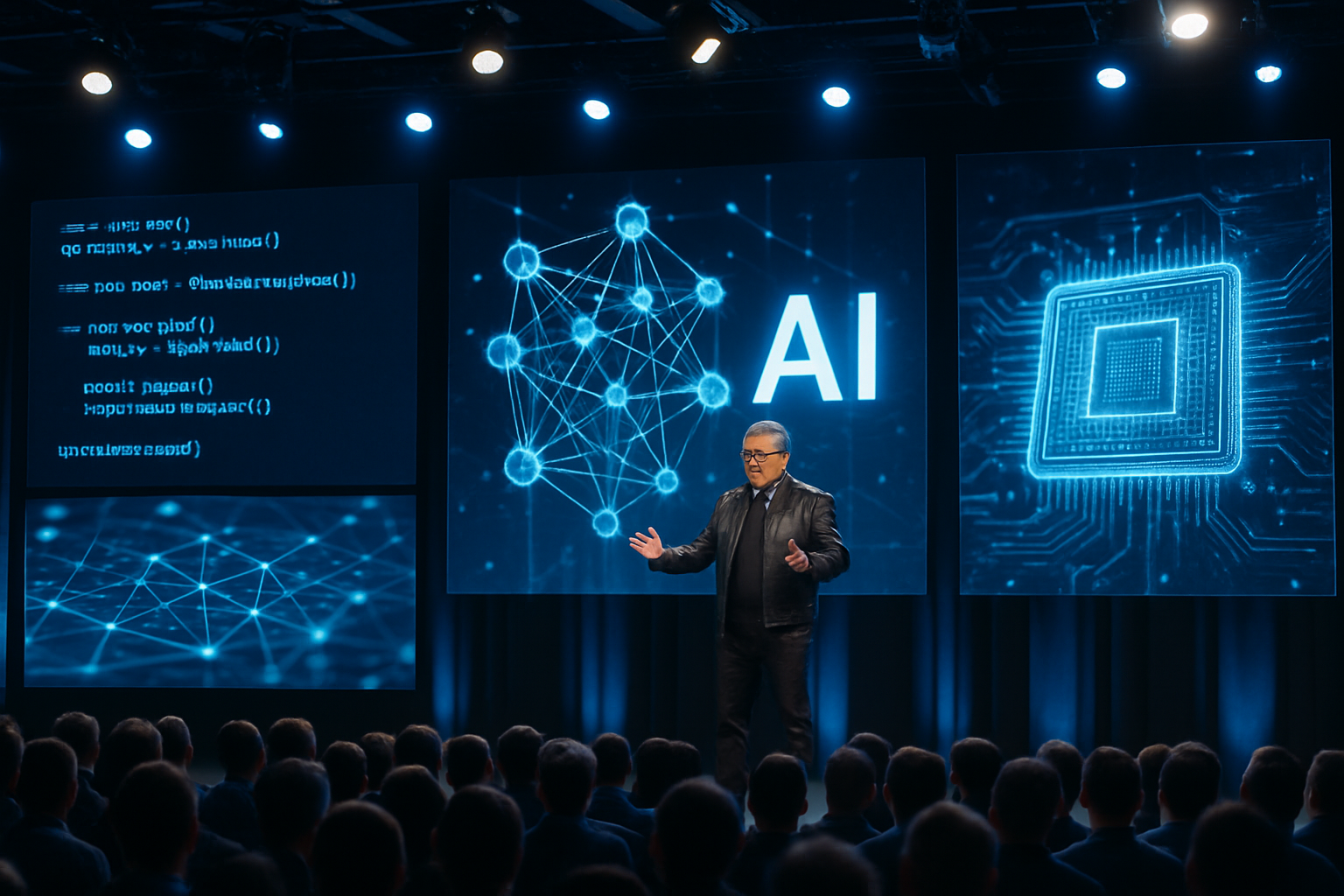
Nvidia Corporation unveiled a comprehensive suite of artificial intelligence innovations spanning graphics, computing infrastructure, and software platforms at its annual GTC developer conference in San Jose, marking a pivotal moment in the global AI industry's transition from experimental technology to essential business infrastructure.
The announcement comes as industry analysts project unprecedented growth opportunities, with Nvidia's Blackwell and Rubin chip architectures positioned to capture sales opportunities exceeding $1 trillion by 2027, according to market intelligence reports. This represents the most aggressive expansion timeline in the company's history, coinciding with what experts are calling the "March 2026 Critical Inflection Point" for artificial intelligence deployment worldwide.
Breakthrough Infrastructure Developments
The GTC 2026 conference, which opened Monday in San Jose, showcased next-generation AI solutions designed to address the growing demand for intelligent computing across multiple sectors. The timing proves particularly significant as global technology companies navigate severe infrastructure constraints, including a persistent memory semiconductor crisis that has driven chip prices up sixfold, affecting major manufacturers including Samsung, SK Hynix, and Micron.
Despite these supply chain challenges, industry investment remains robust. Alphabet has committed $185 billion to AI infrastructure development in 2026, while Amazon's AI development plans exceed $1 trillion, demonstrating unprecedented corporate confidence in AI's transformative potential.
"We're witnessing the most critical AI juncture since the boom began. The decisions made in 2026 will determine whether AI fulfills its transformative promise or requires systematic corrections."
— Industry Analysis Report, March 2026
Global Market Dynamics
The announcement occurs against a backdrop of intensifying international competition in AI development. Chinese companies have recently achieved breakthrough capabilities using restricted Nvidia Blackwell chips despite export controls, while European regulators have implemented the world's first criminal executive liability framework for technology platforms in Spain, with France conducting cybercrime raids on AI companies.
This multipolar landscape has created what analysts describe as a "civilizational choice point" determining whether AI serves democratic values and human flourishing or becomes a tool for exploitation and control. The United Nations has established an Independent Scientific Panel with 40 global experts under Secretary-General António Guterres to provide the first fully independent global AI impact assessment.
Enterprise AI Integration
The corporate sector continues experiencing what industry observers term the "SaaSpocalypse" – the systematic elimination of hundreds of billions in traditional software market capitalization as AI systems demonstrate direct replacement capabilities for conventional solutions. Microsoft's Mustafa Suleyman has predicted that AI will replace the majority of office workers within two years, with lawyers and auditors facing displacement within 18 months.
However, regional variations in implementation approaches have emerged. Indian IT giants including Infosys, Wipro, and HCL have implemented comprehensive worker transition programs rather than mass layoffs, demonstrating more thoughtful AI integration strategies that enhance rather than replace human capabilities.
Successful Human-AI Collaboration Models
Emerging success stories from the educational sector provide templates for effective AI deployment. Canada has implemented AI teaching assistants at universities while maintaining critical thinking standards. Malaysia operates the world's first AI-integrated Islamic school, combining artificial intelligence with traditional religious and academic learning. Singapore's WonderBot 2.0 has achieved remarkable success in heritage education applications.
These implementations share common characteristics: they treat AI as sophisticated amplification tools for human capabilities rather than wholesale replacements, maintain focus on preserving creativity, cultural understanding, and emotional intelligence while leveraging computational advantages.
Infrastructure and Environmental Challenges
The rapid AI expansion faces significant environmental and resource constraints. The World Bank projects that AI systems will require 4.2 to 6.6 billion cubic meters of water annually by 2027 for data center cooling – equivalent to four to six times Denmark's annual water consumption. This massive resource demand coincides with ongoing semiconductor manufacturing bottlenecks expected to persist until 2027 when new fabrication facilities come online.
These constraints have paradoxically driven innovation in memory-efficient algorithms, hybrid processing approaches, and alternative architectures that maximize AI capabilities while minimizing hardware requirements. Companies are increasingly exploring space-based AI data centers and other novel deployment strategies to overcome terrestrial limitations.
Regulatory Framework Evolution
The global regulatory landscape for AI continues evolving rapidly. Spain's implementation of criminal executive liability for technology platforms represents the most sophisticated attempt at global technology governance since internet commercialization. European Commission investigations into Digital Services Act violations threaten billions in penalties for companies using "addictive design" features.
Military applications have created additional tensions, with the Pentagon integrating ChatGPT into military systems while pressuring companies to deploy AI on classified networks without civilian safety restrictions. Anthropic faces potential "supply chain risk" designation over its refusal to allow unlimited military use of its Claude AI system for operations including violence and surveillance.
Global Economic Implications
The Amazon Web Services division anticipates that AI capabilities could double prior sales projections to $600 billion by 2036, according to exclusive reports. This projection reflects broader industry confidence in AI's capacity to generate sustained economic value across multiple sectors including healthcare, financial services, automotive manufacturing, and transportation.
The transformation extends beyond technology companies. Healthcare applications show particular promise, with AI-powered medical scribes saving emergency doctors up to 10 minutes per patient encounter – representing 20% time savings in typical emergency department workflows. Following successful trials, several countries have announced nationwide rollouts of AI medical documentation systems.
Looking Ahead: Critical Decisions
As the AI industry reaches this critical inflection point, success will depend on unprecedented coordination between governments, technology companies, educational institutions, and civil society. The challenge involves balancing innovation acceleration with responsible development, commercial interests with human welfare, and national competitiveness with international cooperation.
The most promising path forward appears to lie in sophisticated human-AI collaboration that amplifies human capabilities while preserving the creativity, cultural understanding, and emotional depth that define human potential. Technology must serve humanity's highest aspirations while addressing pressing global challenges through thoughtful governance frameworks that prioritize human flourishing.
The window for effective coordinated action continues narrowing as AI development accelerates, making the decisions and implementations of 2026 crucial for determining the trajectory of human-AI relationships for the remainder of the century.