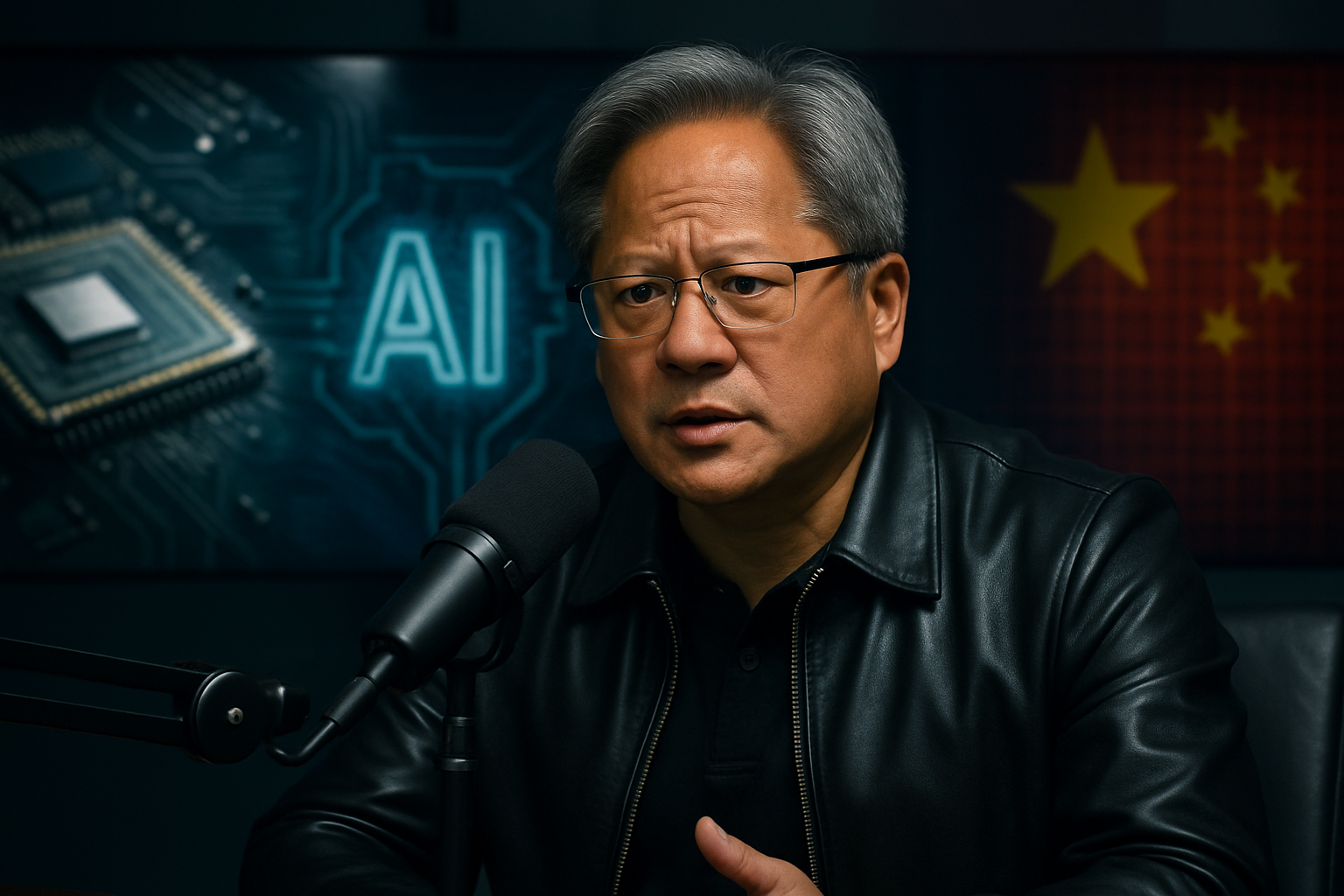
Nvidia CEO Jensen Huang delivered a stark warning about the future of artificial intelligence competition, declaring that if Chinese AI startup DeepSeek optimizes its breakthrough models on Huawei Technologies chips, it would represent "a horrible outcome" for the United States.
Speaking on the Dwarkesh Podcast this week, Huang articulated concerns that extend far beyond typical market competition, addressing fundamental questions about global technological leadership in the AI era. His comments come as DeepSeek has emerged as a formidable challenger to US-dominated AI services, achieving breakthrough capabilities that have disrupted global technology markets.
The Stakes of AI Infrastructure Competition
Huang's warning centers on a critical technological inflection point. "If future AI models are optimised in a very different way than the American tech stack," he explained, "and as AI diffuses out into the rest of the world" with Chinese standards and technology, China "will become superior to" the US in artificial intelligence capabilities.
This concern reflects more than corporate rivalry. The Nvidia CEO's comments underscore how AI infrastructure choices made today could determine technological leadership for decades. DeepSeek's recent achievements have already triggered what analysts call the "SaaSpocalypse" – a market disruption that eliminated hundreds of billions in traditional software market capitalization as investors reassess the competitive landscape.
DeepSeek's Strategic Breakthrough
DeepSeek's emergence as a technological force represents a watershed moment in AI development. The Chinese startup has demonstrated sophisticated capabilities despite US export controls, reportedly training advanced models using restricted Nvidia Blackwell chips through systematic circumvention strategies. Intelligence sources suggest these systems are clustered at an Inner Mongolia data center, highlighting China's commitment to developing indigenous AI capabilities.
The company's success has proven particularly disruptive because it challenges fundamental assumptions about American technological dominance. When DeepSeek's capabilities became public in February 2026, global markets experienced immediate volatility. Indian IT giants declined 6%, the US Nasdaq dropped 1.4% eliminating $300 billion in market capitalization, and analysts described an "apocalypse for software houses."
"This represents the first time Chinese AI models have captured global leadership positions, ending a year of US market dominance."
— Technology Industry Analysis
The Huawei Factor
Huang's specific concern about Huawei optimization reflects the Chinese company's position as a leading semiconductor manufacturer despite US sanctions. Huawei has continued developing advanced chip architectures that could provide DeepSeek with alternatives to American-designed processors, potentially creating a completely indigenous Chinese AI technology stack.
This development would represent what experts call "technological sovereignty" – the ability to develop and deploy advanced AI systems without dependence on foreign technology suppliers. For the US, such an outcome would mean losing leverage over global AI development through export controls and supply chain management.
Global Infrastructure Crisis Context
Huang's warnings come amid an unprecedented global semiconductor crisis that has driven memory chip prices to surge sixfold, affecting Samsung, SK Hynix, and Micron operations. The shortage is expected to persist until 2027 when new fabrication facilities come online, creating a critical window where access to alternative chip architectures becomes strategically valuable.
Despite these constraints, major corporations continue massive AI infrastructure investments. Alphabet has committed $185 billion for AI infrastructure in 2026 – the largest single-year corporate technology investment in history – while Amazon's AI development plans exceed $1 trillion. These investments demonstrate confidence in AI's transition from experimental technology to essential business infrastructure.
International Governance Response
The competition for AI supremacy has prompted unprecedented international coordination efforts. The United Nations has established an Independent Scientific Panel with 40 experts under António Guterres' leadership, representing the first fully independent global AI assessment body. This initiative acknowledges that AI governance requires cooperation between governments, companies, institutions, and civil society.
European responses have been particularly robust. Spain has implemented the world's first criminal executive liability framework for technology platforms, while France has conducted AI cybercrime raids on major companies. These regulatory innovations represent the most sophisticated global technology governance framework since the internet's commercialization.
Successful Human-AI Integration Models
While geopolitical competition intensifies, successful AI integration models continue emerging globally. Canadian universities have deployed AI teaching assistants that maintain critical thinking standards, while Malaysia operates the world's first AI-integrated Islamic school combining technology with traditional learning. Singapore's WonderBot 2.0 heritage education program demonstrates how AI can enhance cultural understanding rather than replace human insight.
These examples share common characteristics: they treat AI as amplification tools serving human goals rather than replacement mechanisms. They demonstrate sustained commitment to human development, stakeholder engagement, and cultural sensitivity – approaches that could inform broader AI governance frameworks.
Military and Security Implications
The Pentagon has already integrated ChatGPT into military systems serving over 800 million weekly users, highlighting how civilian AI technologies rapidly acquire defense applications. Ukrainian forces have deployed AI-enhanced drone systems with improved capabilities, while only one-third of countries have agreed to AI warfare governance frameworks. Notably, both the US and China have abstained from comprehensive commitments on autonomous weapons systems.
This military dimension adds urgency to Huang's concerns. If China develops a completely independent AI technology stack optimized on Huawei chips, it could create parallel defense capabilities that operate outside Western influence or oversight.
The Civilizational Choice Point
Technology experts characterize this moment as a "civilizational choice point" where decisions about AI development will determine whether artificial intelligence serves human flourishing or becomes a tool for surveillance and control. The window for coordinated international action is narrowing as AI capabilities advance faster than governance frameworks can adapt.
Success requires unprecedented coordination balancing innovation acceleration with safety governance, commercial interests with human welfare, and national competitiveness with international cooperation. The challenge is ensuring that AI serves humanity's highest aspirations through democratic governance and human-centered values during this experimental-to-essential infrastructure transition.
Looking Forward
Jensen Huang's warning represents more than corporate competition concerns – it highlights fundamental questions about technological sovereignty, democratic governance, and international cooperation in the AI era. As DeepSeek and other Chinese AI companies continue advancing, the global technology community faces critical decisions about how to balance competition with collaboration.
The most promising path forward involves sophisticated human-AI collaboration that amplifies capabilities while preserving the creativity, cultural understanding, and ethical reasoning that define human potential. Organizations and nations that treat AI as amplification tools serving human goals, rather than replacement mechanisms, consistently demonstrate superior outcomes.
As 2026 continues, the decisions made about AI infrastructure, international cooperation, and regulatory frameworks will establish human-AI relationship patterns for the remainder of the century. The stakes extend far beyond market share – they encompass the fundamental question of whether artificial intelligence will serve democratic values and human flourishing or create new forms of technological dependence and control.