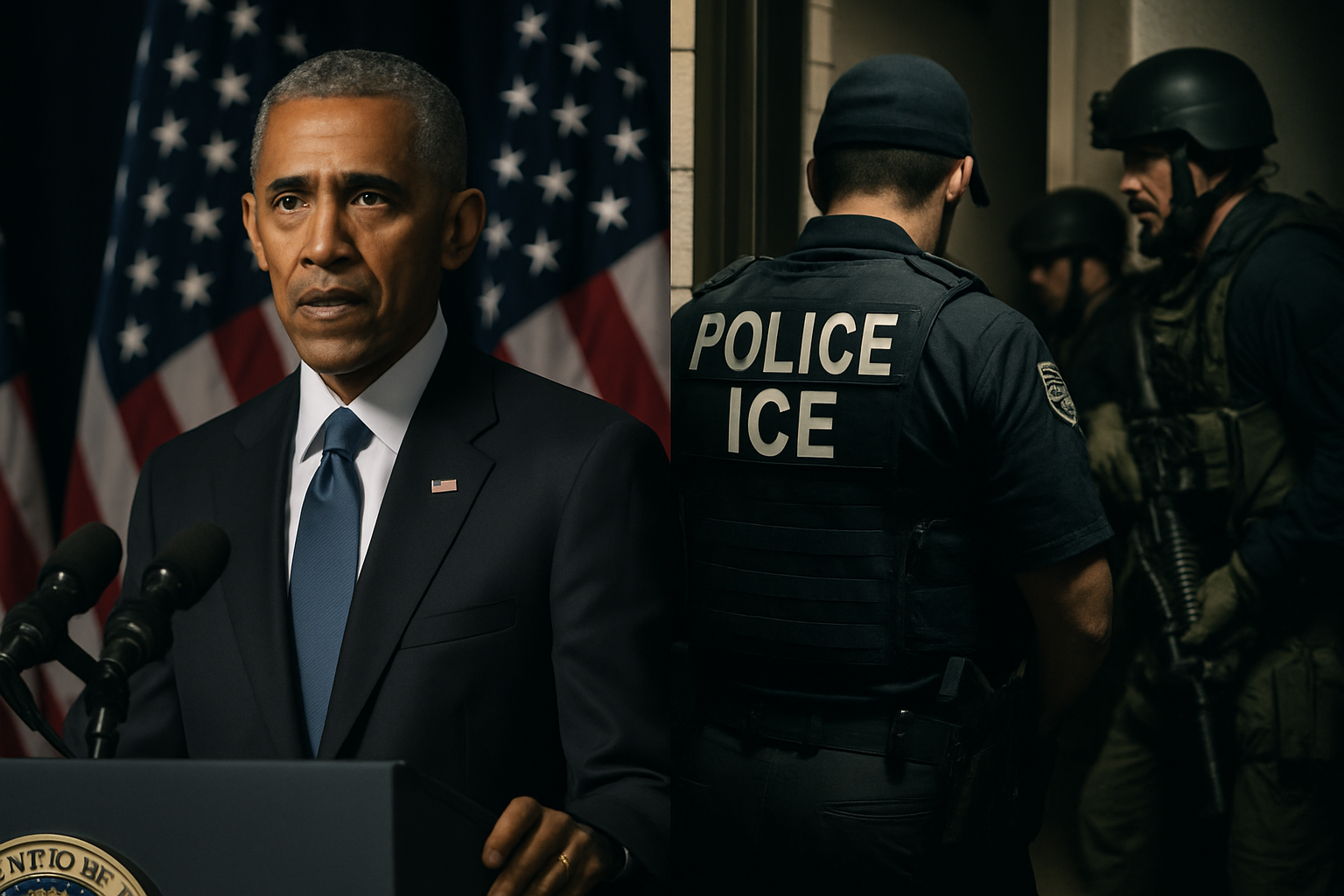
Former President Barack Obama delivered his strongest condemnation yet of President Donald Trump's immigration enforcement policies, comparing federal agents' conduct to behavior seen "in dictatorships" while addressing for the first time a racist video that depicted him and his wife Michelle as monkeys.
In a wide-ranging podcast interview with liberal commentator Brian Tyler Cohen released Saturday, Obama characterized the current political climate as a "brazen clown show" and lamented the loss of "shame" and "decorum" that once guided American public officials. The rare public intervention comes as Trump's aggressive immigration enforcement has sparked unprecedented opposition and international criticism.
Obama's First Response to Racist Video
The former president's comments mark his first public response to a racist video shared on Trump's Truth Social account February 5 that depicted Obama and Michelle Obama as apes set to "The Lion Sleeps Tonight." The clip, which remained online for 18 hours before deletion, was embedded within a larger video promoting unfounded claims about voter fraud in the 2020 election.
"The shame and decorum that once guided public officials is now lost. A majority of Americans find this behavior deeply troubling."
— Barack Obama, Former U.S. President
The White House initially defended the video, calling criticism "fake outrage" over an "internet meme," before later claiming a staff member had "erroneously" posted the content. Trump himself told reporters he "didn't watch it completely" but later declared he "didn't make a mistake" and refused to apologize.
Immigration Enforcement Compared to Dictatorships
Obama's harshest criticism targeted the conduct of Immigration and Customs Enforcement (ICE) agents in Minnesota, where federal operations have resulted in over 4,000 arrests since December 2025. The former president condemned what he called "rogue behavior" of federal agents, drawing explicit comparisons to authoritarian regimes.
The criticism comes in the wake of fatal shootings of two U.S. citizens, Alex Pretti and Renee Nicole Good, by ICE agents in Minneapolis in January 2026. The deaths sparked nationwide protests, a three-day government shutdown, and unprecedented calls for federal law enforcement accountability.

Unprecedented Scale of Immigration Enforcement
A University of California study reveals deportations from the U.S. interior have quadrupled during the first nine months of Trump's second administration compared to pre-Trump levels. The aggressive enforcement has extended beyond traditional workplace raids to include public spaces, community gatherings, and major events like the Super Bowl.
Guatemala's Institute of Migration reports that 5,094 Guatemalan nationals were returned in January 2026 alone, with an average age of 24 and many having developed technical skills during 3+ years abroad. Mexico's consulate has issued warnings to nationals about ICE operations during public events, highlighting the climate of fear in immigrant communities.
Political Crisis and Accountability Measures
The Minneapolis shootings triggered the most serious political crisis over immigration enforcement in decades. Congressional Democrats threatened to block Department of Homeland Security funding unless "drastic changes" were implemented, ultimately forcing the administration to make tactical adjustments.
DHS Secretary Kristi Noem implemented mandatory body cameras for ICE agents in Minneapolis effective February 2, while Border Czar Tom Homan withdrew 700 federal agents from Minnesota, reducing deployment from approximately 2,700-3,000 to 2,000 agents. Homan characterized the move as "smarter law enforcement, not less law enforcement."
International Condemnation and Domestic Opposition
The immigration crackdown has drawn extensive international media coverage across Europe, Asia, and the Americas, with many outlets highlighting tensions in the U.S. immigration system. Civil rights organizations have filed lawsuits challenging visa suspensions affecting 75 countries, while federal judges in multiple jurisdictions have begun requiring ICE warrants before arrests unless there's an escape risk.
Polling by NPR/PBS/Marist shows two-thirds of Americans believe ICE has "gone too far" in immigration enforcement, marking a significant shift in public opinion. The opposition has been particularly strong among Democrats and independents, while Republicans maintain support for the administration's policies.
Broader Pattern of Controversy
The racist video controversy represents the latest in a pattern of inflammatory content from the Trump administration. The clip, which originated from an October 2025 social media post and appeared to be AI-generated or manipulated, drew bipartisan condemnation including from Republican Senator Tim Scott, who called it "unacceptable and deeply offensive."
"This transforms American politics into a clown show. Most Americans want better leadership than this."
— Barack Obama, on current political discourse
The NAACP characterized the video as a "deliberate attempt to dehumanize and demean not just the Obamas, but all Black Americans," emphasizing the historical significance of racist imagery targeting the first Black president and First Lady.
Economic and Social Impact
The intensified enforcement has created widespread disruption across multiple sectors. Major corporations including Target have faced employee pressure over ICE workplace protocols, while immigrant families are avoiding essential services out of fear. The agriculture, hospitality, and healthcare sectors have reported significant workforce disruptions.
In Minneapolis, the Mexican family interviewed by international media described feeling "trapped behind deadbolt" during deportation raids, while Native American communities report racial profiling and wrongful detentions despite their indigenous status, leading to the establishment of safe zones and tribal ID protection measures.
Federal Court Challenges
Federal Judge Ana Reyes blocked the Trump administration's attempt to terminate Temporary Protected Status for approximately 350,000 Haitians, ruling the decision was motivated by discriminatory considerations. The judge cited a pattern of disparaging remarks by Trump about Haitians as evidence of discriminatory animus rather than legitimate policy concerns.
Meanwhile, an Oregon federal judge now requires ICE warrants before arrests unless there's an escape risk, following the broader pattern of judicial pushback against enforcement tactics. The legal challenges have created a complex patchwork of varying enforcement authorities across different jurisdictions.
Political Calculations
Obama's decision to break his traditional post-presidency restraint reflects what many observers see as a calculation that the racist imagery and immigration enforcement tactics crossed lines requiring direct confrontation. The former president has generally avoided direct criticism of his successor, but the combination of personal attacks and policy concerns appears to have prompted this unusual intervention.
The timing is significant as Trump faces pressure on multiple fronts, including congressional opposition to his trade policies, international criticism of his approach to allies, and growing domestic concern about immigration enforcement methods. House Speaker Mike Johnson has scheduled two weeks of ICE reform debates following the resolution of the government shutdown.
Long-term Implications
Obama's characterization of the current situation as a "clown show" reflects deep concern about the health of American democratic institutions. Political historians note this represents the most explicit racist attack by a sitting president against a former president in modern American history, crossing traditional party lines and violating widely accepted standards of presidential behavior.
The immigration enforcement crisis has established new precedents for federal law enforcement accountability, including body camera requirements and judicial oversight mechanisms that may extend to other cities. However, the administration maintains that its overall enforcement strategy remains unchanged despite tactical adjustments in Minnesota.
As the controversy continues to unfold, it raises fundamental questions about American democracy's ability to maintain institutional norms while addressing unprecedented challenges to traditional standards of political discourse and law enforcement accountability.