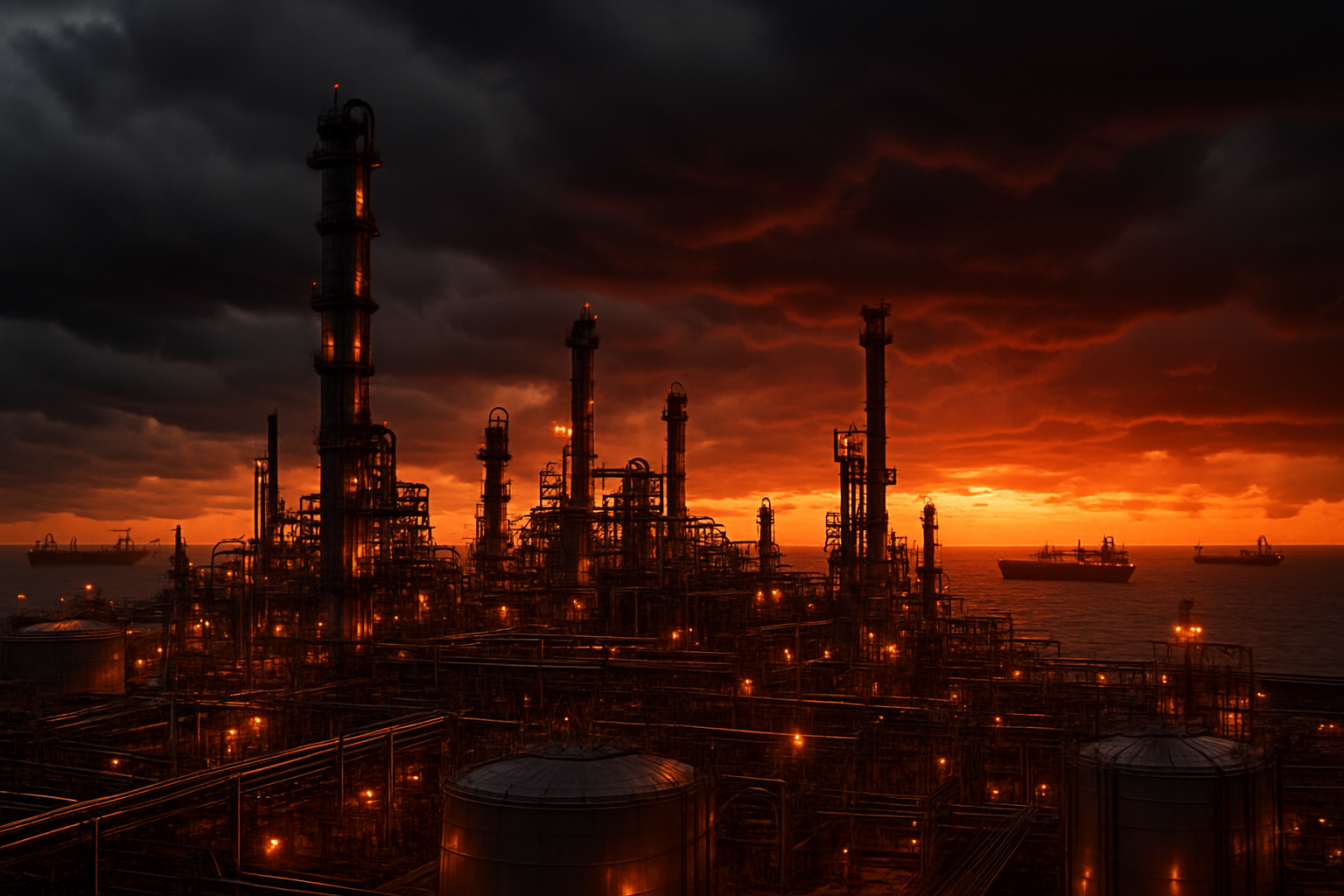
Oil prices have surged past $80 per barrel in the most severe global energy crisis in decades, triggered by Iran's Revolutionary Guard declaring the Strait of Hormuz "unsafe" and effectively closing the world's most critical oil chokepoint that handles 40% of global seaborne oil transit.
The dramatic escalation follows the complete breakdown of nuclear diplomacy between the United States and Iran, despite achieving a Geneva framework breakthrough described as "broad agreement on guiding principles" - the most significant diplomatic progress since the JCPOA collapse in 2018. The failure to bridge fundamental scope disagreements has now plunged global energy markets into unprecedented volatility.
Energy Markets in Turmoil
Brent crude has jumped 10% from $73 to over $80 per barrel, while WTI futures have reached $89.09 - levels not seen since 2023. The crisis deepened as natural gas prices exploded by 24% in Europe and a staggering 78% in the United States, with European gas prices rocketing to €47.32/MWh, the highest since February 2025.
Qatar, a critical supplier of liquefied natural gas representing approximately 20% of global LNG exports, has halted production at its Ras Laffan and Mesaid facilities following Iranian attacks on its infrastructure. Industry sources expect a force majeure declaration imminently, further constraining global gas supplies.
"This is the most severe energy security crisis in decades, exposing our over-dependence on strategic chokepoints with limited alternatives," warns Samuel Ciszuk, energy analyst.
— Samuel Ciszuk, Energy Security Expert
Shipping Industry Paralyzed
Major shipping companies Maersk and MSC have suspended all Persian Gulf operations, leaving more than 150 oil and LNG tankers stranded in the Persian Gulf representing billions of dollars in cargo value. The 21-mile-wide Strait of Hormuz has proven to be geographically irreplaceable, with alternative Arabian Peninsula routes offering inadequate capacity and significantly longer transit times at higher costs.
OPEC+ announced an emergency production increase of 206,000 barrels per day for April, but analysts confirm this is insufficient to offset the shipping disruption. As one industry executive noted, "Increased production is meaningless if tankers cannot transit safely."
Global Consumer Impact
The energy crisis is already hitting consumers worldwide with immediate price increases:
- Sweden: Electricity prices expected to rise 10-20 öre, gasoline up 1-2 kronor per liter, with southern Sweden's Malmö zone 4 most exposed due to continental European market integration
- Austria: Fuel costs have surged 20%, drawing criticism from trade unions over profiteering
- Ireland: Deputies have slammed "brazen rip-offs" with massive heating oil and motor fuel price hikes
- New Zealand: Petrol prices expected to exceed $3 per liter
- Romania: Experts warn that current fuel price increases don't yet fully reflect international oil market spikes, with more severe impacts expected in coming weeks
Romanian energy expert Dumitru Chisăliță warned that "diesel reaches pumps weeks after purchase, and Romania could see the effects of global market spikes in the coming period."
Aviation Crisis Compounds Problems
The energy crisis has been compounded by an unprecedented aviation emergency, with over 18,000 flights cancelled worldwide - the most extensive disruption since COVID-19. Eight Middle Eastern countries have simultaneously closed their airspace: Iran, Iraq, Israel, UAE, Qatar, Syria, Kuwait, and Bahrain.
Dubai International Airport, the world's busiest with over 86 million passengers annually, remains completely shut down due to missile damage. Major carriers including Emirates, Air France-KLM, Wizz Air, and Bulgaria Air have suspended operations indefinitely, affecting hundreds of thousands of passengers globally.
Financial Markets Crash
Global financial markets have experienced severe disruption, with Pakistan's KSE-100 crashing 8.97% in the largest single-day decline in the exchange's history. South Korea's KOSPI plunged 12% with circuit breakers activated, while the Korean won hit a 17-year low as investors fled AI and memory chip positions.
PayPal postponed its $1.1 billion IPO indefinitely due to market volatility, while technology companies are reassessing international expansion plans. Central banks, led by the ECB and Bank of Japan, are coordinating emergency liquidity provisions to prevent broader financial contagion.
Supply Chain Vulnerabilities Exposed
The crisis has exposed critical vulnerabilities in global supply chains that extend far beyond energy. The Persian Gulf serves as a critical trade hub affecting everything from consumer goods to industrial materials worldwide. China has suspended refined fuel export contracts, cancelling committed shipments and further tightening global supplies.
Manufacturing sectors dependent on Gulf networks - including automotive, electronics, and textiles - are experiencing severe disruptions. Singapore retailers are warning of 30% increases in logistics costs for some goods.
Diplomatic Breakdown Context
The current crisis stems from the complete collapse of US-Iran nuclear diplomacy, despite what had appeared to be the most promising engagement in years. The Geneva talks had achieved what Iranian Foreign Minister Abbas Araghchi called "broad agreement on guiding principles" with Switzerland-Oman mediation.
However, fundamental scope disagreements proved insurmountable. Iran excluded ballistic missiles and regional proxies as "red lines," demanding nuclear-only talks, while US Secretary Marco Rubio insisted on comprehensive agreements addressing missiles, armed groups, and human rights.
This led to Operation Epic Fury, described as the largest US-Israeli coordinated operation since 2003, triggering massive Iranian retaliation under Operation True Promise 4, with Iran's Revolutionary Guard declaring "no red lines remain."
Regional Coalition Under Strain
An unprecedented regional coalition of Saudi Arabia, UAE, Qatar, and Egypt that had backed the diplomatic process is now severely strained as Iranian retaliation has targeted member territories. The UAE reported one civilian killed in Abu Dhabi, Kuwait reported 32 foreign nationals injured in airport strikes, and Qatar reported eight injured despite intercepting 65 missiles and 12 drones with Patriot systems.
Egyptian President Sisi condemned attacks on "sisterly countries," warning of "comprehensive chaos" in the region.
Government Emergency Responses
Governments worldwide are implementing emergency measures:
- Japan: Considering national oil stockpile deployment for the first time since the 2011 Fukushima disaster, despite Japan's reliance on the Middle East for 95% of oil supplies
- European Union: Rapidly developing emergency options including state aid for energy-intensive industries
- Cyprus: Activated the ESTIA national evacuation plan for the first time
- Multiple Nations: Coordinating the largest evacuation since the Arab Spring 2011, with Australia reporting 115,000 nationals trapped and Germany 30,000 stranded
Nuclear Governance Crisis Context
The crisis unfolds against a broader nuclear governance crisis. The New START treaty expired on February 5, marking the first time in over 50 years without US-Russia nuclear constraints. Combined with China's nuclear expansion and Iran's continued uranium enrichment at 60% purity approaching weapons-grade levels, UN Secretary-General Guterres warns nuclear risks are at their "highest in decades."
Recovery Timeline Uncertain
Unlike weather or technical disruptions, recovery depends entirely on military operations resolution and diplomatic normalization. Aviation industries cannot engage in long-term scheduling with multiple airspaces closed, while energy markets remain volatile with critical transit routes blocked.
Traditional monetary policy tools show limited effectiveness against structural geopolitical disruptions affecting infrastructure and international relationships rather than market sentiment alone.
Long-term Implications
March 2026 represents a watershed moment for global energy security, exposing strategic chokepoint vulnerabilities and interconnected supply chain fragility. The crisis highlights the urgent need for fundamental energy architecture restructuring to reduce dependence on volatile geopolitical regions.
Success in containing the escalation could provide a framework for future nuclear crisis resolution and strengthen diplomatic precedents. However, failure may accelerate military solutions, reshape Middle Eastern geopolitics for decades, encourage nuclear proliferation globally, and undermine diplomatic credibility worldwide.
This crisis serves as the greatest test of multilateral cooperation and crisis management in the modern era, with implications extending far beyond current events to influence international approaches to conflict resolution, energy markets evolution, and diplomatic precedents for the 21st century.
"This situation is going longer than people initially thought. The financial markets are the ultimate constraint on prolonged conflict," observes portfolio strategist Damien Boey.
— Damien Boey, Portfolio Strategist
As the crisis enters its second week, the international community faces critical decisions balancing immediate supply needs against long-term energy security architecture that could fundamentally reshape global energy markets and international relations for generations to come.