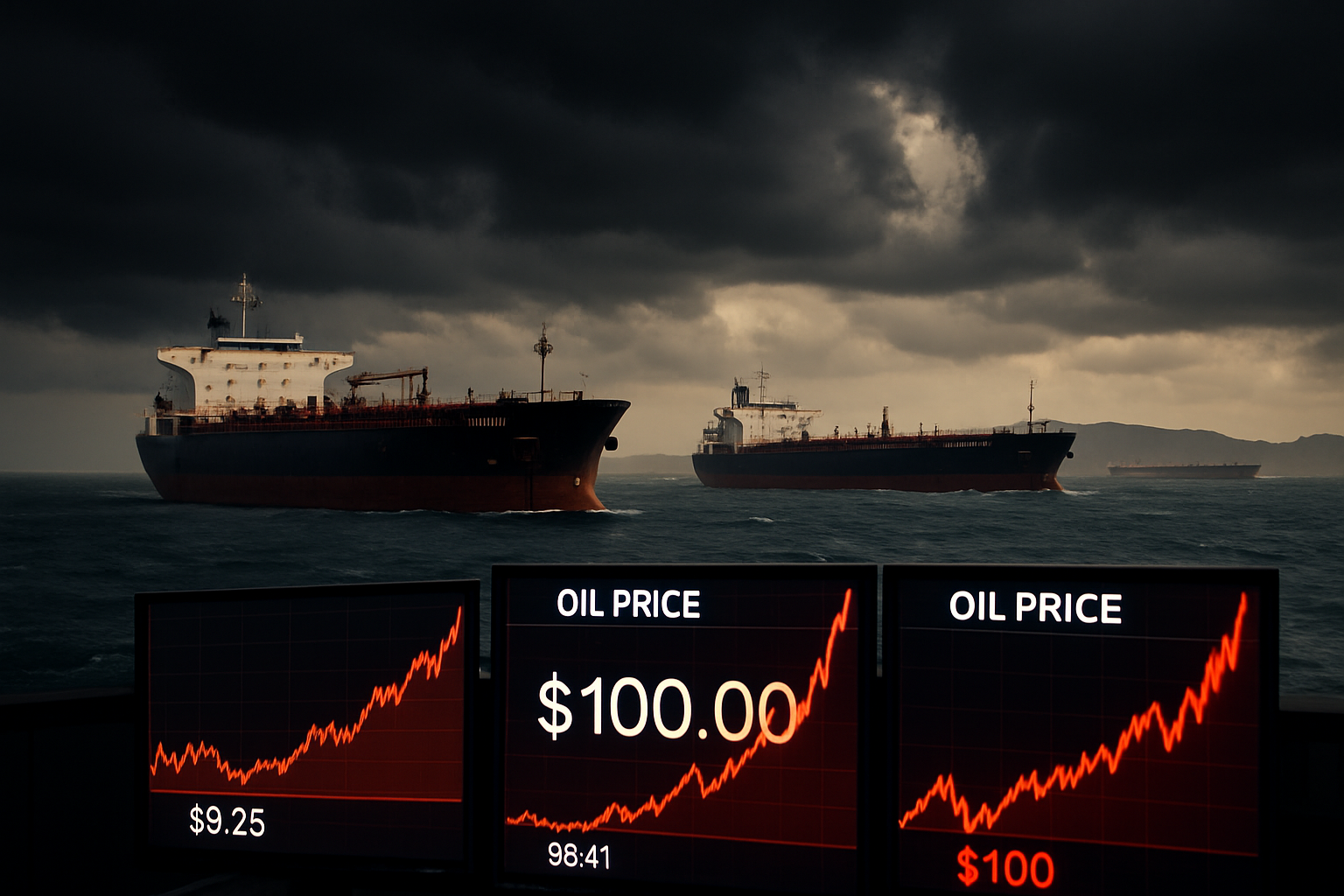
Oil prices are surging toward the critical $100 per barrel threshold as escalating Middle East conflict creates the most severe global energy crisis in decades, with Iran's effective closure of the Strait of Hormuz disrupting 40% of worldwide oil transit and triggering unprecedented market volatility across multiple sectors.
Brent crude has already breached $91 per barrel—the highest level since April 2024—representing a dramatic 10% surge from the $73 baseline, while WTI crude futures jumped 9.96% to $89.09 per barrel. The price acceleration reflects mounting concerns over supply disruptions as Iran's Revolutionary Guard declared the strategic Strait of Hormuz waterway "unsafe," effectively blocking the world's most critical oil chokepoint.
Strait of Hormuz Closure Creates Supply Shock
The 21-mile-wide Strait of Hormuz, through which approximately 40% of global seaborne oil transits daily, has become the epicenter of a geopolitical crisis with far-reaching economic implications. Major shipping companies including Maersk and MSC have suspended all Persian Gulf operations, leaving more than 150 oil and LNG tankers stranded in the region, representing billions of dollars in cargo value.
"The situation is going longer than people thought initially," said Damien Boey, Portfolio Strategist, reflecting the market's growing concern about extended supply disruptions. Energy analyst Samuel Ciszuk described the current scenario as "the most severe energy security crisis in decades, with single-chokepoint vulnerabilities now fully exposed."
"Modern conflict no longer needs to destroy oil supply to destabilize the global economy — it only needs to inject doubt into the arteries of trade."
— Analysis from Philippine Economic Observers
The crisis stems from ongoing military operations following the complete breakdown of nuclear diplomacy despite recent Geneva talks achieving what was described as "broad agreement on guiding principles"—the most progress since the JCPOA collapse in 2018. However, fundamental disagreements over the scope of any potential agreement proved insurmountable, with Iran excluding ballistic missiles and regional proxies as "red lines" while the US demanded comprehensive coverage including missiles, armed groups, and human rights issues.
Natural Gas Markets in Turmoil
The energy crisis extends beyond crude oil, with natural gas prices experiencing explosive growth: 24% increases in Europe and a staggering 78% surge in the United States. European gas prices have rocketed 50% to €47.32 per megawatt-hour, reaching levels not seen since February 2025.
Qatar, which supplies approximately 20% of global LNG exports, has halted production at its massive Ras Laffan and Mesaid facilities following infrastructure attacks. Industry sources expect a force majeure declaration, which would formally release Qatar from contractual obligations due to extraordinary circumstances, further constraining global gas supplies.
Global Aviation Paralyzed
The crisis has created an unprecedented aviation emergency, with over 18,000 flights cancelled worldwide—the most extensive disruption since the COVID-19 pandemic. Eight Middle Eastern countries have simultaneously closed their airspace: Iran, Iraq, Israel, UAE, Qatar, Syria, Kuwait, and Bahrain.
Dubai International Airport, the world's busiest with over 86 million passengers annually, remains completely shut down due to missile damage. Major carriers including Emirates, Air France-KLM, Wizz Air, and Bulgaria Air have suspended operations indefinitely, stranding hundreds of thousands of passengers globally and severing critical Europe-Asia connections.
Stock Markets in Freefall
Financial markets are experiencing severe disruption as investors flee risk assets. Pakistan's KSE-100 crashed 8.97% in the largest single-day decline in the exchange's history. South Korea's KOSPI plunged 12%, triggering circuit breakers, while the Korean won hit a 17-year low as foreign capital fled AI and memory chip positions.
European markets are experiencing significant losses, with Germany's DAX continuing steep declines, Italy's Milan exchange down 4%, and the pan-European STOXX 600 falling 1.3%. US Dow futures dropped 400-570 points as investors sought safe-haven assets.
Corporate casualties include PayPal's postponement of its $1.1 billion IPO due to market volatility, while technology companies are delaying major announcements and reassessing international expansion plans.
Consumer Impact Across the Globe
The energy crisis is rapidly translating into higher costs for consumers worldwide. Sweden is predicting electricity price increases of 10-20 öre and gasoline price rises of 1-2 kronor, with the southern Malmö zone 4 most exposed due to continental European market integration.
Other nations face similar pressures: Austria is experiencing 20% fuel cost increases prompting trade union criticism, Ireland is witnessing what officials call "brazen rip-offs" in heating oil and motor fuel prices, and New Zealand expects petrol prices to exceed $3 per liter. China has suspended refined fuel export contracts, cancelling committed shipments and further tightening global supplies.
OPEC Response Proves Insufficient
The Organization of Petroleum Exporting Countries has announced an emergency production increase of 206,000 barrels per day for April, but analysts confirm this measure is inadequate to offset the shipping disruption in the Strait of Hormuz. The fundamental challenge is that increased production becomes meaningless if tankers cannot transit safely through the world's most critical oil chokepoint.
Alternative routes around the Arabian Peninsula offer inadequate capacity and would require significantly longer transit times with substantial cost penalties, making them insufficient substitutes for the blocked Strait.
Regional Diplomatic Coalition Under Strain
The crisis has severely tested an unprecedented regional diplomatic coalition that included Saudi Arabia, UAE, Qatar, and Egypt supporting peaceful resolution. This remarkable Middle Eastern consensus has come under strain as retaliatory attacks have targeted member territories.
The UAE has reported one civilian killed in Abu Dhabi from missile debris, while Kuwait International Airport suffered drone strikes injuring 32 foreign nationals. Qatar intercepted 65 missiles and 12 drones using Patriot defense systems, with 8 people injured from fragments. Egyptian President Abdel Fattah el-Sisi condemned attacks on "sisterly Arab countries," warning of "comprehensive chaos."
Mass International Evacuations
The deteriorating security situation has triggered the largest coordinated international evacuation since the Arab Spring in 2011. Australia has 115,000 nationals trapped in the region, while Germany reports 30,000 tourists stranded. The European Union has activated Cyprus's ESTIA evacuation plan for the first time, with multiple embassy evacuations occurring across 15 Middle Eastern countries.
Nuclear Governance Context
The energy crisis unfolds against a broader backdrop of nuclear governance breakdown. The New START treaty expired on February 5—marking the first time in over 50 years without US-Russia nuclear constraints. Combined with China's nuclear expansion and what UN Secretary-General António Guterres describes as nuclear risks at their "highest level in decades," the current crisis represents a template-setting moment for 21st-century diplomacy versus military confrontation.
Long-term Implications for Energy Security
The crisis has exposed fundamental vulnerabilities in global energy architecture, highlighting dangerous over-dependence on strategic chokepoints with limited alternatives. The 21-mile-wide Strait of Hormuz demonstrates how a single geographical bottleneck can create worldwide economic disruption, affecting everything from manufacturing supply chains to household energy costs.
Unlike weather-related disruptions, recovery timelines remain uncertain as they depend on military operations resolution and diplomatic normalization. Traditional monetary policy tools have limited effectiveness against structural geopolitical disruptions, forcing central banks like the ECB and Bank of Japan to coordinate emergency liquidity provision to prevent broader financial contagion.
Looking Ahead: Template-Setting Crisis
This crisis represents the most dangerous international situation since the end of the Cold War, testing regional war prevention, global energy security, nuclear governance credibility, and international law enforcement mechanisms simultaneously. Success in containing the escalation could provide a framework for future nuclear crisis resolution and strengthen diplomatic precedents.
However, failure may accelerate military solutions over diplomatic engagement globally, reshape Middle Eastern geopolitics for decades, encourage nuclear proliferation elsewhere, and undermine diplomatic credibility worldwide, affecting 21st-century approaches to conflict resolution.
The crisis has fundamentally exposed the need for energy architecture restructuring to reduce dependence on volatile geopolitical regions. While strategic petroleum reserves provide temporary buffers, long-term energy security requires supply diversification—transitions that typically require years or decades to implement effectively.
As oil prices approach the psychologically critical $100 per barrel mark, the world watches a crisis that extends far beyond energy markets, touching aviation networks, supply chains, financial stability, and the fundamental principles governing international order established after World War II. The coming phase will determine whether this becomes a contained regional confrontation or evolves into a broader Middle Eastern conflict with worldwide implications extending decades beyond the current crisis.