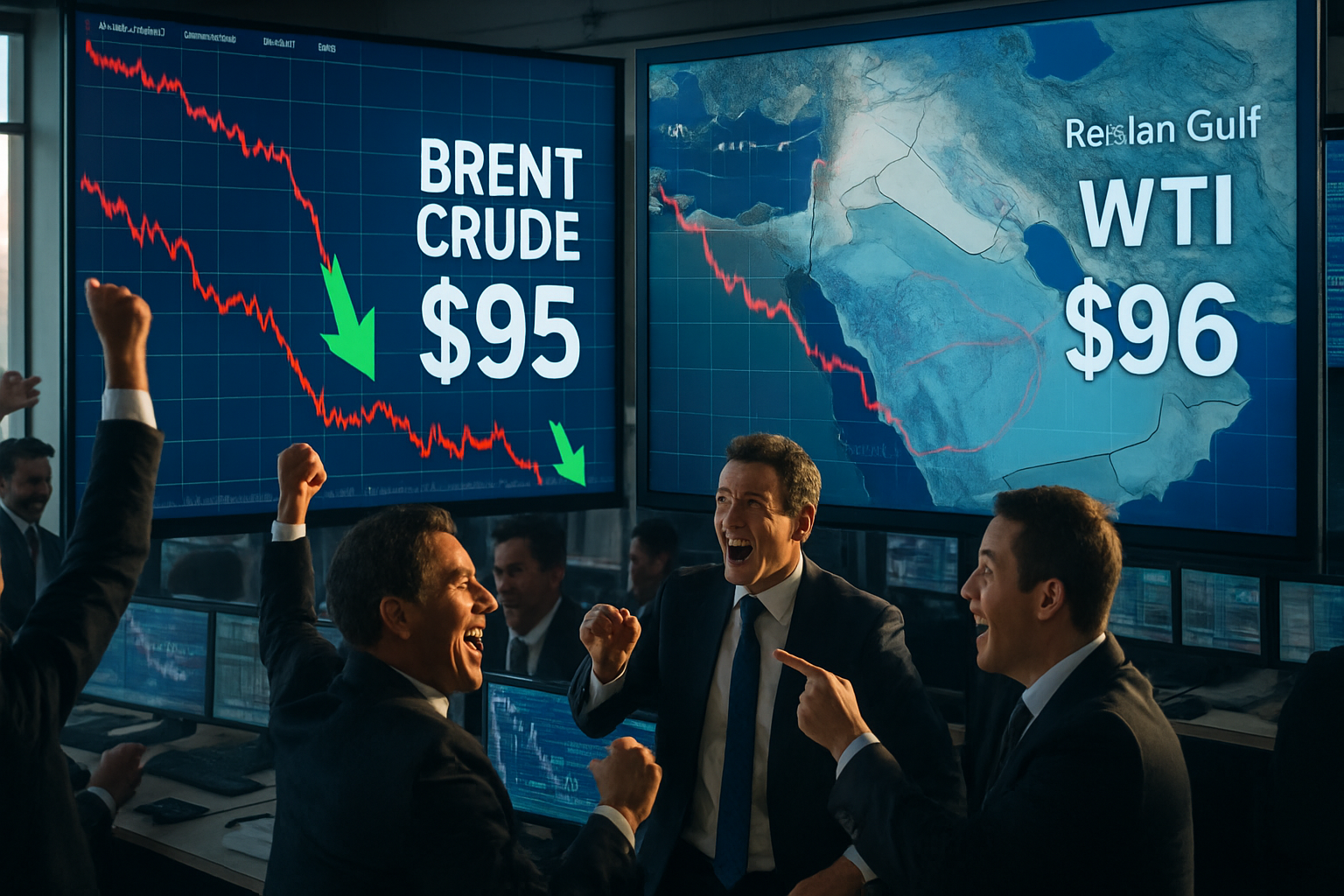
Global oil prices crashed nearly 20% overnight in the steepest decline in six years following a breakthrough US-Iran ceasefire agreement that ended the world's most dangerous energy crisis since the 1970s oil shocks, with Brent crude plummeting from its March peak of $119.50 to below $95 per barrel.
The historic diplomatic breakthrough came just 88 minutes before President Trump's "whole civilization will die tonight" deadline, as Pakistan successfully mediated an "Islamabad Accord" that secured Iran's agreement to reopen the critical Strait of Hormuz shipping lane. The 21-mile waterway, which handles 40% of global seaborne oil transit, had been effectively closed since March when Iran's Revolutionary Guard declared it "unsafe for shipping" during the military escalation.
Market Response: Fastest Oil Price Drop Since 2020
Energy markets erupted in relief as news of the ceasefire broke, with West Texas Intermediate (WTI) crude falling 18.7% to $96.27 per barrel from its record single-day high of $108.15. Asian stock markets posted explosive rallies, while airlines immediately began planning the resumption of Middle East routes that had been suspended during the six-week crisis.
The International Energy Agency (IEA) announced it would scale back its record-breaking 400 million barrel strategic petroleum reserve release - the largest deployment in the agency's 50-year history. The coordinated release from 32 countries had been more than double the response to the 2022 Ukraine crisis, highlighting the unprecedented severity of the March energy emergency.
"This represents the most dramatic reversal in global energy markets in modern history," said Samuel Ciszuk, senior energy analyst at Energy Aspects. "The speed of the price decline reflects just how severe the supply disruption had become and how fragile our energy security architecture really is."
— Samuel Ciszuk, Energy Aspects
Pakistan's Diplomatic Triumph
The breakthrough came through innovative Pakistani mediation, with Prime Minister Shehbaz Sharif and Army Chief Field Marshal Asim Munir orchestrating round-the-clock contact between Vice President JD Vance and Iranian officials. Iran's 10-point proposal was accepted as a "workable basis for negotiations" by the Trump administration, marking the most direct US-Iran engagement in decades.
Iranian Foreign Minister Abbas Araghchi confirmed the agreement would ensure "safe passage" through the Strait of Hormuz during the two-week ceasefire period, coordinated with Iranian armed forces. The first ships are expected to transit the waterway within 48 hours, though vessel owners remain cautious about potential stranding if negotiations fail.
China and Germany immediately voiced "full support" for the framework, while scheduled talks in Islamabad on Friday April 10 may include participation from Vice President Vance, senior adviser Jared Kushner, and Iranian negotiators.
End of Aviation Crisis
The aviation industry, which had suffered the cancellation of over 18,000 flights worldwide - the most extensive disruption since COVID-19 - began immediate recovery operations. Dubai International Airport, the world's busiest with 86 million annual passengers, announced preparations for reopening after being shut down by missile damage during the conflict.
Major carriers including Emirates, Air France-KLM, and Wizz Air, which had suspended operations indefinitely, are now planning rapid restoration of services. Jet fuel costs, which had surged 122% from $85-90 to $150-200 per barrel, began declining immediately as supply chains prepare for normalization.
Energy Infrastructure Recovery
Qatar announced the resumption of LNG production at its Ras Laffan and Mesaid facilities, which represent approximately 20% of global exports and had been halted due to Iranian attacks. Natural gas prices, which had exploded 24% in Europe and 78% in the US during the crisis, began retreating from their peaks.
Major shipping companies Maersk and MSC are preparing to mobilize the 150+ oil and LNG tankers that had been stranded in the Persian Gulf with billions of dollars in cargo. However, industry analysts warn that full normalization of supply chains could take months rather than weeks, given the complexity of restarting global energy logistics.
Consumer Relief Worldwide
Governments across the globe began reviewing emergency measures implemented during the crisis. Bangladesh announced it would reassess fuel rationing affecting 170 million people, while Pakistan is considering reversing wartime austerity measures that had included four-day work weeks as fuel prices hit Rs321.17 per liter.
European households are expected to see relief from the dramatic cost increases that had pushed gasoline prices up 1-2 kronor in Sweden and heating oil to €2 per liter in Ireland. The crisis had particularly impacted Malmö and other areas exposed to continental energy integration, where electricity costs had risen 10-20 öre.
Template for 21st Century Diplomacy
UN Secretary-General António Guterres, who had called the crisis "the greatest test of multilateral cooperation in the modern era," praised the diplomatic breakthrough as demonstrating that innovative mediation can succeed even in the "darkest hours" of international relations.
The success provides a potential template for 21st-century crisis resolution when traditional mechanisms fail. Pakistan's middle-power mediation demonstrates how smaller nations can bridge major adversaries during maximum-stakes confrontations involving energy security, nuclear governance, and international law enforcement.
"This diplomatic innovation when military confrontation seemed inevitable provides a framework for future crisis management in our increasingly volatile and interconnected world," said international relations expert Dr. Maria Santos at the Geneva Graduate Institute.
— Dr. Maria Santos, Geneva Graduate Institute
Regional Coalition Preserved
The unprecedented Saudi-UAE-Qatar-Egypt coalition supporting diplomatic processes survived despite severe strain from Iranian attacks on member territories. The UAE suffered one civilian death in Abu Dhabi, Kuwait reported 32 injuries from airport strikes, and Qatar had eight wounded while intercepting missiles and drones with Patriot systems.
Egyptian President Abdel Fattah el-Sisi, who had warned of "comprehensive chaos" if the crisis continued, welcomed the breakthrough as preventing broader regional war with potentially catastrophic global consequences.
Nuclear Diplomacy Window Opens
While the immediate crisis emerged from the complete collapse of US-Iran nuclear talks despite achieving "broad agreement on guiding principles" in Geneva, the ceasefire creates a new diplomatic window. Iran maintains uranium enrichment at 60% purity with over 400kg of weapons-grade material, but the cessation of hostilities allows for renewed negotiations.
The broader nuclear governance crisis continues, with the New START treaty having expired in February 2026 for the first time in over 50 years without US-Russia nuclear constraints. However, the successful crisis resolution demonstrates that diplomatic solutions remain possible even under the most dangerous circumstances.
Economic Recovery Begins
Financial markets that had crashed globally during the crisis - with Pakistan's KSE-100 suffering its largest decline in history at -8.97% and South Korea's KOSPI triggering circuit breakers - began recovery. The "ultimate constraint" of market pressure that had limited military options proved crucial in forcing diplomatic solutions.
The two-week ceasefire window is now critical for determining whether the temporary pause can be converted into lasting stability. The most direct US-Iran diplomatic engagement in decades scheduled for Islamabad carries implications extending far beyond the immediate crisis, potentially affecting approaches to territorial and nuclear disputes for decades to come.
Looking Forward: Energy Security Transformation
While celebrating the immediate resolution, energy security experts emphasize that the crisis exposed catastrophic vulnerabilities in global energy architecture that require fundamental transformation. The near-total dependence on the 21-mile Strait of Hormuz chokepoint - with no realistic alternatives - demonstrated dangerous single-point failures in modern logistics systems.
Strategic petroleum reserves, while successful as temporary buffers, cannot substitute for the urgent need for supply diversification and accelerated renewable energy transitions. The crisis has accelerated calls for revolutionary changes in energy security planning to reduce dependence on volatile geopolitical regions and strategic waterways.
As the first ships prepare to navigate the reopened strait under the new cryptocurrency payment system Iran has implemented, the world watches whether this diplomatic innovation can triumph over military escalation in an increasingly volatile global system. The success of converting temporary ceasefire into lasting frameworks could reshape post-Cold War international order and provide precedents for 21st-century crisis management.