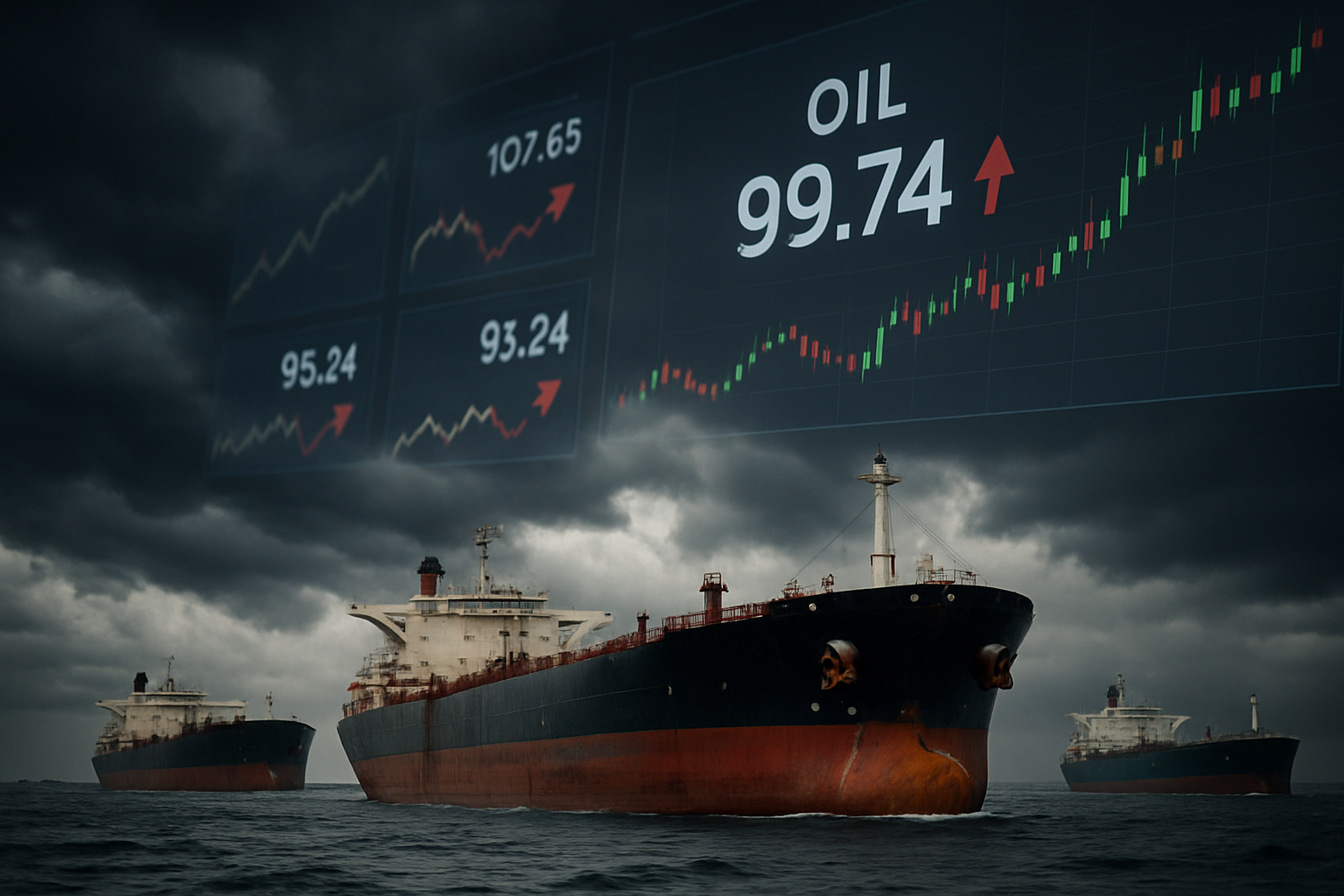
Global oil prices surged dramatically on Monday, with Brent crude surpassing $96 per barrel as escalating Middle East tensions and Iranian maritime actions reignited fears of a wider energy crisis that could destabilize the global economy.
The latest surge follows a pattern of volatility that has defined oil markets throughout 2026, with this latest spike driven by renewed concerns over the strategic Strait of Hormuz, a critical chokepoint that handles approximately 40% of global seaborne oil transit.
Current Crisis Unfolds
Monday's price spike reflects growing market anxiety over potential disruptions to global energy supplies, particularly given the history of dramatic oil price volatility this year. Sources across Cyprus, Greece, Norway, and Qatar report increasing concerns about energy market stability as geopolitical tensions escalate.
The Cyprus-based Πολίτης reports significant "worry in markets as Middle East tensions escalate again," while Greek energy publication Η ΝΑΥΤΕΜΠΟΡΙΚΗ documents explosive increases in European natural gas contracts, with some regions seeing gains of up to 11% as Iran's renewed closure threats for the Strait of Hormuz "rekindle fears of prolonged energy flow disruptions."
Historical Context: The March 2026 Crisis
Today's developments come against the backdrop of the most severe energy crisis since the 1970s oil shocks, which reached its peak in March 2026. During that period, oil prices breached historic levels with Brent crude reaching $119.50 per barrel and West Texas Intermediate (WTI) jumping a record 18.98% in a single day to $108.15 - the largest single-day increase on record.
"This represents the most severe energy security crisis in decades, with single-chokepoint vulnerabilities completely exposed."
— Samuel Ciszuk, Energy Security Analyst
The March crisis was triggered when Iran's Revolutionary Guard declared the Strait of Hormuz "unsafe for shipping," effectively blocking the critical 21-mile waterway with no realistic alternatives. The result was catastrophic: over 150 oil and LNG tankers were stranded in the Persian Gulf representing billions in cargo value, while major shipping companies Maersk and MSC completely suspended operations.
International Response and Strategic Reserves
The severity of the March crisis prompted the International Energy Agency (IEA) to deploy its largest strategic petroleum reserve release in its 50-year history - 400 million barrels from 32 countries, more than double the 182.7 million barrels released during the 2022 Ukraine crisis.
Japan led the international response with an 80 million barrel contribution, marking the first strategic reserve deployment since the 2011 Fukushima disaster. This was particularly significant given Japan's 95% dependence on Middle East oil, with 70% of supplies transiting through the Strait of Hormuz.
Aviation Industry Devastation
The energy crisis extended far beyond oil markets, creating unprecedented disruption in global aviation. Over 18,000 flights were cancelled worldwide - the most extensive disruption since COVID-19 - as eight countries simultaneously closed their airspace: Iran, Iraq, Israel, UAE, Qatar, Syria, Kuwait, and Bahrain, creating what analysts called an "aviation black hole" in the Europe-Asia corridor.
Dubai International Airport, the world's busiest with 86 million passengers annually, was completely shut down due to missile damage, while major carriers including Emirates, Air France-KLM, Wizz Air, and Bulgaria Air suspended operations indefinitely.
Financial Market Crashes and Consumer Impact
The energy crisis triggered historic financial market crashes worldwide. Pakistan's KSE-100 suffered its largest single-day decline in history, falling 8.97%, while South Korea's KOSPI dropped 12%, triggering circuit breakers as the Korean won hit 17-year lows. PayPal was forced to postpone its $1.1 billion IPO indefinitely due to market volatility.
Consumer impacts were severe and global in scope:
- Bangladesh: Implemented fuel rationing for 170 million people
- Pakistan: Fuel prices reached Rs321.17/liter, the highest in South Asia, with the government implementing wartime austerity measures including four-day work weeks
- Ireland: Heating oil approached €2/liter, criticized as "brazen rip-offs"
- Sweden: Electricity increased 10-20 öre with gasoline rising 1-2 kronor, particularly affecting Malmö due to continental European market integration
Diplomatic Breakdown and Nuclear Concerns
The energy crisis stemmed from a complete collapse of US-Iran nuclear negotiations, despite what had been described as a "broad agreement on guiding principles" - the most significant progress since the JCPOA breakdown in 2018. The fundamental disagreement centered on scope: Iran wanted nuclear-only discussions with ballistic missiles and regional proxies as "red lines," while the US demanded comprehensive agreements addressing missiles, armed groups, and human rights.
The diplomatic breakdown led to Operation Epic Fury, the largest coordinated US-Israeli operation since 2003, which triggered massive Iranian retaliation called "Operation True Promise 4." The context was made more dangerous by the February 2026 expiration of New START - the first time in over 50 years without US-Russia nuclear constraints - while Iran continued 60% uranium enrichment with over 400kg of weapons-grade material.
Regional Coalition Under Pressure
The crisis severely strained the Saudi-UAE-Qatar-Egypt coalition that had been supporting diplomatic solutions. Iranian attacks on coalition territories included one civilian killed in Abu Dhabi, 32 injured in Kuwait airport strikes, and 8 wounded in Qatar despite successful interception of 65 missiles and 12 drones by Patriot systems. Egyptian President Sisi condemned attacks on "sisterly Arab countries" while warning of "comprehensive chaos" spreading regionally.
Energy Architecture Vulnerabilities Exposed
The crisis exposed fundamental vulnerabilities in global energy architecture, with the 21-mile Strait of Hormuz representing a dangerous single-point failure in modern logistics with no realistic alternatives. Qatar Energy Minister Saad Al Kaabi warned that Gulf states might be forced to declare force majeure "within weeks" if oil approached $150 per barrel, threatening to "bring down the economies of the world."

Current Situation and Market Outlook
Norwegian sources report that "Asian markets are rising Monday while the ceasefire is about to expire," indicating continued uncertainty about the durability of recent diplomatic progress. Meanwhile, Al Jazeera reports that "Brent crude rises more than 7 percent as Washington and Tehran offer conflicting accounts on ceasefire negotiations."
The mixed signals on US-Iran peace talks have created significant market volatility, with oil prices surging amid conflicting diplomatic accounts. This uncertainty reflects the fragile nature of any energy market stability in the current geopolitical environment.
Government Emergency Measures Continue
European governments maintain enhanced emergency protocols established during the March crisis. These include:
- Hungary's price caps addressing "war-driven price explosions"
- France's deployment of 500 fuel inspectors to prevent price manipulation
- Romania's five-scenario approach to prevent diesel exceeding 10 lei/liter
- Slovakia's continued activation of strategic petroleum reserves
- Germany's strengthened antitrust laws targeting gas station manipulation
Long-term Implications and Energy Transformation
Energy security experts warn that the recurring crises demonstrate the urgent need for fundamental energy architecture transformation. The dangerous over-dependence on strategic chokepoints requires comprehensive restructuring to reduce geopolitical volatility, though supply diversification and renewable energy transitions will take years or decades to implement fully.
"The situation is going longer than initially thought. Financial markets represent the ultimate constraint on prolonged conflict."
— Damien Boey, Financial Markets Analyst
UN Secretary-General António Guterres has characterized the ongoing situation as "the greatest test of multilateral cooperation in crisis management of the modern era," noting that nuclear risks remain at their "highest levels in decades."
Template-Setting Significance
The 2026 energy crises represent watershed moments for 21st-century international relations, establishing new paradigms for crisis management in an interconnected but volatile world. Success in containing current tensions strengthens diplomatic precedents for nuclear crisis resolution, while failure could accelerate military solutions that reshape Middle Eastern geopolitics for decades, encourage nuclear proliferation globally, and undermine diplomatic credibility in international dispute resolution.
As oil prices surge past $96 per barrel once again, the global economy faces renewed uncertainty about energy security in an era where regional conflicts can instantly become worldwide crises. The recurring nature of these energy shocks underscores the urgent need for fundamental transformation of global energy systems to reduce dependence on volatile geopolitical regions and strategic chokepoints.
The coming days will be critical in determining whether diplomatic solutions can provide sustainable stability or whether the world must prepare for continued energy market volatility as a defining feature of the new geopolitical landscape.