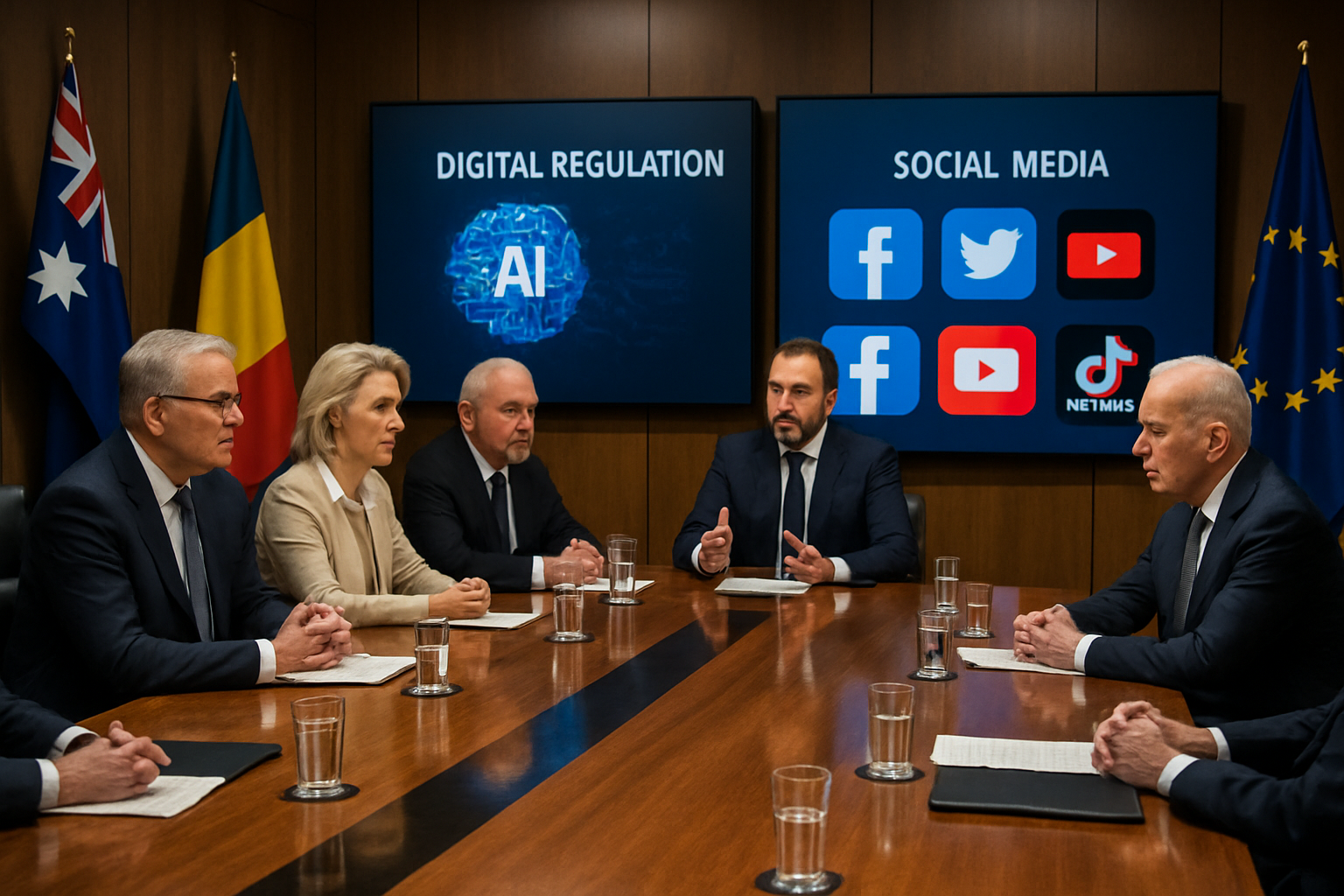
A seismic shift in global digital governance is underway as Australia implements comprehensive age verification laws for online content while Romania leads European efforts to establish ethical AI guidelines for education, marking the most significant regulatory transformation since the internet's commercialization.
Australia's eSafety Commissioner Julie Inman Grant announced the implementation of sweeping new safety measures designed to protect children online, coinciding with the nation's groundbreaking digital age verification laws taking effect this week. The comprehensive framework requires proof of age to access online adult content, R-rated games, and explicit chatbots, representing the world's most ambitious attempt to regulate digital access based on age.
Simultaneously, Romania's European Commission Executive Vice-President Roxana Mînzatu unveiled new ethical guidelines for artificial intelligence use in education, emphasizing that teachers must become "ethical guardians" of AI implementation in schools. Speaking at the launch of European AI ethics guidelines published March 5, 2026, Mînzatu declared: "Artificial intelligence is one of the defining transformations of our era and is rapidly changing education. Teachers must be prepared to use it responsibly in the classroom."
Australia's Digital Age Verification Revolution
The Australian model builds on the nation's unprecedented success with social media age restrictions, which eliminated 4.7 million teen accounts in December 2025 when the under-16 social media ban took effect. The new age verification requirements extend far beyond social media to encompass adult content sites, gaming platforms, and AI systems.
Canadian-owned adult content giant Aylo, which operates PornHub, RedTube, YouPorn, and Tube8, chose to block Australian access entirely rather than comply with the verification requirements, representing the first major corporate response to the legislation. The company's decision highlights the significant compliance costs and technical challenges posed by "real age verification" systems that require biometric authentication or identity document validation.
"This represents a watershed moment for democratic technology governance. We're proving that governments can effectively regulate digital platforms when they have the political will to do so."
— Julie Inman Grant, Australia's eSafety Commissioner
The eSafety Commission's age-restricted material codes require platforms to prevent children from accessing inappropriate content including pornography, violence, self-harm, suicide, and disordered eating material. The rules extend to search engines, social media platforms, app stores, gaming providers, and artificial intelligence systems.
Romania's Educational AI Ethics Framework
Romania's leadership in establishing European AI ethics guidelines represents a parallel but complementary approach to digital regulation. The guidelines, published March 5, 2026, emphasize the responsible integration of AI tools in educational settings while preserving fundamental pedagogical principles.
The framework addresses mounting concerns about AI's impact on learning, following research showing that over 50% of teenagers worldwide now regularly use artificial intelligence tools to complete homework assignments. European educators have documented what researchers call the "double workload effect," where students perform their original responsibilities while also supervising and correcting AI outputs, often creating more work rather than the promised efficiency gains.

Global Regulatory Coordination
These developments occur within the context of the most significant social media regulation wave in internet history. Spain leads with the world's first criminal executive liability framework, creating personal imprisonment risks for tech executives whose platforms violate safety regulations. The European coordination now spans Greece (implementing under-15 restrictions via Kids Wallet), France, Denmark, and Austria (conducting formal consultations), and the UK (launching official reviews).
The coordinated timing prevents what regulators call "jurisdictional shopping," where platforms relocate operations to avoid oversight. This represents the most sophisticated global technology governance attempt since the internet's commercialization.
Dr. Ran Barzilay's research at the University of Pennsylvania provides the scientific foundation driving these policy changes. His studies demonstrate that early smartphone exposure before age 5 causes persistent sleep disorders, cognitive decline, and weight problems. Current global statistics show that 96% of children aged 10-15 use social media, with 70% experiencing harmful content exposure and over 50% encountering cyberbullying.
Implementation Challenges and Industry Resistance
The global memory semiconductor crisis, with sixfold price increases affecting Samsung, SK Hynix, and Micron, constrains the technical infrastructure needed for comprehensive age verification systems until new fabrication facilities come online in 2027. This creates what security experts call a "critical vulnerability window" during which robust verification systems remain difficult to deploy at scale.
Technology industry resistance has escalated significantly. Elon Musk characterized European measures as "fascist totalitarian" overreach, while Telegram's Pavel Durov warned of "surveillance state" implications. The "SaaSpocalypse" of February 2026 eliminated hundreds of billions in technology market capitalization amid regulatory uncertainty.
"Personal data has become the currency of the digital age. We must ensure that democratic institutions can protect citizens while preserving the beneficial aspects of digital connectivity."
— Maria Christofidou, Cyprus Personal Data Protection Commissioner
Alternative Approaches and Philosophical Divides
Not all nations have embraced regulatory enforcement as the primary solution. Malaysia emphasizes parental responsibility through comprehensive digital safety campaigns, with Communications Minister Datuk Fahmi Fadzil stressing that parents must control device access rather than using devices as "digital babysitters."
Oman has implemented "Smart tech, safe choices" educational initiatives focusing on conscious digital awareness and teaching recognition of "digital ambushes" where attackers exploit security curiosity to install malicious software. This represents a philosophical divide between government intervention and individual agency approaches to digital governance.
Technical Infrastructure and Surveillance Concerns
The implementation of comprehensive age verification systems requires biometric authentication, raising significant privacy concerns. The Netherlands' Odido telecommunications breach, which affected 6.2 million customers (nearly one-third of the population), demonstrates the vulnerabilities inherent in centralized data repositories that governments are building for age verification and digital surveillance purposes.
Privacy advocates warn that infrastructure designed for child protection could evolve into comprehensive surveillance systems vulnerable to the same sophisticated attacks that have compromised major corporations. The creation of government databases containing biometric information on millions of citizens represents an unprecedented expansion of state surveillance capabilities.
Educational AI Success Models
Despite challenges, several successful AI integration models have emerged in education. Malaysia operates the world's first AI-integrated Islamic school, combining artificial intelligence with traditional religious and academic learning. Singapore's WonderBot 2.0 has achieved notable success in heritage education, while Canadian universities have implemented AI teaching assistants that maintain critical thinking standards.
These success stories share common elements: sustained commitment to human development, comprehensive stakeholder engagement, cultural sensitivity, and the use of AI as an amplification tool rather than a replacement for fundamental human capabilities.
Global Precedent and Future Implications
March 2026 represents a critical inflection point determining whether democratic institutions can effectively regulate multinational technology platforms while preserving the beneficial aspects of digital connectivity. The coordinated international response spans multiple continents and represents the first serious challenge to the technology industry's decades-long self-regulation model.
Success could trigger worldwide adoption of criminal liability frameworks for tech executives and comprehensive age verification systems. Failure might strengthen anti-regulation arguments and consolidate platform power beyond governmental authority. The stakes extend far beyond individual privacy to include the preservation of democratic society itself amid escalating digital threats.
The resolution of these regulatory initiatives will establish precedents affecting billions of people globally and determine the framework for 21st-century technology governance. As artificial intelligence transitions from experimental tool to essential infrastructure across all sectors of society, the decisions made in 2026 will determine whether these technologies serve human flourishing or become exploitation tools beyond democratic accountability.
"We are at a civilizational choice point. The decisions we make about AI and digital platform regulation in 2026 will determine the trajectory of human-technology interaction for decades to come."
— António Guterres, UN Secretary-General
The convergence of Australia's practical age verification implementation, Romania's educational AI ethics framework, and the broader European regulatory revolution represents the most significant attempt to establish democratic oversight of digital infrastructure in the internet era. Whether this coordinated effort succeeds in balancing technological innovation with human welfare will define the relationship between technology and democracy for generations to come.