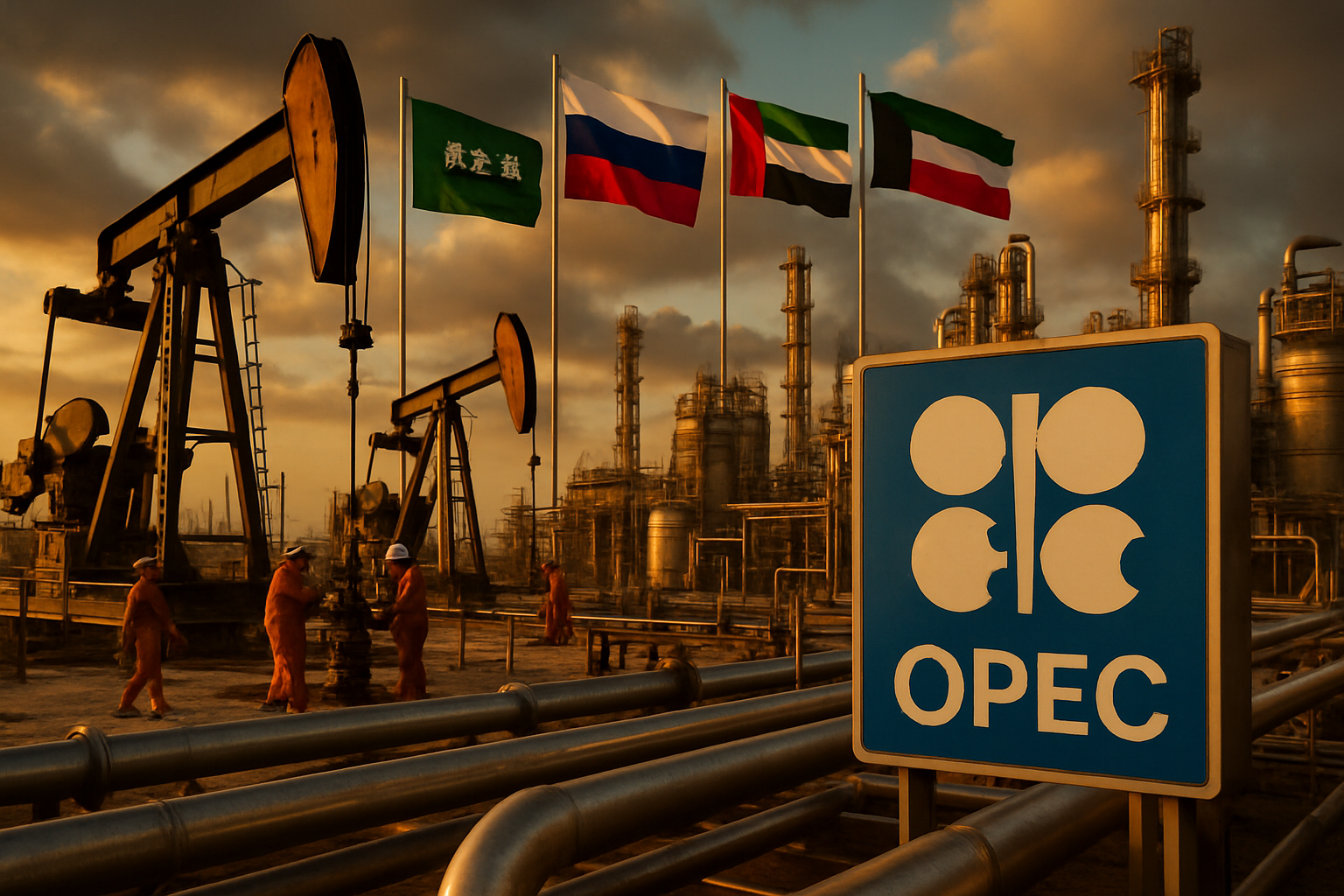
The OPEC+ oil alliance announced a second consecutive monthly production increase of 206,000 barrels per day, yet warned the measure would provide little relief amid the ongoing closure of the Strait of Hormuz and escalating Middle East conflict that has created the most severe global energy crisis since the 1970s oil shocks.
Eight major OPEC+ countries—Saudi Arabia, Russia, Iraq, UAE, Kuwait, Kazakhstan, Algeria, and Oman—agreed to the production boost starting in May 2026, marking a partial rollback of the voluntary production cuts implemented since April 2023. However, energy analysts warn the increase is largely symbolic given that key members remain unable to effectively raise production amid the US-Israel war on Iran.
Strait of Hormuz Closure Creates Global Crisis
The production increase comes as Iran's Revolutionary Guard has declared the Strait of Hormuz "unsafe for shipping," effectively blocking the critical chokepoint that handles 40% of global seaborne oil transit. The 21-mile waterway closure has stranded over 150 oil and LNG tankers in the Persian Gulf, representing billions in cargo value.
Oil prices have surged dramatically, with Brent crude reaching historic peaks of $119.50 per barrel and West Texas Intermediate jumping 18.98% to $108.15—the largest single-day increase on record. The crisis has also triggered natural gas price explosions of 24% in Europe and 78% in the United States.
"The rise is largely symbolic as some key members are unable to raise production amid the US-Israel war on Iran."
— Al Jazeera Analysis
Infrastructure Damage Complicates Recovery
OPEC+ warned that repairing energy infrastructure damaged during the Middle East conflict will be "expensive and require a long time." The organization faces the fundamental challenge that increased production is meaningless if tankers cannot transit safely through critical waterways.
Qatar Energy Minister Saad Al Kaabi has issued stark warnings that Gulf states may be forced to declare force majeure "within weeks" if the conflict continues, with oil prices potentially approaching $150 per barrel that could "bring down the economies of the world."
Global Response and Strategic Reserves
The International Energy Agency has responded with its largest strategic petroleum reserve release in 50 years—400 million barrels from 32 member countries, more than double the 2022 Ukraine crisis response. Japan is releasing 80 million barrels for the first time since the 2011 Fukushima disaster, highlighting the crisis's severity.
Major shipping companies Maersk and MSC have suspended Persian Gulf operations entirely, while alternative Arabian Peninsula routes lack adequate capacity and involve significant time and cost penalties. The crisis has exposed dangerous over-dependence on strategic chokepoints in modern global logistics.
Aviation and Financial Market Impacts
The energy crisis has created parallel disruptions across global transportation networks. Over 18,000 flights have been cancelled worldwide—the most extensive disruption since COVID-19—as eight Middle Eastern countries maintain simultaneous airspace closures. Dubai International Airport, the world's busiest with 86 million annual passengers, remains completely shut due to missile damage.
Financial markets have experienced severe volatility, with Pakistan's KSE-100 recording its largest single-day decline in history (-8.97%), while South Korea's KOSPI hit circuit breakers with a 12% drop. Central banks including the ECB and Bank of Japan are coordinating emergency liquidity measures.
Diplomatic Breakdown Context
The current crisis emerged from the complete collapse of US-Iran nuclear negotiations despite achieving "broad agreement on guiding principles" in Geneva—the most diplomatic progress since the 2018 JCPOA breakdown. The fundamental scope disagreement remained insurmountable: Iran excluded ballistic missiles and regional proxies as "red lines" for nuclear-only talks, while the US demanded comprehensive agreements addressing missiles, armed groups, and human rights.
This diplomatic failure led to Operation Epic Fury, the largest US-Israeli coordinated military operation since 2003, which prompted Iran's massive retaliation under "Operation True Promise 4" with the Revolutionary Guard declaring "no red lines remain."
Regional Coalition Under Strain
The unprecedented consensus among Saudi Arabia, UAE, Qatar, and Egypt that initially supported diplomatic solutions has come under severe strain as Iranian retaliation has directly targeted member territories. The UAE suffered one civilian death in Abu Dhabi, Kuwait experienced 32 injuries from airport drone strikes, and Qatar intercepted 65 missiles and 12 drones despite Patriot missile defenses.
Egyptian President Sisi condemned the attacks on "sisterly countries" and warned of "comprehensive chaos" if the conflict continues to expand regionally.
Long-Term Energy Security Implications
Energy security experts describe this as the most severe crisis in decades, exposing critical vulnerabilities in global energy architecture. Samuel Ciszuk, an energy analyst, characterized it as revealing "single-chokepoint vulnerabilities" that require fundamental restructuring of supply chains.
The crisis highlights the urgent need for energy architecture transformation, including supply diversification and renewable energy transitions, though such changes require years or decades to implement. Strategic petroleum reserves provide only temporary relief for sustained disruptions of this magnitude.
Nuclear Governance Crisis Context
The energy crisis occurs against the backdrop of a broader nuclear governance breakdown. The New START treaty expired in February 2026—the first time in over 50 years without US-Russia nuclear constraints—while China expands its nuclear arsenal and Iran continues uranium enrichment at 60% purity with over 400 kilograms of weapons-grade material.
UN Secretary-General Guterres has called this "the greatest test of multilateral cooperation in the modern era," with nuclear risks at their "highest in decades."
Recovery Timeline Uncertain
Unlike weather-related disruptions with predictable timelines, recovery depends entirely on military operations resolution and diplomatic normalization. Aviation industries cannot make long-term scheduling decisions with multiple airspaces closed, while energy markets remain volatile with critical transit routes blocked.
Traditional monetary policy tools have limited effectiveness against such structural geopolitical disruptions, requiring coordinated international responses addressing root causes rather than just symptoms.
The March 2026 crisis represents a template-setting moment for 21st-century international relations, determining whether diplomatic solutions remain viable for nuclear crises or whether military approaches become the preferred framework for resolving territorial and security disputes globally. Success in containing the crisis could provide a framework for future nuclear crisis resolution, while failure may accelerate military solutions and encourage proliferation worldwide, fundamentally undermining diplomatic credibility for decades to come.