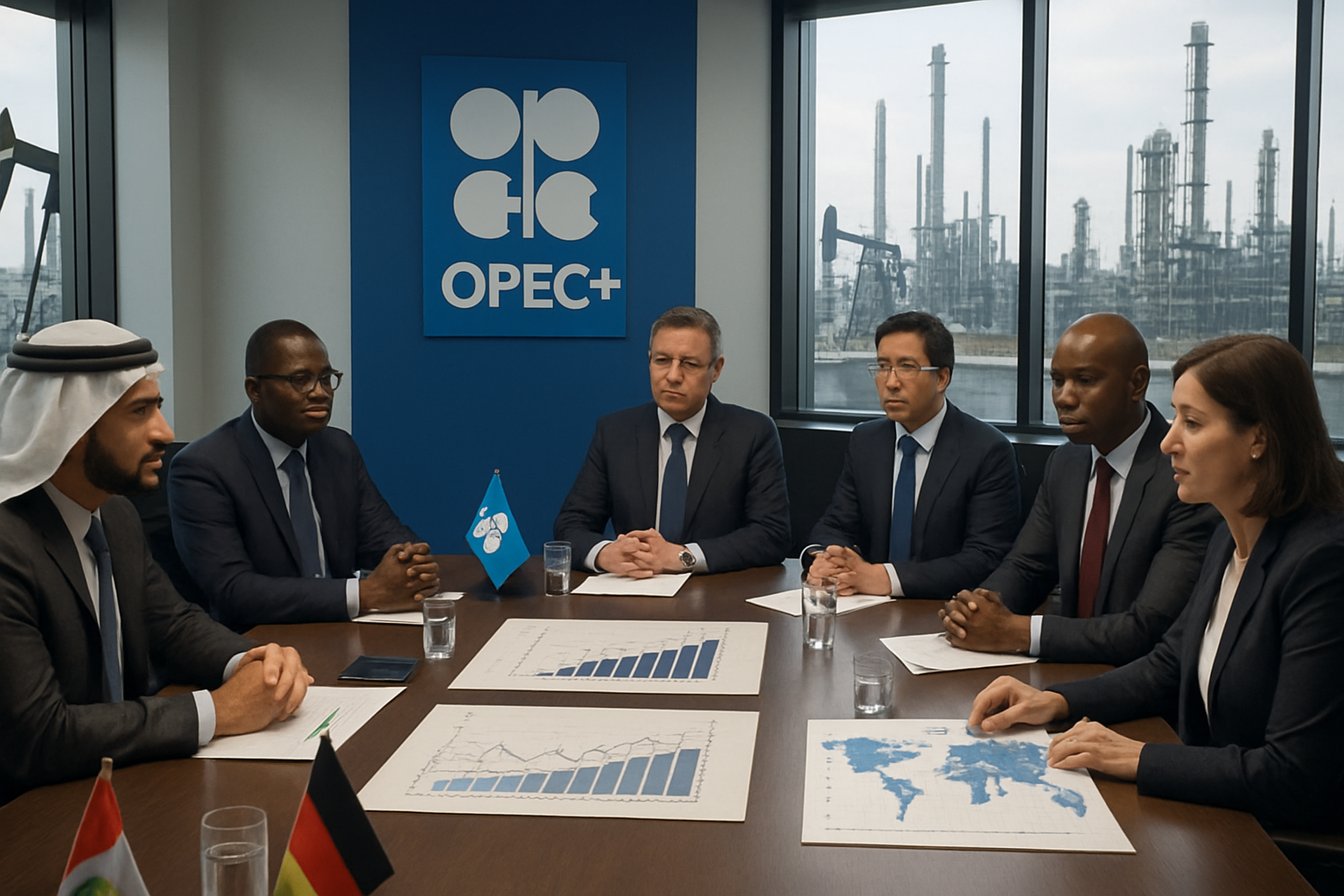
OPEC+ member countries have agreed to increase oil production by 206,000 barrels per day beginning in May 2026, marking a coordinated response to the ongoing global energy crisis that has seen oil prices breach $100 per barrel for the first time since 2022.
The decision was announced following a virtual coordination meeting of the eight-country coalition comprising Saudi Arabia, Russia, Iraq, UAE, Kuwait, Kazakhstan, Algeria, and Oman. The production adjustment represents a partial rollback of the 1.65 million barrels per day in voluntary cuts announced in April 2023.
Modest Response to Historic Crisis
The 206,000 barrel increase comes as global energy markets face unprecedented volatility following Iran's Revolutionary Guard declaration that the Strait of Hormuz is "unsafe for shipping." This critical waterway, through which 40% of global seaborne oil transit passes, has been effectively blockaded since March, creating the most severe energy crisis since the 1970s oil shocks.
Oil prices have surged dramatically, with Brent crude peaking at $119.50 and West Texas Intermediate recording its largest single-day jump in history at 18.98% to reach $108.15. The crisis has forced the International Energy Agency to authorize the largest strategic petroleum reserve release in its 50-year history—400 million barrels from 32 member countries.
"In their collective commitment to support oil market stability, the eight participating countries decided to implement a production adjustment of 206,000 barrels per day from the 1.65 million barrels per day additional voluntary adjustments," OPEC+ stated in their official announcement.
Insufficient to Address Supply Disruption
Energy analysts have expressed skepticism about the effectiveness of the production increase given the scale of the current crisis. The Strait of Hormuz blockade has stranded over 150 oil and LNG tankers in the Persian Gulf, representing billions of dollars in cargo value.
"The OPEC+ emergency response is insufficient to offset the Strait of Hormuz shipping disruption," noted energy security expert Samuel Ciszuk. "This represents the most severe energy security crisis in decades, exposing single-chokepoint vulnerabilities in our global system."
Major shipping companies including Maersk and MSC have suspended all operations in the Persian Gulf, while alternative Arabian Peninsula routes lack adequate capacity and involve significant time and cost penalties.
Global Impact and Consumer Response
The energy crisis has created severe impacts for consumers worldwide. Bangladesh has implemented fuel rationing for 170 million people, while Pakistan has instituted wartime austerity measures including four-day government work weeks. European nations are experiencing electricity price increases of 10-20 öre in Sweden and gasoline prices approaching €2 per liter in Ireland.
Qatar Energy Minister Saad Al Kaabi has warned that Gulf states may be forced to declare force majeure "within weeks" if the crisis continues, potentially driving oil prices toward $150 per barrel—a level he warned could "bring down economies of the world."
Limited Production Flexibility
The OPEC+ statement emphasized that the 1.65 million barrels per day in cuts "may be returned in part or in full subject to evolving market conditions and in a gradual manner." However, the organization faces the fundamental challenge that increased production is largely meaningless if tankers cannot safely transit critical waterways.
Natural gas markets have seen even more dramatic disruptions, with prices exploding 24% in Europe and 78% in the United States. Qatar, which accounts for approximately 20% of global LNG exports, has halted production at its Ras Laffan and Mesaid facilities following Iranian attacks.
Geopolitical Context
The current crisis stems from the complete breakdown of US-Iran nuclear negotiations, despite what had been described as a "broad agreement on guiding principles"—the most diplomatic progress since the JCPOA collapse in 2018. Iran's exclusion of ballistic missiles and proxy groups as "red lines" conflicted with US demands for comprehensive agreements.
The situation escalated following Operation Epic Fury, the largest coordinated military operation since 2003, which prompted Iran's retaliation and the subsequent Strait of Hormuz closure. Regional coalition unity among Saudi Arabia, UAE, Qatar, and Egypt has been severely strained by Iranian attacks on member territories.
Long-term Energy Security Implications
The crisis has exposed fundamental vulnerabilities in global energy architecture, with the 21-mile Strait of Hormuz representing a critical single-point failure in modern logistics systems. Energy experts are calling for fundamental restructuring to reduce dependence on volatile geopolitical regions.
"This watershed moment establishes new paradigms for energy security planning," said market analyst Damien Boey. "The situation is going on longer than initially thought, with financial markets serving as the ultimate constraint on prolonged conflict."
While strategic petroleum reserves provide a temporary buffer, sustained supply disruptions require long-term solutions including supply diversification and renewable energy transitions—transformations that typically require years or decades to implement but whose urgency has been dramatically accelerated by current events.
Market Response and Recovery Prospects
Financial markets have responded with historic crashes, including Pakistan's KSE-100 experiencing its largest single-day decline in history at -8.97%, and South Korea's KOSPI falling 12% with circuit breakers activated. The aviation industry has seen over 18,000 flight cancellations—the most extensive disruption since COVID-19.
Recovery timelines remain uncertain, as they depend on military operations and diplomatic normalization rather than predictable economic factors. Unlike weather-related disruptions, the current crisis affects critical infrastructure and international relationships simultaneously.
As OPEC+ continues to monitor market conditions, the modest production increase represents both recognition of the crisis's severity and acknowledgment of the limited tools available to address supply disruptions when shipping routes themselves are compromised. The decision underscores the complex challenges facing global energy governance in an era of increasing geopolitical volatility.