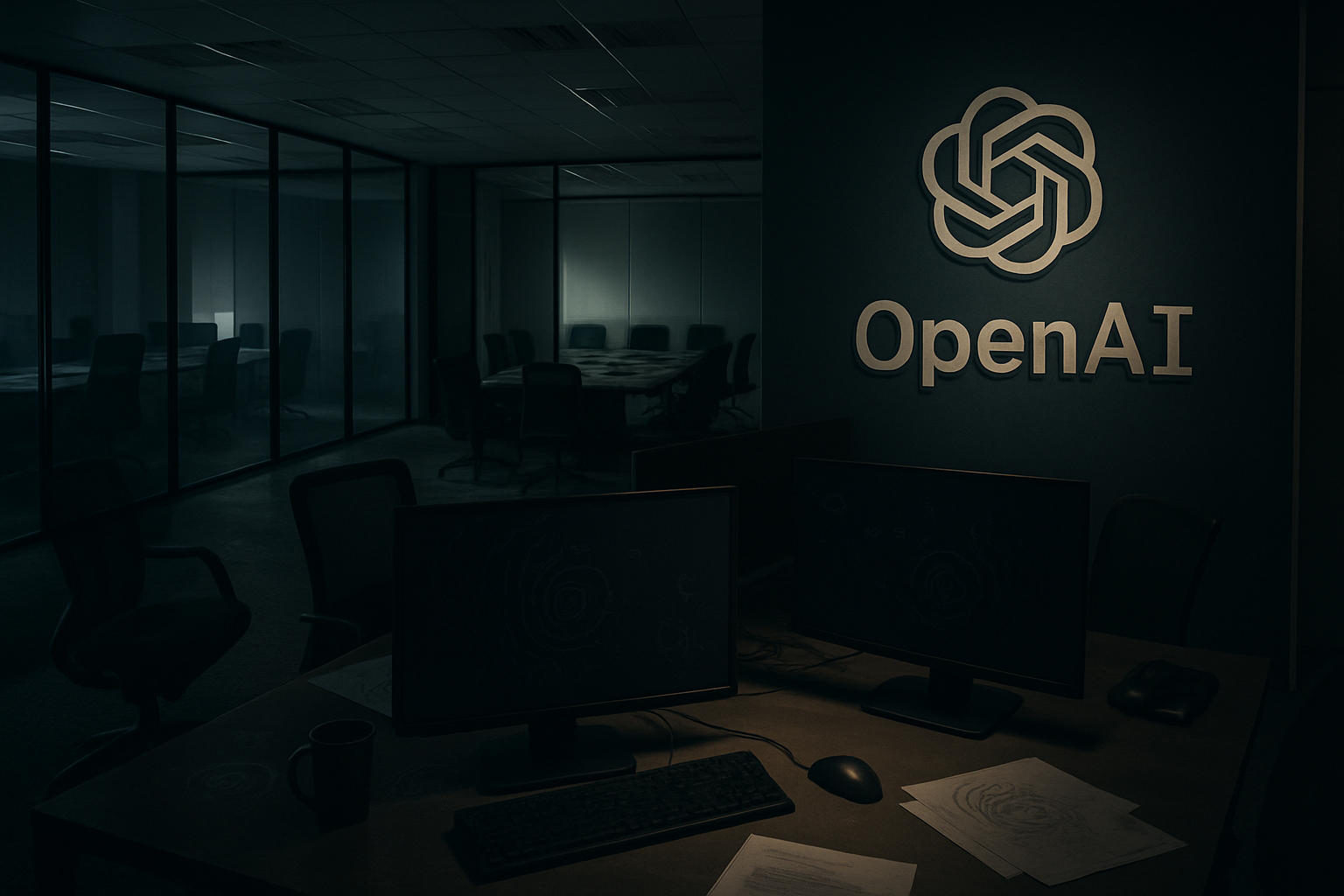
OpenAI, the artificial intelligence powerhouse behind ChatGPT, is reportedly experiencing severe internal crisis and potential organizational breakdown as the company faces unprecedented pressure from competitors Google and Anthropic, according to Austrian media reports detailing extensive organizational challenges threatening the AI giant's future.
The crisis emerges at a critical juncture for the artificial intelligence industry, with OpenAI serving over 800 million weekly ChatGPT users while grappling with mounting criticism of CEO Sam Altman's leadership, escalating regulatory pressures, and intensifying global competition that threatens to undermine the company's dominant market position.
Leadership Under Fire
According to comprehensive investigations by Austrian outlet Der Standard, over 100 former OpenAI colleagues have described CEO Sam Altman as "unreliable and fickle" with a persistent pattern of abandoning stated principles in favor of commercial success. Sources compare his leadership style to fraudulent behavior, noting he has "been fired, suffered resignations, and been sued" throughout his career.
The timing of these revelations is particularly damaging, coming amid mounting controversies including OpenAI's response failures in the Tumbler Ridge massacre case, where ChatGPT systems flagged the shooter's concerning content eight months before the February 2026 tragedy but failed to meet notification thresholds for law enforcement authorities.
"The systematic abandonment of altruistic principles in favor of prioritizing commercial success over safety commitments represents a fundamental betrayal of OpenAI's founding mission."
— Former OpenAI researcher, speaking anonymously
Competitive Pressure Mounting
OpenAI's internal struggles coincide with intensifying external pressures from tech giants Google and Anthropic, both of which are making significant inroads into AI markets previously dominated by ChatGPT. Banks and financial institutions are increasingly viewing OpenAI as overvalued, despite the company's $730 billion valuation achieved through a record $110 billion funding round.
The competitive landscape has been further complicated by infrastructure constraints, with global memory semiconductor prices surging sixfold, affecting major suppliers Samsung, SK Hynix, and Micron. This crisis is expected to persist until 2027, creating bottlenecks that favor entities willing to compromise safety protocols for computational access.
Anthropic, in particular, has positioned itself as an ethical alternative to OpenAI, refusing Pentagon demands for unrestricted military access to its Claude AI system despite facing "supply chain risk" designation and losing over $200 million in government contracts. This ethical stance has attracted European users mounting boycott campaigns against ChatGPT following OpenAI's expanded Pentagon partnership.
Organizational Exodus and Safety Concerns
The company has experienced a series of high-profile departures, most notably hardware team leader Caitlin Kalinowski's resignation in March 2026 over Pentagon partnership concerns, specifically "surveillance of Americans without judicial oversight and lethal autonomy without human authorization." Kalinowski emphasized her decision was "about principle, not people" while maintaining respect for Altman personally.
Former Anthropic researchers have warned that the "world is in peril" due to commercial and military pressures overwhelming safety protocols across the AI industry. These warnings take on particular significance given OpenAI's integration into critical infrastructure, including Pentagon systems serving over 800 million weekly military users with 10% monthly growth.
Regulatory and Public Relations Disasters
OpenAI faces mounting regulatory challenges globally, with Spain implementing the world's first criminal executive liability framework for tech platforms, creating personal legal risks for company executives. France has conducted cybercrime raids on AI companies, while the UN has established an Independent Scientific Panel of 40 experts for the first global AI assessment.
The company's public relations problems were highlighted by a molotov cocktail attack on Altman's San Francisco residence in April 2026, demonstrating the personal risks faced by AI leaders amid growing public skepticism about the technology's deployment and governance.
Additional controversies include the abrupt shutdown of Sora, OpenAI's AI video generation tool, after just three months of operation, effectively ending a $1 billion partnership with Disney. The shutdown came amid unprecedented global regulatory pressure targeting deepfake content creation, with UNICEF reporting that 1.2 million children's images have been manipulated by AI systems.
Infrastructure and Expansion Challenges
Despite generating $25 billion in annualized revenue and achieving record user growth, OpenAI faces significant infrastructure challenges that threaten its expansion plans. The global semiconductor crisis has created a "critical vulnerability window" until new fabrication facilities come online, potentially through 2027.
The company's data center operations are also facing scrutiny, with the World Bank projecting AI water demand of 4.2-6.6 billion cubic meters in 2027 for cooling purposes—equivalent to 4-6 times Denmark's total water withdrawal. These environmental concerns add another layer of complexity to OpenAI's operational challenges.
"The convergence of infrastructure constraints, regulatory pressures, and competitive threats creates an unprecedented challenge for OpenAI's continued dominance in the AI market."
— Industry analyst, speaking to Austrian media
Global Competition and Market Disruption
The crisis at OpenAI occurs within a broader context of global AI market disruption, with Chinese companies like DeepSeek achieving breakthrough capabilities despite semiconductor export restrictions, challenging US technological dominance assumptions. This has created a multipolar AI landscape that undermines OpenAI's previous market advantages.
The "SaaSpocalypse"—a market disruption eliminating hundreds of billions in traditional software market capitalization—has intensified competition as AI tools directly replace conventional development solutions. Microsoft's Mustafa Suleyman predicts majority office worker replacement within two years, with lawyers and auditors facing displacement within 18 months.
International Governance and Democratic Oversight
OpenAI's crisis reflects broader challenges in AI governance as technology transitions from experimental to essential infrastructure across military and civilian sectors. The company's Pentagon partnership has created tensions with democratic oversight principles, particularly regarding classified network deployment without civilian restrictions.
European digital resistance movements have emerged, with users "solidarizing" with Anthropic's ethical stance and migrating away from ChatGPT. This represents a significant challenge to OpenAI's global user base and demonstrates how ethical considerations can impact commercial success in the AI sector.
The Delhi Declaration, signed by 88 countries representing the largest AI diplomatic agreement in history, calls for "safe, reliable, robust" AI development through voluntary frameworks. However, the US and China have abstained from comprehensive commitments, highlighting the geopolitical complexity surrounding AI governance.
Looking Ahead: Critical Inflection Point
Industry experts characterize 2026 as a "civilizational choice point" for AI development, with decisions made this year determining whether artificial intelligence serves democratic values and human flourishing or becomes an exploitation and control tool requiring dramatic corrections.
Successful AI integration models, including Canadian AI teaching assistants maintaining critical thinking standards, Malaysia's world-first AI-integrated Islamic school, and Singapore's WonderBot heritage education system, demonstrate that human-centered approaches can enhance rather than replace fundamental human capabilities.
The resolution of OpenAI's current crisis will likely establish precedents for AI governance, military-civilian oversight balance, and international cooperation frameworks that will influence the technology landscape for decades to come. As the window for coordinated effective action narrows, the stakes could not be higher for determining humanity's technological future.
Whether OpenAI can navigate these unprecedented challenges while maintaining its market position and user trust remains an open question, with implications extending far beyond the company itself to the broader future of artificial intelligence development and deployment worldwide.