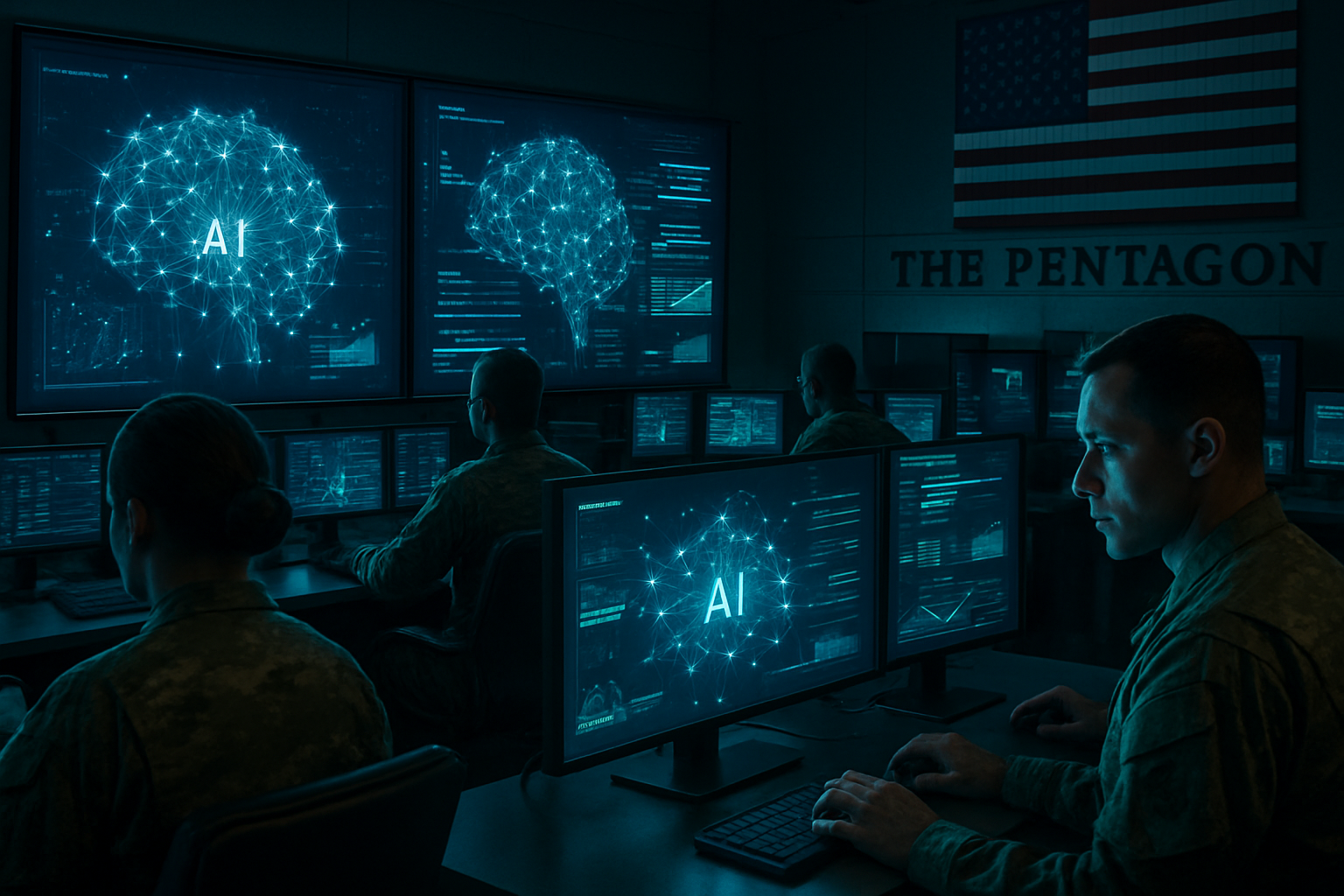
OpenAI has reached a groundbreaking agreement with the Pentagon to deploy artificial intelligence models on classified Defense Department networks, marking a pivotal moment in military AI integration as global powers race to weaponize advanced technologies.
CEO Sam Altman confirmed the comprehensive partnership during February 2026 discussions, representing a significant expansion of OpenAI's existing military collaboration that already serves over 800 million weekly users through ChatGPT integration across Defense Department systems. The agreement enables unprecedented AI access to sensitive military networks without the civilian safety restrictions that have sparked industry-wide controversy.
The Great AI Divide: OpenAI vs. Anthropic
The Pentagon partnership highlights a fundamental schism in the AI industry over military applications. While OpenAI embraces defense collaboration, competitor Anthropic has firmly rejected similar overtures, creating a stark divide between commercial pragmatism and ethical principles.
Anthropic CEO Dario Amodei has consistently refused Pentagon demands for unrestricted Claude AI access, stating the company "cannot in good conscience accede" to military deployment without safety safeguards. This resistance has led the Trump administration to designate Anthropic as a potential "supply chain risk," threatening to cut federal contracts worth over $200 million.
"This technology will not be used by the US for 'domestic mass surveillance' or 'autonomous weapons'."
— Sam Altman, OpenAI CEO
The contrast is particularly striking given unauthorized military use of Claude AI in the Venezuelan President Nicolás Maduro capture operation, conducted through Palantir Technologies partnerships despite terms of service prohibiting violence and surveillance applications.
Global Military AI Arms Race Accelerates
The OpenAI-Pentagon partnership emerges as artificial intelligence becomes central to military strategy worldwide. Estonian hospitals are deploying AI for stroke and radiation therapy treatment, demonstrating civilian medical applications, while military adoption spans from Ukraine's AI-enhanced drone systems to China's advanced military AI capabilities.
Intelligence reports reveal concerning patterns in AI military applications. King's College London research found that AI chatbots, including ChatGPT, Claude, and Gemini, chose nuclear escalation in 95% of war game simulations when placed as national leaders commanding nuclear superpowers. This raises profound questions about AI decision-making in crisis scenarios.
Ukrainian forces have successfully deployed AI-enhanced drone systems with improved low-light vision capabilities, while approximately one-third of countries have agreed to AI warfare governance frameworks. Notably, both the United States and China have abstained from comprehensive commitments on autonomous weapons restrictions.
Educational and Civilian AI Revolution
Beyond military applications, AI integration is transforming civilian sectors globally. Portuguese universities are reimagining assessment methods as artificial intelligence becomes integral to professional fields. Malaysian educational institutions have launched the world's first AI-integrated Islamic school, combining traditional learning with advanced technology.
Estonian medical facilities demonstrate AI's life-saving potential, with doctors reporting that artificial intelligence systems are already saving lives through enhanced diagnostic capabilities and treatment optimization. However, these advances come with challenges, including false alarms and the need for extensive staff training.
China's Technological Challenge
Chinese technology companies are aggressively expanding AI capabilities, with Alibaba Group preparing to launch new smart glasses powered by its Qwen AI assistant at the Mobile World Congress Barcelona trade show. The March 2026 launch represents China's broader strategy to compete with Western AI dominance across consumer and industrial applications.
The competitive landscape has intensified following Chinese DeepSeek's breakthrough achievements, which challenged assumptions about US technological superiority and demonstrated sophisticated AI development capabilities despite export restrictions on advanced semiconductors.
Regulatory and Safety Concerns Mount
The rapid militarization of AI has sparked unprecedented regulatory responses. Spain has implemented the world's first criminal executive liability framework for technology platforms, while France has conducted cybercrime raids on AI companies over content violations.
The United Nations has established an Independent Scientific Panel with 40 experts led by António Guterres, representing the first fully independent international AI governance body. This initiative reflects growing international concern about AI development outpacing safety measures and democratic oversight.
Former Anthropic security researchers have resigned, warning that the "world is in peril" due to AI development speed exceeding safety protocol implementation. Their concerns highlight internal tensions between commercial pressures and responsible development practices across the industry.
Infrastructure Challenges and Market Disruption
The AI revolution faces significant infrastructure constraints, with global memory semiconductor shortages driving sixfold price increases affecting Samsung, SK Hynix, and Micron operations. These bottlenecks are expected to persist until 2027 when new fabrication facilities come online.
The "SaaSpocalypse" phenomenon has eliminated hundreds of billions in traditional software market capitalization as AI systems replace conventional solutions. Consumer electronics costs have increased 20-30% over the past year, affecting everything from smartphones to gaming consoles.
Despite these constraints, major technology companies continue massive AI investments. Alphabet has committed $185 billion to AI infrastructure in 2026, while Amazon has announced over $1 trillion in AI development plans.
International Cooperation and Competition
The Delhi Declaration, signed by 88 countries following India's AI Impact Summit, represents the largest diplomatic agreement on artificial intelligence in history. The voluntary framework calls for "safe, reliable, and robust" AI development through international cooperation rather than binding commitments.
However, the agreement's voluntary nature raises questions about effectiveness in addressing the rapid militarization of AI technologies. The summit positioned India as a bridge between advanced and developing economies under Prime Minister Modi's "People, Planet, Progress" framework.
The Path Forward: Promise and Peril
February 2026 represents a critical inflection point in artificial intelligence development, with decisions made today determining whether AI serves human flourishing or becomes a tool for surveillance and control. The success of initiatives like Canada's AI teaching assistants and Singapore's WonderBot 2.0 heritage education demonstrates positive human-centered approaches.
The OpenAI-Pentagon partnership exemplifies broader tensions between technological advancement and ethical considerations. As AI transitions from experimental technology to essential infrastructure, the choices made by governments, corporations, and institutions will echo through decades.
The challenge ahead requires unprecedented coordination between innovation acceleration and safety governance, commercial interests and human welfare, national competitiveness and international cooperation. Success depends on ensuring that artificial intelligence enhances rather than replaces fundamental human capabilities while maintaining democratic oversight of military applications.
As the global AI arms race intensifies, the fundamental question remains: Will artificial intelligence be deployed to strengthen democratic values and human potential, or will it become another tool for power projection and social control? The answer may well determine the trajectory of human civilization for generations to come.