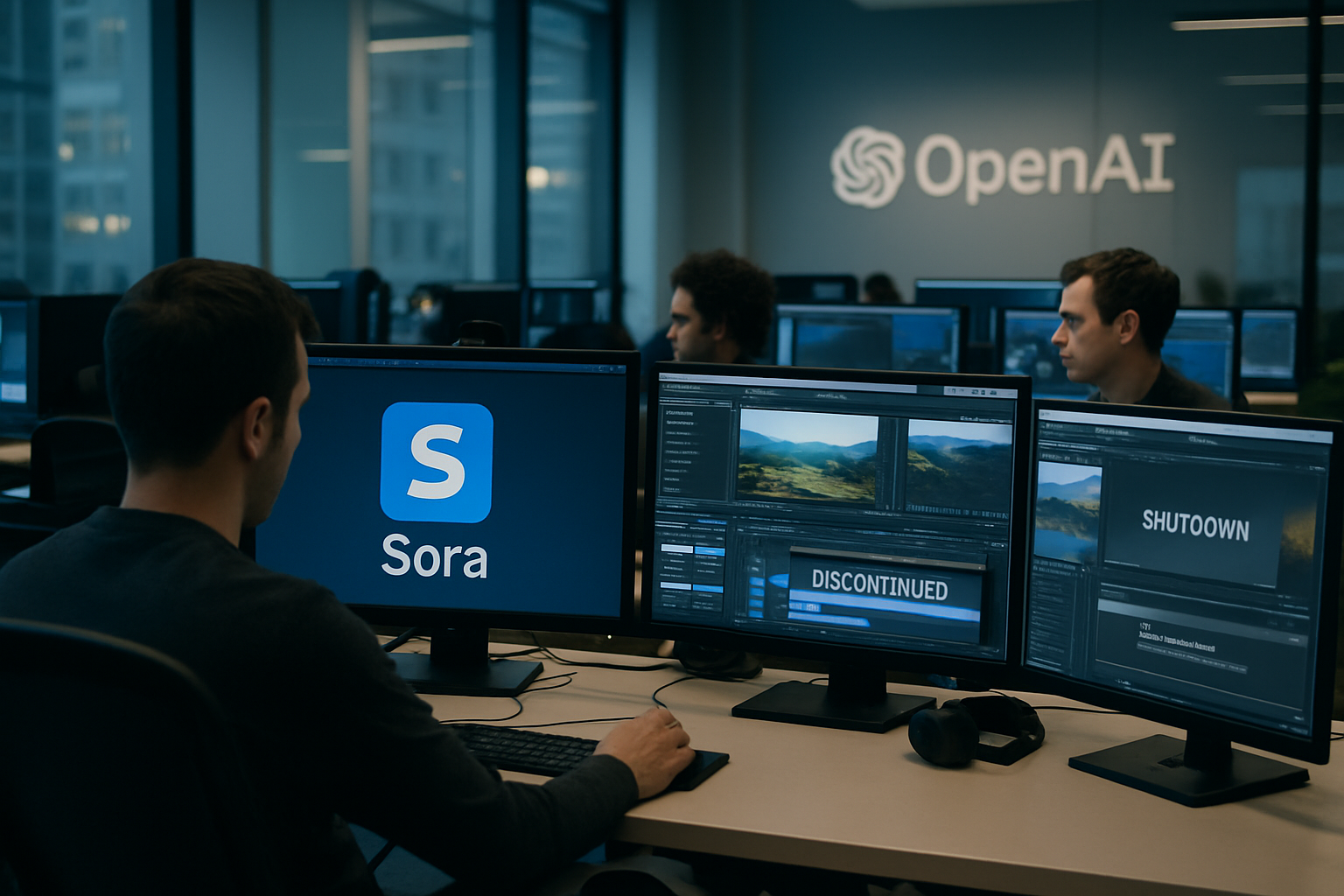
OpenAI announced the immediate shutdown of its Sora video generation app on Wednesday, marking the end of one of 2025's most controversial AI applications amid mounting concerns about deepfake creation and consent violations.
The artificial intelligence company made the announcement via social media on March 25, stating: "We're saying goodbye to the Sora app. To everyone who created with Sora, shared it, and built community around it: thank you. What you made with Sora mattered, and we know this news is disappointing."
The app, which launched in fall 2025, allowed users to create short-form videos from text prompts using AI technology. While it gained viral popularity for its sophisticated video generation capabilities, Sora quickly became embroiled in controversy over its potential for creating non-consensual deepfake content and realistic fake videos.
Rising Industry Concerns Over Deepfakes
The shutdown comes during a critical period for AI video generation technology, with industry experts and regulators increasingly concerned about the misuse of such platforms. According to sources familiar with the matter, the decision follows sustained pressure from entertainment industry leaders, lawmakers, and advocacy groups.
Hollywood studios and entertainment companies had raised particular alarm about Sora's capabilities. The app's ability to create cinema-quality videos threatened traditional production methods and raised significant intellectual property concerns. Disney and other major studios reportedly issued warnings about unauthorized use of copyrighted characters and content.
The platform had also attracted criticism for enabling the creation of realistic deepfakes that could be used maliciously. Recent research indicates that 96% of deepfake videos online target women, often for harassment or non-consensual intimate imagery.
Context of AI Video Revolution
Sora's demise coincides with what industry analysts have termed the "2026 AI Revolution in Cinema." Competing platforms like ByteDance's Seedance 2.0 have demonstrated similar capabilities, creating viral celebrity deepfakes and sophisticated video content that has prompted copyright infringement accusations from major studios.
The French entertainment industry has been particularly vocal about AI concerns, with over 4,000 French actors and filmmakers condemning what they termed the "systematic plundering" of voices and images by AI tools. This resistance reflects broader anxiety within the creative industries about AI-generated content threatening traditional livelihoods and artistic integrity.
"The democratization of AI video creation has outpaced our ability to establish proper safeguards and consent mechanisms."
— Dr. Emily Richardson, Digital Ethics Institute
Regulatory and Technical Challenges
The shutdown occurs amid unprecedented global regulatory pressure on AI companies. Spain recently implemented the world's first criminal executive liability framework for tech platforms, while France has conducted cybercrime raids on AI companies. The European Union is investigating major platforms for violations of the Digital Services Act, with potential penalties reaching billions of dollars.
OpenAI's decision also reflects broader infrastructure challenges facing the AI industry. The global semiconductor crisis has driven memory chip prices up sixfold, affecting major manufacturers including Samsung, SK Hynix, and Micron. These constraints have forced companies to prioritize their most essential AI applications.
Despite these challenges, massive investments in AI infrastructure continue. Alphabet has committed $185 billion to AI development in 2026, while Amazon has announced plans exceeding $1 trillion. However, the focus has shifted toward more controlled, enterprise-focused applications rather than consumer-facing creative tools.
Impact on Content Creation Community
The Sora shutdown represents a significant loss for content creators who had built communities around the platform. The app had democratized high-quality video production, allowing independent creators to produce content that previously required substantial resources and technical expertise.
Early users had created everything from artistic short films to educational content using Sora's capabilities. The platform had also been used by small businesses for marketing content and by educators for creating engaging visual materials.
However, the same accessibility that made Sora popular also contributed to its problems. The low barrier to entry meant that malicious actors could easily create convincing fake videos, leading to the spread of misinformation and the creation of non-consensual content.
Industry Shift Toward Professional Applications
French media reports suggest that OpenAI is repositioning its focus toward professional tools and enterprise applications in response to competition from companies like Anthropic. This strategic shift reflects broader industry trends toward more controlled AI deployment with stronger oversight mechanisms.
The company's partnership with Disney, announced in December 2025, had allowed the use of animated character imagery in approved contexts. However, this partnership could not address the broader issues of consent and misuse that plagued the consumer-facing application.
Other successful AI integration models have emphasized human-centered approaches. Canadian universities have implemented AI teaching assistants while maintaining critical thinking standards, and Malaysia has launched the world's first AI-integrated Islamic school, combining technology with traditional learning methods.
Looking Forward: AI Video Generation's Future
The Sora shutdown does not signal the end of AI video generation technology but rather marks a maturation of the field toward more responsible deployment. Industry experts expect future AI video tools to incorporate stronger consent mechanisms, watermarking requirements, and usage restrictions.
The closure also highlights the growing importance of AI governance frameworks. The United Nations has established an Independent Scientific Panel of 40 experts to provide the first fully independent global AI impact assessment, while multiple countries are developing regulatory approaches to balance innovation with safety concerns.
As the AI industry transitions from experimental applications to essential infrastructure, companies face increasing pressure to demonstrate responsible development practices. The Sora experience provides valuable lessons for the deployment of powerful AI tools that can significantly impact society.
"This represents a critical inflection point where the AI industry must choose between rapid growth and responsible development."
— António Guterres, UN Secretary-General
Broader Implications for AI Development
The Sora shutdown occurs during what experts characterize as March 2026's "critical inflection point" for artificial intelligence. This period has seen unprecedented coordination between governments, technology companies, and international organizations to address AI's societal implications.
The decision reflects growing recognition that AI development must prioritize human welfare alongside technological advancement. Successful AI implementations increasingly focus on amplifying human capabilities rather than replacing them, as demonstrated by educational and healthcare applications that maintain human oversight and cultural sensitivity.
The challenge facing the industry is determining how to harness AI's transformative potential while preserving human creativity, consent, and authentic expression. The Sora experience suggests that the future lies in sophisticated human-AI collaboration rather than unrestricted AI capabilities.
As the dust settles on Sora's closure, the broader AI community faces fundamental questions about the balance between innovation and responsibility. The decisions made in 2026 will likely establish precedents that shape human-AI relationships for decades to come, making the thoughtful development of governance frameworks more crucial than ever.