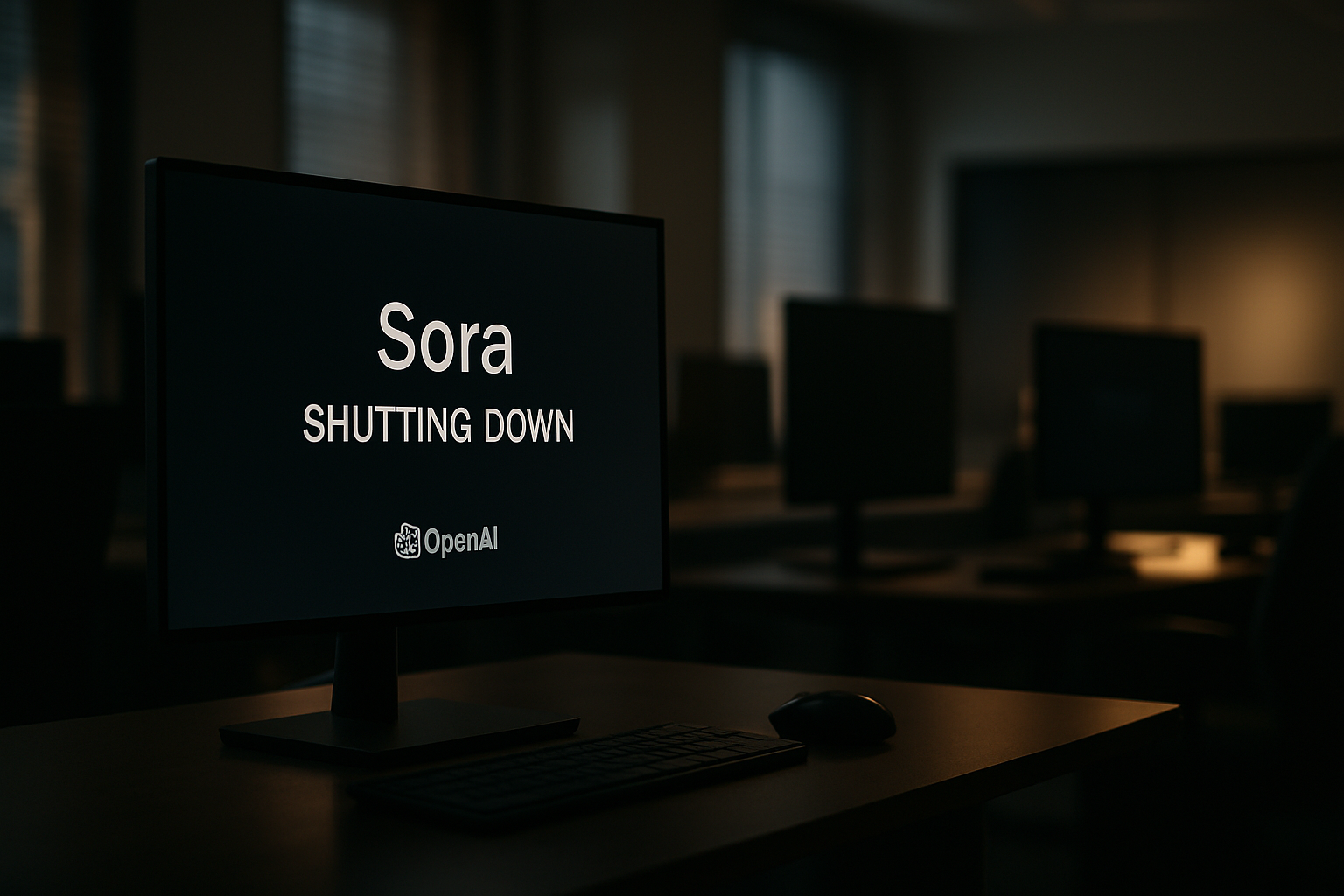
OpenAI announced the immediate shutdown of its viral AI video generator Sora on Tuesday, marking a dramatic reversal for the company just three months after securing a $1 billion partnership with Disney and amid growing global concerns about deepfake technology and consent violations.
In a brief statement posted to X (formerly Twitter), OpenAI confirmed it is "saying goodbye to the Sora app" and promised to share more information soon about how users can preserve videos they have already created with the platform.
"What you made with Sora mattered, and we know this news is disappointing," the company wrote in the post, which garnered widespread international media attention within hours of publication.
Sudden End to Ambitious Partnership
The shutdown effectively terminates what was positioned as a groundbreaking collaboration with Disney, announced just months earlier with significant fanfare. According to multiple sources, Disney was reportedly "completely caught off guard" by OpenAI's decision, highlighting the abrupt nature of the announcement.
The timing is particularly significant given Sora's rapid rise to viral status since its public launch in fall 2025. The AI video generation tool captured widespread attention for its ability to create sophisticated, cinema-quality videos from simple text prompts, leading many industry observers to herald it as a revolutionary advancement in artificial intelligence applications.
However, the platform's success quickly became overshadowed by mounting concerns about its potential for misuse, particularly in creating non-consensual deepfake content that could harm individuals and undermine trust in digital media.
Growing Regulatory and Industry Pressure
The shutdown occurs during what experts describe as a critical inflection point for AI regulation globally, with unprecedented international coordination targeting AI-generated content and platform accountability.
European nations have led the charge with comprehensive new legislation. Latvia recently introduced the world's first criminal penalties for non-consensual AI-generated intimate imagery, with sentences of up to seven years imprisonment. Austria has launched major investigations into platforms enabling misogynistic deepfake content, while Spain has implemented criminal executive liability frameworks that could see technology executives face personal legal consequences.
The regulatory pressure extends beyond Europe. Research from UNICEF reveals that 1.2 million children's images have been manipulated by AI systems globally, while studies consistently show that 96% of deepfake videos target women. These statistics have driven policymakers worldwide to demand stronger protections and accountability measures.
"We are witnessing the democratization of abuse through AI tools, and platforms must take responsibility for the harms their technologies enable."
— Dr. Ran Barzilay, University of Pennsylvania researcher
Hollywood's AI Confrontation Intensifies
The entertainment industry has emerged as a flashpoint in the broader AI debate. More than 4,000 French actors and filmmakers condemned what they called the "systematic plundering" of creative work by AI systems in February 2026, while major studios including Disney and Paramount have issued copyright warnings about unauthorized use of their intellectual property in AI training.
The tensions reached a dramatic crescendo at the recent Oscars after-party, where a public confrontation between a successful playwright and OpenAI CEO Sam Altman over AI's role in "global violences" highlighted the growing rift between creative industries and technology companies.
ByteDance's competing Seedance 2.0 platform has only intensified these concerns, with its viral Tom Cruise-Brad Pitt fight video demonstrating how AI can create convincing content featuring real people without their consent.
Technical Challenges and Infrastructure Constraints
Beyond regulatory pressure, the AI industry faces significant technical challenges that may have influenced OpenAI's decision. The global semiconductor crisis continues to drive memory chip prices to sixfold increases, affecting major manufacturers including Samsung, SK Hynix, and Micron. These shortages are expected to persist until 2027 when new fabrication facilities come online.
This "critical vulnerability window" has forced AI companies to make strategic decisions about resource allocation. While companies like Alphabet have committed $185 billion to AI infrastructure and Amazon has announced over $1 trillion in development plans, the constraints have pushed the industry toward more efficient and targeted applications.
The World Bank projects that AI systems will demand between 4.2 and 6.6 billion cubic meters of water by 2027 for data center cooling alone—equivalent to four to six times Denmark's entire annual water consumption.
Strategic Shift in AI Development
Industry analysts suggest the Sora shutdown represents a broader strategic pivot by OpenAI toward more controlled, professional applications rather than consumer-facing creative tools. This shift aligns with the company's expanding Pentagon partnership, where ChatGPT now serves over 800 million weekly users across military systems with 10% monthly growth.
The move contrasts sharply with Anthropic's approach, which has faced "supply chain risk" designation from the U.S. government after refusing to remove safety restrictions from its Claude AI system for military applications.
OpenAI's decision to maintain collaboration with government agencies while shuttering consumer creative tools suggests a calculated strategy to focus on applications where human oversight and professional standards can mitigate potential harms.
Global Governance at a Critical Juncture
The shutdown occurs as international bodies attempt to establish comprehensive AI governance frameworks. The UN has established an Independent Scientific Panel of 40 experts led by Secretary-General António Guterres to conduct the first fully independent global AI impact assessment.
The Delhi Declaration, signed by 88 countries, represents the largest AI diplomatic agreement in history, though it remains voluntary and lacks enforcement mechanisms. Meanwhile, the "AI Revolution in Cinema" of 2026 has created competing pressures between innovation and responsibility.
Successful AI integration models continue to emerge, including Canadian universities' AI teaching assistants that maintain critical thinking standards, Malaysia's world-first AI-integrated Islamic school, and Singapore's WonderBot 2.0 heritage education program. These examples demonstrate that responsible AI deployment remains possible with proper governance frameworks.
Economic Impact and Market Response
The shutdown contributes to ongoing market volatility in the technology sector, part of what analysts term the "SaaSpocalypse"—the elimination of hundreds of billions in market capitalization as AI capabilities threaten traditional software business models.
Consumer trust has also been significantly impacted, with companies like Coupang experiencing 3.2% declines following various AI-related controversies. Mental health professionals report unprecedented cases of deepfake trauma, with symptoms consistent with severe psychological abuse.
The economic barriers to women's professional participation have increased as reputations become vulnerable to AI-generated attacks, leading to decreased online participation among female journalists, activists, and public figures.
Looking Forward: The Path to Responsible AI
The Sora shutdown represents what experts characterize as March 2026's "critical inflection point"—a moment that will determine whether AI serves human flourishing or becomes a tool for systematic exploitation requiring dramatic corrections.
Success in navigating this transition requires unprecedented coordination between governments, technology companies, educational institutions, and civil society. The most promising approaches emphasize AI as amplification tools for human capabilities rather than replacement mechanisms, preserving creativity, cultural understanding, and ethical reasoning.
The resolution of current challenges will establish precedents for 21st-century governance at the intersection of digital and physical realities, affecting billions of people globally. As OpenAI noted in its farewell message, "What you made with Sora mattered"—but increasingly, how AI tools are governed and constrained may matter even more for society's future.