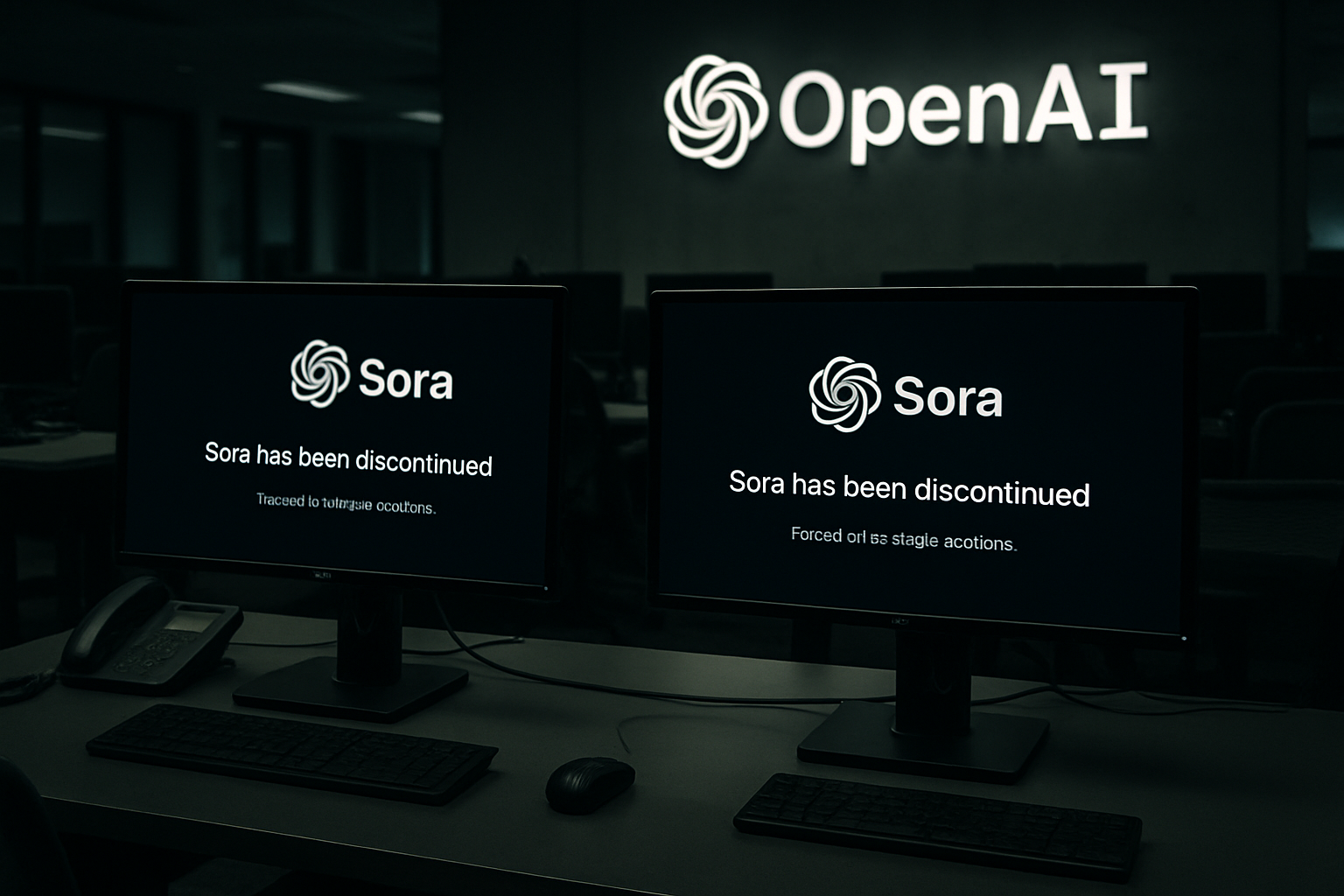
OpenAI announced the immediate discontinuation of its Sora AI video generation application on March 27, 2026, effectively ending a $1 billion partnership with Disney after just months of operation and marking a significant industry retreat from consumer creative tools amid mounting regulatory pressure.
The company posted a brief statement on X (formerly Twitter) saying it was "saying goodbye to the Sora app" and promised to provide preservation details for existing user videos. Disney executives were reportedly "completely caught off guard" by the abrupt decision, according to industry sources familiar with the matter.
Regulatory Pressure Drives Decision
The shutdown comes during an unprecedented wave of global AI regulation targeting non-consensual deepfake content. UNICEF reports that 1.2 million children's images have been manipulated by AI systems, with 96% of deepfake videos targeting women. This has prompted severe regulatory responses across multiple jurisdictions.
Latvia introduced seven-year prison sentences for AI-generated intimate imagery, while Austria launched investigations into misogynistic platforms. Spain implemented the world's first criminal executive liability framework for tech platform executives, creating personal legal risks for company leaders.
"The regulatory landscape has fundamentally shifted. We're seeing coordinated international action that makes consumer-facing creative tools increasingly untenable from a risk perspective."
— Industry analyst speaking on condition of anonymity
Creative Industry Resistance
The decision also follows intense resistance from the creative industry. Over 4,000 French actors and filmmakers condemned what they called "systematic plundering" by AI tools that reproduce voices and images without consent. This resistance culminated in a dramatic confrontation at the Academy Awards after-party between a successful playwright and OpenAI CEO Sam Altman over what the playwright termed "global violences" against creative professionals.
Hollywood studios, including Disney and Paramount, have issued copyright warnings about unauthorized intellectual property usage in AI training systems. The Motion Picture Association has raised concerns about fundamental threats to traditional business models from AI-generated content.
Strategic Pivot to Professional Applications
Industry experts view the Sora shutdown as part of OpenAI's strategic repositioning from consumer creative tools toward controlled enterprise and professional applications. This aligns with the company's expanding Pentagon partnership, where ChatGPT now serves over 800 million weekly users with 10% monthly growth in military applications.
The pivot contrasts sharply with Anthropic, which faces "supply chain risk" designation from the Pentagon over its refusal to remove Claude AI safety restrictions for military use. OpenAI appears to be choosing applications with clearer governance pathways over prolonged regulatory battles in the consumer space.
Infrastructure Constraints and Market Dynamics
The shutdown also reflects broader infrastructure challenges facing the AI industry. A global semiconductor crisis has driven memory chip prices up sixfold, affecting Samsung, SK Hynix, and Micron operations. These shortages are expected to persist until 2027, when new fabrication facilities come online.
Despite these constraints, massive investments continue in AI infrastructure. Alphabet committed $185 billion to AI development in 2026, described as the largest single-year corporate tech investment in history, while Amazon announced plans exceeding $1 trillion over the decade.
The broader "SaaSpocalypse" has eliminated hundreds of billions in traditional software market capitalization as AI systems demonstrate direct replacement capabilities for conventional solutions. Microsoft's Mustafa Suleyman predicts that AI will replace the majority of office workers within two years, with lawyers and auditors affected within 18 months.
International Governance Response
The Sora shutdown occurs amid the most sophisticated global technology governance effort since internet commercialization. The UN established an Independent Scientific Panel with 40 experts under Secretary-General António Guterres, representing the first fully independent international AI assessment body.
European coordination has intensified, with France conducting cybercrime raids on AI companies and multiple nations implementing coordinated age restrictions and platform accountability measures. The Delhi Declaration, signed by 88 countries, represents the largest AI diplomatic agreement in history.
Successful Alternative Models
While OpenAI retreats from consumer creative tools, other models demonstrate successful AI integration. Canadian universities have implemented AI teaching assistants while maintaining critical thinking standards. Malaysia operates the world's first AI-integrated Islamic school, combining artificial intelligence with traditional learning approaches. Singapore's WonderBot 2.0 has achieved success in heritage education.
These examples treat AI as sophisticated amplification tools rather than replacement mechanisms, preserving human oversight and cultural authenticity while leveraging computational advantages.
March 2026: Critical Inflection Point
Industry experts characterize March 2026 as a "critical inflection point" determining whether AI serves democratic values and human flourishing or becomes an exploitation tool beyond democratic accountability. The Sora shutdown symbolizes broader AI industry reckoning over responsible development approaches.
The decision establishes a precedent for how major AI companies respond to regulatory pressure and raises questions about the viability of large-scale creative AI integration. It accelerates the shift toward enterprise and professional tools with built-in oversight mechanisms versus broad consumer access applications.
Environmental and Social Implications
The World Bank projects that AI systems will require 4.2-6.6 billion cubic meters of water by 2027 for data center cooling—equivalent to four to six times Denmark's annual water consumption. This environmental challenge drives investment in renewable energy and more efficient computing architectures.
Consumer trust in AI platforms has eroded amid widespread concerns about deepfake content and its societal impacts. Mental health professionals report unprecedented numbers of deepfake trauma cases, with women increasingly reducing online participation due to fears of AI targeting.
Looking Forward
The future of AI in creative industries appears to lie in sophisticated human-AI collaboration rather than unrestricted consumer tools. Organizations that prioritize human welfare, stakeholder engagement, and cultural sensitivity are achieving superior outcomes compared to wholesale automation approaches.
OpenAI's decisive retreat suggests a preference for strategic repositioning toward applications with clearer governance pathways. The company's choice reflects broader industry recognition that sustainable AI development requires balancing innovation with responsibility, commercial interests with human welfare, and competitive advantage with democratic oversight.
As the window for coordinated international action narrows, the decisions made in 2026 will determine the trajectory of human-AI relationships for decades to come, establishing whether technology serves humanity's highest aspirations or becomes a tool for exploitation and control.