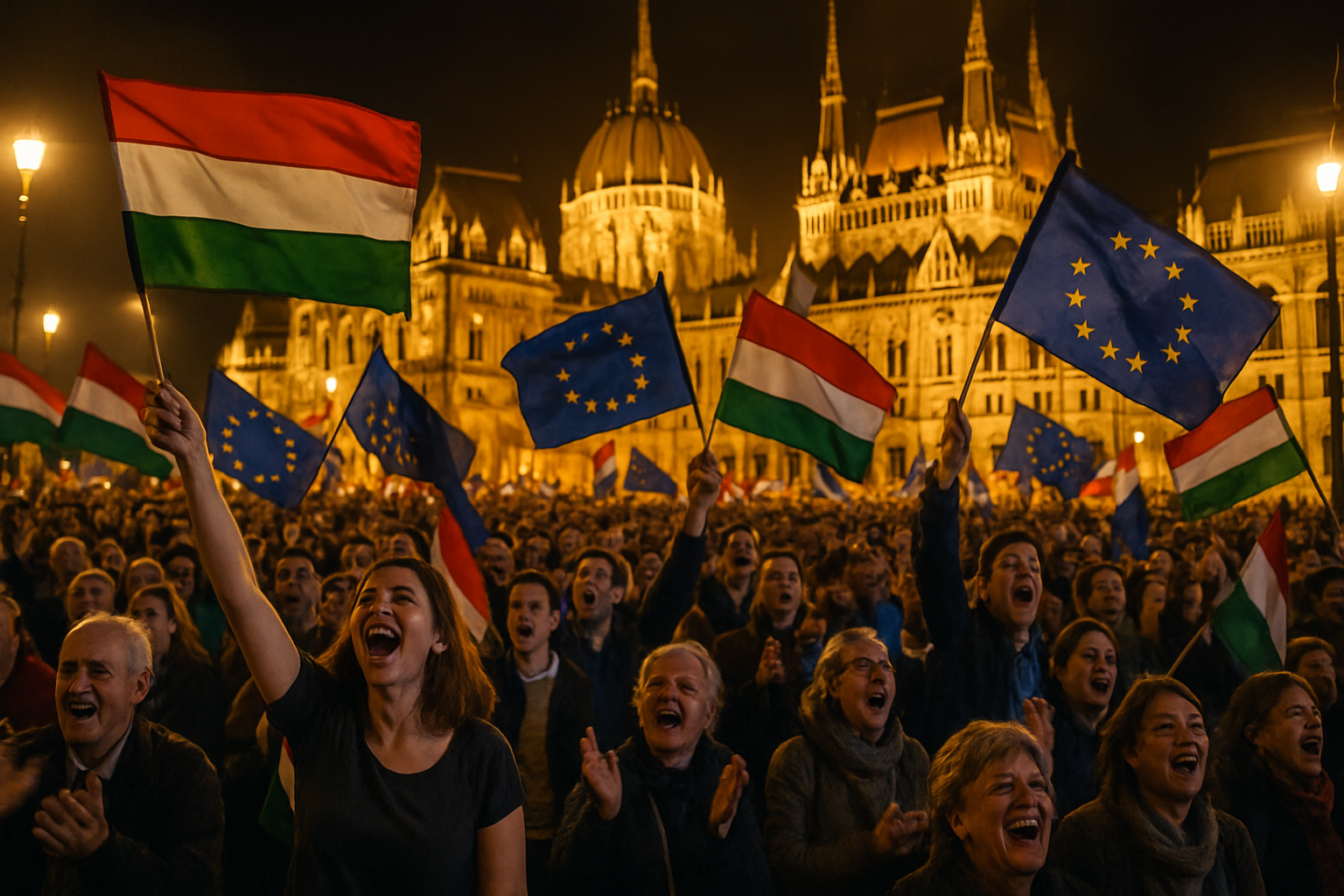
Hungarian voters delivered a stunning electoral earthquake on Sunday, ending Viktor Orbán's 16-year grip on power and handing a decisive victory to pro-European challenger Péter Magyar, whose Tisza Party secured a constitutional supermajority of 138 seats in the 199-member parliament.
The result represents the most dramatic political transformation in Hungary since the fall of communism in 1989, with initial projections showing Magyar's party capturing over 53% of the vote compared to Fidesz's collapse to just 38% - the largest electoral defeat in Orbán's political career.
Record voter turnout of nearly 80% - the highest since Hungary's democratic transition - reflected the magnitude of political change as citizens across the country decisively rejected Orbán's increasingly authoritarian rule in favor of Magyar's promise to "liberate Hungary" and restore its place in the European mainstream.
Dramatic Electoral Shift
For the first time since 2010, Fidesz found itself trailing in polls throughout the campaign, as Magyar - a former government insider turned opposition leader - successfully consolidated pro-European forces behind a comprehensive reform platform promising wealth taxes, euro adoption, and stronger EU and NATO ties.
The scale of Magyar's victory was historic. With a two-thirds constitutional supermajority, the new government will have the power to reverse many of Orbán's controversial constitutional changes, restore judicial independence, and dismantle the media oligarchy that has defined Hungarian politics for over a decade.
"We have liberated Hungary," Magyar declared before ecstatic supporters in Budapest, as crowds celebrated throughout the capital.
— Péter Magyar, Prime Minister-elect
Magyar's first announcement as victor signaled his government's immediate priorities: "My first official visit will be to Poland," he said, symbolically reconnecting Hungary with its Central European neighbors and the broader European project.
The Opposition's Path to Victory
The transformation began with Magyar's "Greatest National March" in March 2026, which drew an estimated 500,000 participants to Budapest - the largest opposition demonstration since 2010. The march became a watershed moment, demonstrating the extent of public dissatisfaction with Orbán's rule.
Key to the opposition's success was its ability to escape government media control through digital platforms and international coverage, particularly reaching younger "Generation Orbán" voters aged 18-30 who had come of age during the prime minister's rule but ultimately rejected his nationalist messaging.
Economic stagnation, corruption scandals, and fatigue with authoritarian governance created perfect conditions for Magyar's message of democratic renewal and European integration.
International Dimensions and Foreign Interference
The election was marked by unprecedented foreign interference from multiple directions. Investigative reports by Szabolcs Panyi revealed the presence of Russian operative teams in Budapest actively supporting Fidesz - the first documented case of Kremlin agents participating directly in an EU member state election.
Simultaneously, the Trump administration provided explicit political backing for Orbán, with Vice President JD Vance visiting Budapest just days before the election to condemn EU "shameless interference" while declaring Orbán a "model for Europe."
This dual foreign intervention - Russian operational support combined with American political endorsement - created an unprecedented international dimension to what should have been a domestic Hungarian election.
EU Crisis Resolution
Magyar's victory immediately resolves Hungary's ongoing blockade of the €90 billion Ukraine aid package, which had created the deepest institutional crisis in EU history. Orbán had maintained the blockade over the Druzhba pipeline dispute, forcing European leaders to consider enhanced cooperation mechanisms that would bypass unanimity requirements.
European Commission President Ursula von der Leyen welcomed the result, stating: "The heart of Europe beats stronger in Hungary today." French President Emmanuel Macron hailed it as "a victory for democratic participation," while Ukrainian President Volodymyr Zelensky praised the "constructive approach" that would now prevail.
The European Union is expected to immediately unfreeze the €19 billion in funding that had been suspended over rule of law concerns, while Hungary's new government has pledged to lift its veto on Ukraine aid within days of taking office.
Domestic Transformation Ahead
With constitutional supermajority power, Magyar's government can immediately begin reversing Orbán's most controversial reforms. Priority areas include:
- Restoring judicial independence and dismantling political control over courts
- Breaking up media oligarchies and ensuring press freedom
- Implementing wealth taxes on the super-rich
- Beginning the process toward euro adoption
- Strengthening democratic institutions and transparency
The new government also promises to review Hungary's relationship with China, particularly regarding controversial battery manufacturing facilities in eastern Hungary that became a significant campaign issue.
Generational Change
Perhaps most significantly, the election represents a generational shift. Many young Hungarians in their twenties described seeing Orbán ousted as akin to their parents' experience of 1989 and the fall of communist dictatorship.
Budapest erupted in celebration Sunday night, with tens of thousands taking to the streets in scenes reminiscent of Hungary's democratic revolution. The Danube riverfront became one massive party as citizens celebrated what many called their "return to Europe."
Regional and Global Implications
The result sends shockwaves through right-wing populist movements across the West, which had looked to Orbán's Hungary as a successful model of illiberal democracy within the European framework.
For Vladimir Putin's Russia, which had actively supported Orbán through covert operations, the defeat represents a significant geopolitical setback. Hungary had been Moscow's most reliable ally within the EU, consistently blocking sanctions and maintaining energy ties despite the Ukraine conflict.
For the European Union, Magyar's victory removes its most persistent internal critic and creates new possibilities for deeper integration. The result demonstrates that well-established authoritarian systems can still be defeated democratically when opposition forces unite behind credible leadership and clear alternatives.
Looking Forward
As Hungary prepares for its democratic renewal under Magyar's leadership, the broader implications extend far beyond the country's borders. The election serves as a template for 21st-century democracy's capacity to adapt and overcome authoritarian challenges through electoral means.
The peaceful transfer of power, accomplished through record democratic participation, strengthens the European democratic model globally and provides hope for similar movements facing authoritarian pressure worldwide.
For Hungary itself, April 12, 2026, marks not just the end of the Orbán era, but the beginning of a new chapter defined by democratic renewal, European integration, and a return to the founding values that brought the country into the European family of nations more than two decades ago.