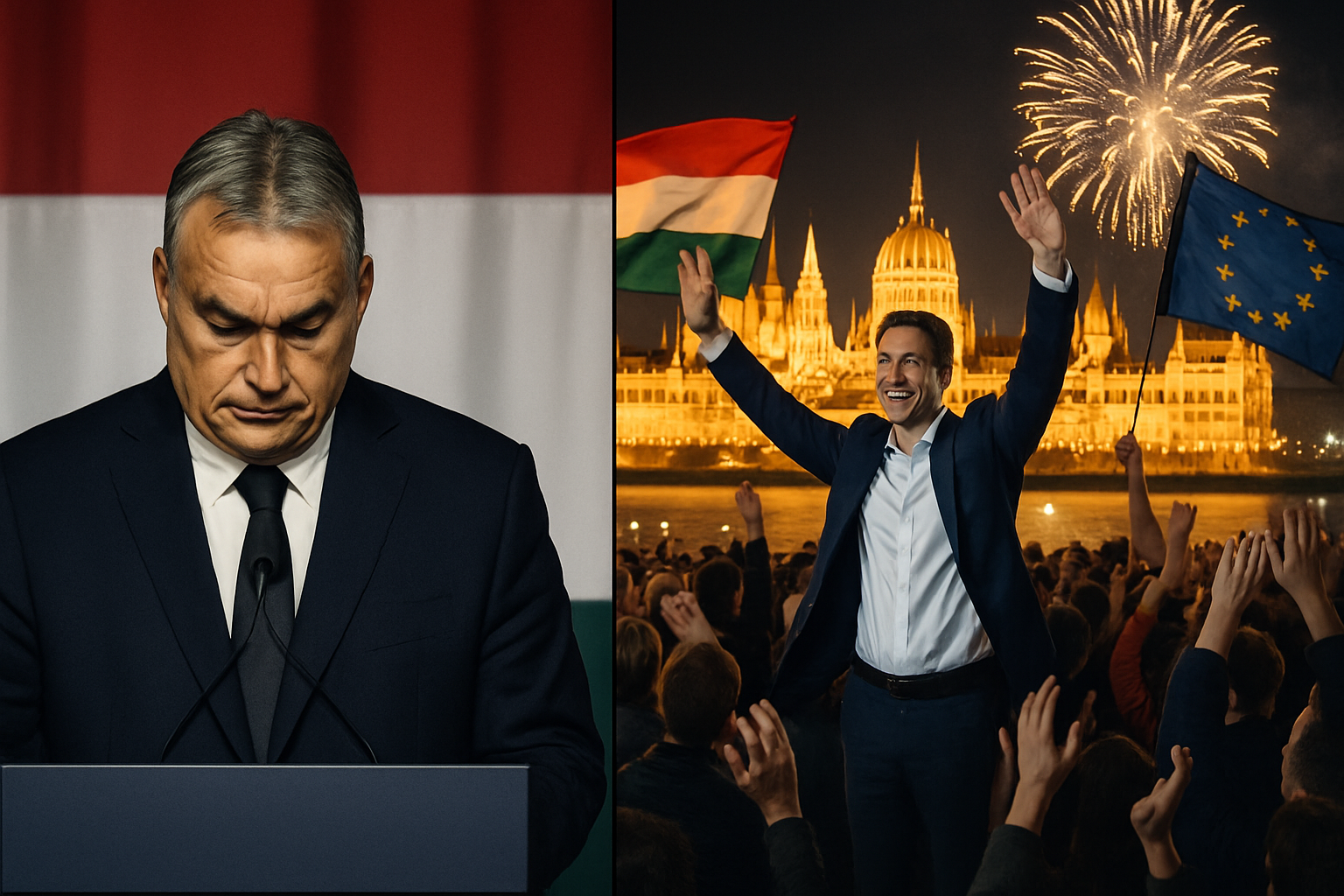
Viktor Orbán's 16-year grip on power in Hungary came to a dramatic end on Sunday night as opposition leader Péter Magyar's Tisza Party secured a constitutional supermajority in the most significant political transformation in Central Europe since the fall of communism.
With a record-breaking turnout of 80% – the highest since Hungary's democratic transition in 1989 – Magyar's pro-European coalition achieved an overwhelming victory, capturing 138 seats out of 199 in parliament. Orbán's ruling Fidesz party collapsed to just 55 seats, marking their worst performance since returning to power in 2010.
A Democratic Watershed Moment
As results became clear on Sunday evening, tens of thousands of jubilant Hungarians poured into Budapest's streets, waving Hungarian and European Union flags in scenes reminiscent of the 1989 democratic revolution. The iconic Chain Bridge was illuminated in celebration as fireworks lit up the Danube River.
"We have liberated Hungary," Magyar declared to ecstatic crowds gathered near the Hungarian Parliament. "Today, the Hungarian people have chosen Europe, democracy, and their future over fear and division."
The victory represents the culmination of an extraordinary political journey for the 45-year-old lawyer who, less than two years ago, was still operating within Orbán's political system as a government insider before dramatically breaking away to lead the opposition.
"This is more important than the transition to democracy in 1989. Then we freed ourselves from foreign domination. Today we freed ourselves from domestic tyranny."
— Anna Kovács, Budapest resident celebrating in the streets
The Rise of Péter Magyar
Magyar's meteoric rise to power began in early 2024 when he burst onto the political scene as a whistleblower, exposing corruption within Orbán's government from the inside. His transformation from regime loyalist to opposition leader galvanized a broad coalition of voters hungry for change.
The turning point came with the "Greatest National March" in March 2026, when an estimated 500,000 people filled Budapest's streets – the largest anti-government demonstration since 2010. This massive show of support demonstrated that Magyar had successfully tapped into widespread frustration with Orbán's authoritarian rule.
Magyar's campaign focused on three core pillars: restoring judicial independence, implementing wealth taxes on oligarchs, and accelerating Hungary's integration with European institutions. His promise to adopt the euro and strengthen NATO ties stood in stark contrast to Orbán's nationalist, sovereignty-first approach.
Generation Orbán Rejects Its Namesake
Perhaps most remarkably, the election saw "Generation Orbán" – voters aged 18-30 who came of age entirely under the current prime minister's rule – decisively reject the only leader they had known. Exit polls showed over 70% of young voters supported Magyar's vision of a European Hungary.
"I was born in 2005. Orbán has been in power my entire conscious life," said university student Márton Szabó. "But we don't want to be isolated from Europe anymore. We want to be part of something bigger."
The youth vote was crucial in Magyar's victory, facilitated by opposition success in escaping government media control through digital platforms and international coverage. Hungarian online media platforms like Márton Gulyás's "Partizán" built counter-narratives that reached millions, particularly younger demographics.
International Interference Backfires
The election occurred against a backdrop of unprecedented foreign interference, with both Russian operatives and American political figures attempting to influence the outcome. Investigative journalist Szabolcs Panyi revealed concrete evidence of Russian operative teams operating in Budapest to support Fidesz – the first documented case of Kremlin agents participating in EU elections.
Meanwhile, the Trump administration provided explicit political backing for Orbán, with US Vice President JD Vance visiting Budapest just five days before the election to condemn what he called EU "shameless interference." Vance declared Orbán a "model for Europe" and promised American economic support if he won.
However, this dual foreign intervention ultimately backfired, with many Hungarian voters expressing anger at what they saw as external attempts to manipulate their democracy.
EU Celebrates Return of Prodigal Nation
European leaders welcomed the results with barely contained euphoria. European Commission President Ursula von der Leyen declared that "the heart of Europe beats stronger in Hungary today," while French President Emmanuel Macron called it "a victory for democratic participation."
Ukrainian President Volodymyr Zelensky welcomed what he called the "constructive approach" of Hungary's new government, noting that Magyar had promised to immediately lift Hungary's blockade of €90 billion in EU aid to Ukraine.
The victory removes Brussels' most persistent internal critic and promises to restore Hungarian alignment with EU values. Hungarian markets responded positively, with the forint appreciating 1.9% to a four-year high against the euro as investors anticipated the restoration of frozen EU funding.
Constitutional Reforms on the Horizon
With a constitutional supermajority of 138 seats, Magyar's government will have the power to implement sweeping democratic reforms. He has promised to restore judicial independence, dismantle media oligopolies, implement wealth taxes, and begin the process of euro adoption.
In a symbolic gesture, Magyar announced that his first official visit as prime minister would be to Warsaw, Poland, reconnecting Hungary with its Central European neighbors and the broader European project.
"Hungary's place was, is, and always will be in Europe," Magyar declared in his victory speech. "We will be constructive partners, not obstructionists."
Orbán's Era Ends
Viktor Orbán, who has dominated Hungarian politics for over two decades, conceded defeat in a brief statement early Monday morning. The 61-year-old leader, who has been prime minister for 16 of the past 18 years, acknowledged that "the Hungarian people have spoken" and promised a peaceful transition of power.
Orbán's defeat represents more than just a change of government – it marks the end of an era that saw Hungary drift increasingly away from EU norms and toward authoritarian governance. His administration was characterized by attacks on press freedom, judicial independence, and civil society organizations.
Template for Democratic Resilience
The Hungarian election is being viewed by political scientists and democracy advocates as a template for how established authoritarian systems can be defeated through democratic means when opposition forces unite behind credible leadership and clear alternatives.
"This demonstrates that even well-entrenched authoritarian leaders can be voted out when civil society, opposition parties, and ordinary citizens come together," said Dr. Kim Lane Scheppele, a Princeton University expert on Hungarian politics.
The success of Magyar's digital resistance strategy – using social media and online platforms to reach voters despite government control of traditional media – provides a roadmap for opposition movements facing similar challenges worldwide.
Challenges Ahead
Despite the euphoria of victory, Magyar faces significant challenges in governing. Sixteen years of Fidesz rule have embedded loyalists throughout key institutions, from the judiciary to regulatory agencies, creating potential obstacles to reform efforts.
Economic challenges also loom large, with inflation concerns and the need to restore EU funding while implementing promised wealth taxes and social programs. The new government will need to balance ambitious reform agendas with fiscal responsibility.
However, with a clear mandate from Hungarian voters and strong support from European partners, Magyar appears well-positioned to begin the work of democratic restoration and European integration.
As celebrations continued into the early hours of Monday morning across Budapest, one message was clear: Hungary had chosen its European future over nationalist isolation, marking a new chapter in the country's democratic journey and providing hope for similar movements across the continent.