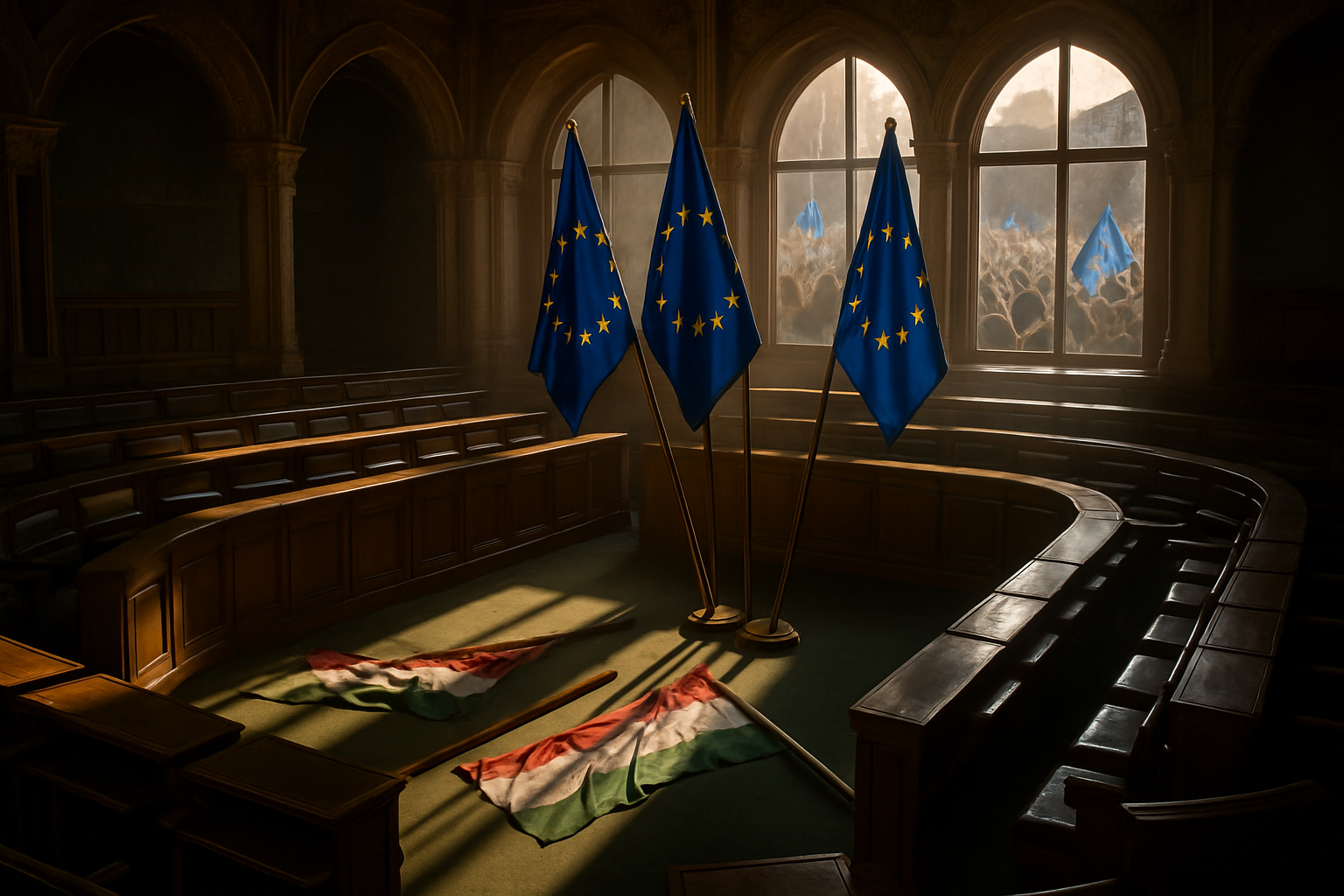
When future historians chronicle the extraordinary electoral defeat of Viktor Orbán on April 12, 2026, they should dedicate at least footnotes to the zebras and golden toilet brushes. The zebras were spotted by drones on the sprawling grounds of a rural palace belonging to Orbán's family. The 72 golden toilet brushes, reportedly purchased for nearly €10,000, adorned a luxurious renovation of Hungary's central bank.
For Orbán's opponents, such excesses became symbols of rampant corruption among the Hungarian Prime Minister's inner circle—a corruption that drained Hungary's economy and transformed it into the EU's most corrupt nation, according to international transparency rankings.
In the end, disgust with corruption and its impact on ordinary citizens' livelihoods were the primary factors driving Orbán's crushing electoral defeat. But the story of how Hungary's strongman fell, and what it means for the future of populism across Europe, reveals far more than simple public frustration with graft.
The Unprecedented Challenge
Viktor Orbán's 16-year rule appeared unshakeable until Péter Magyar emerged as an opposition leader with a difference. A former government insider who had witnessed the system's corruption firsthand, Magyar successfully consolidated Hungary's fractured opposition behind a clear, pro-European platform promising wealth taxes, euro adoption, and stronger EU and NATO ties.
The scale of Magyar's challenge became evident during the "Greatest National March" held on Hungary's national holiday in March 2026. An estimated 500,000 participants filled Budapest's streets—the largest opposition demonstration since 2010. Magyar's declaration resonated with profound historical echoes: "In 1848 and 1956, our revolutions continued in blood. The Russians came, but they could never defeat us. Orbán cannot do this either."
For the first time since Orbán's return to power in 2010, multiple polling organizations showed opposition coalitions leading consistently. The electoral mathematics had fundamentally shifted, creating genuine uncertainty about Hungary's political future.
Foreign Interference Backfires
What made Hungary's 2026 election unprecedented in European democratic history was the documented dual foreign interference operation. Investigative journalist Szabolcs Panyi's VSquare investigation revealed concrete evidence of Russian operative teams actively supporting Fidesz—the first confirmed case of Kremlin agents directly participating in EU electoral campaigns.
Simultaneously, the Trump administration provided unprecedented political backing. Vice President JD Vance's Budapest visit just five days before the election condemned EU "shameless interference" while declaring Orbán a "model for Europe." This represented the most direct American intervention in an EU member state election in modern history.
Yet this extraordinary foreign support ultimately backfired. Hungarian voters, particularly the "Generation Orbán" cohort aged 18-30 who had come of age under his rule, decisively rejected both nationalist messaging and external manipulation. Over 70% of young voters supported Magyar's pro-European vision, demonstrating that authoritarian indoctrination could be overcome through democratic engagement.
Digital Democracy Triumphs
A crucial factor in Orbán's defeat was the opposition's successful escape from government media control. Despite Fidesz's systematic capture of traditional media outlets, digital platforms created alternative information channels that reached younger demographics.
Platforms like Márton Gulyás's "Partizán" built counter-narratives that reached millions, undermining Orbán's information monopoly. International coverage amplified these voices, creating a media environment where government propaganda could no longer dominate completely.
"We have liberated Hungary," Magyar declared to celebrating crowds as results confirmed his constitutional supermajority victory.
— Péter Magyar, Hungary's Prime Minister-elect
This digital resistance provided a template for democratic movements worldwide facing similar authoritarian media capture, proving that alternative information channels could penetrate even sophisticated propaganda systems.
The European Stakes
Orbán's defeat immediately resolved the deepest institutional crisis in EU history. Hungary's €90 billion Ukraine aid blockade, maintained over the Druzhba pipeline dispute, was lifted within hours of the election results. The frozen €19 billion in EU funding due to rule-of-law concerns is expected to be restored within days.
Enhanced cooperation discussions, which had accelerated to bypass Hungarian obstruction through a fundamental departure from consensus decision-making, are now unnecessary. Brussels' most persistent internal critic has been removed through democratic means rather than institutional manipulation.
European leaders celebrated the result as vindication of democratic processes. European Commission President Ursula von der Leyen declared that "the heart of Europe beats stronger in Hungary today," while French President Emmanuel Macron hailed it as "a victory for democratic participation."
The Template for 21st-Century Democracy
The Hungarian election's significance extends far beyond national borders. Senior EU officials described it as Europe "writing the template for 21st-century crisis management," with the world watching how democratic institutions adapt while preserving European values.
The election demonstrated that well-established authoritarian systems could be defeated democratically when opposition forces unite behind credible leadership and clear alternatives. Magyar's constitutional supermajority—138 of 199 parliamentary seats—enables comprehensive democratic reforms including judicial independence restoration, media oligarchy dismantling, and transparency strengthening.
Record voter turnout of 80%—the highest since Hungary's 1989 democratic transition—showed that electoral competition remained effective against authoritarianism when citizens were properly motivated and informed.
Geopolitical Realignment
The broader implications of Orbán's defeat reshape European geopolitics fundamentally. Vladimir Putin has lost his most reliable EU ally, while right-wing populist movements across the continent have lost their most successful model.
The Hungarian forint appreciated 1.9% to a four-year high against the euro as markets responded positively to prospects of EU funding restoration, an end to rule-of-law disputes, and Hungary's return to the European integration path.
Magyar's announcement that his first official visit would be to Poland symbolically reconnects Hungary with Central Europe and the EU project, reversing years of confrontational diplomacy.
Lessons for European Populism
Orbán's fall exposes critical vulnerabilities in populist governance models. Despite controlling media, educational institutions, and electoral frameworks, the Hungarian system proved unable to sustain legitimacy when confronted with united opposition, credible alternatives, and sustained citizen engagement.
The role of corruption proved decisive. The golden toilet brushes and zebras weren't merely symbols—they represented a system where public resources enriched cronies while ordinary citizens struggled with economic stagnation. When this contrast became undeniable, even sophisticated propaganda couldn't maintain support.
Digital platforms created spaces for authentic democratic discourse that traditional media control couldn't eliminate. This suggests that authoritarian adaptation must be met with equally sophisticated democratic counter-strategies leveraging technology for citizen empowerment rather than manipulation.
The Peaceful Transfer of Power
Perhaps most remarkably, Orbán's concession was immediate and gracious. "The Hungarian people have spoken," he acknowledged, promising peaceful transition. This contrasts sharply with authoritarian responses elsewhere and demonstrates that institutional frameworks, however strained, retained enough legitimacy to facilitate democratic change.
The transition process itself becomes a model for how established democracies can renew themselves through electoral competition rather than institutional crisis or extra-legal means.
Looking Forward
April 12, 2026, represents more than Hungarian political change—it marks a potential turning point for European democracy after years of backsliding concerns. The election proves that authoritarian drift can be reversed democratically through united opposition, credible leadership, and clear policy alternatives.
The success strengthens the European democratic model globally, providing hope for similar movements facing authoritarian pressure worldwide. From the streets of Budapest to the corridors of Brussels, the message is clear: democracy, when properly defended and renewed, remains more powerful than any authoritarian alternative.
As Hungary begins its democratic renewal, European integration accelerates with the removal of its most persistent internal critic. The foundations laid in 1945 prove resilient enough to adapt to 21st-century challenges while maintaining their core principles of democratic governance, human rights, and international cooperation.
The fall of Viktor Orbán may mark not just the end of one authoritarian experiment, but the beginning of democracy's renewal across a continent that refused to abandon its founding values.