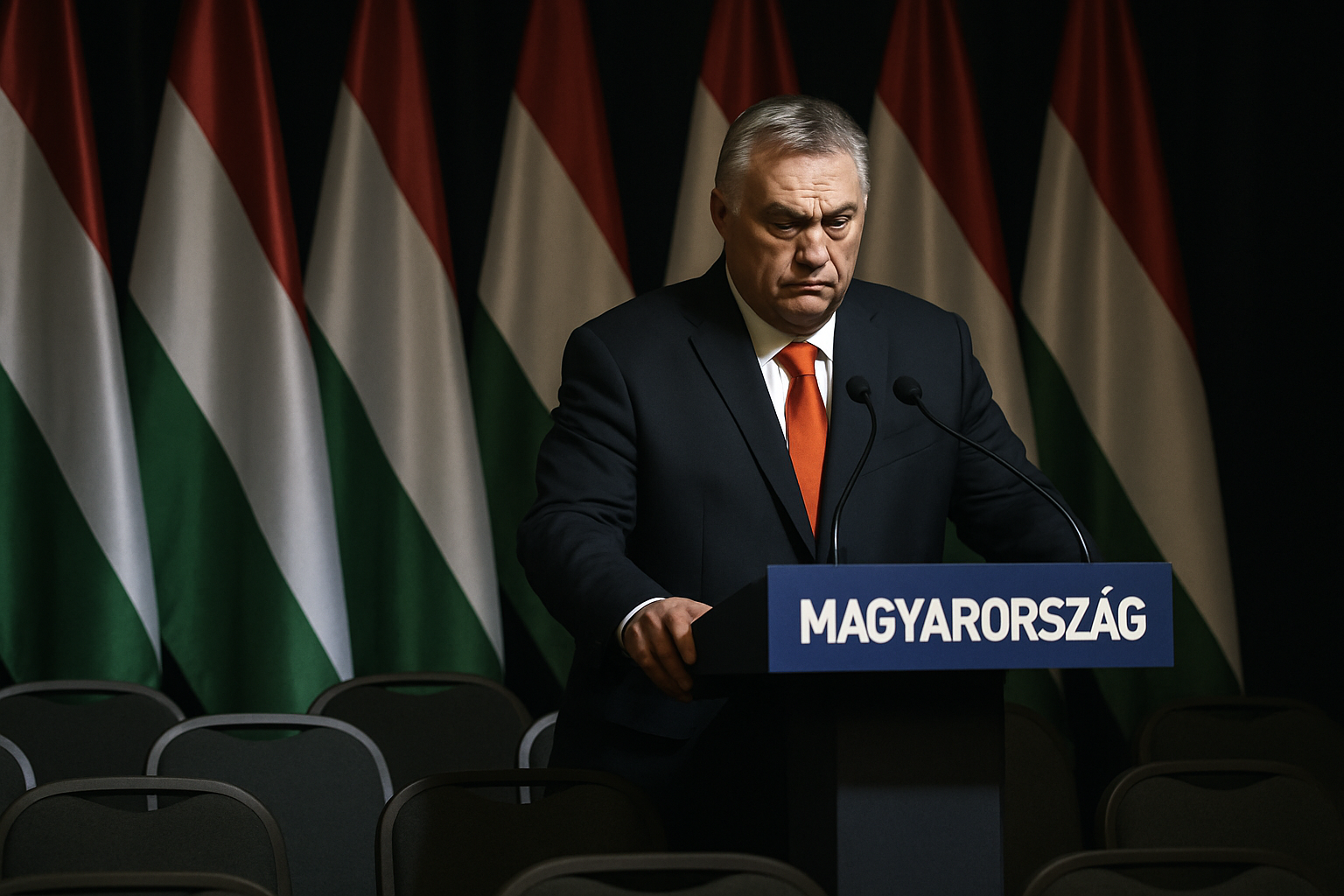
Viktor Orban's 16-year authoritarian rule in Hungary came to a dramatic end on April 12, 2026, as opposition leader Péter Magyar's Tisza Party achieved a stunning landslide victory with a constitutional supermajority, marking the most significant political transformation in Central Europe since the fall of communism.
With a record-breaking 80% voter turnout—the highest since Hungary's 1989 democratic transition—Magyar's Tisza Party secured 138 of 199 parliamentary seats, while Orban's Fidesz party collapsed to just 55 seats in the most devastating electoral defeat of the longtime leader's career.
"We have liberated Hungary," Magyar declared to tens of thousands of celebrating supporters in Budapest's streets, where Hungarian and European Union flags waved together under fireworks illuminating the Danube River and Chain Bridge.
Immediate European Crisis Resolution
The election results triggered immediate geopolitical shifts across Europe. Within hours of the victory declaration, Hungary's controversial €90 billion Ukraine aid blockade—which had created the deepest institutional crisis in EU history—was lifted, ending months of European paralysis over critical wartime support.
European Commission President Ursula von der Leyen welcomed the outcome, stating: "Hungary has chosen Europe. The country has found its European path again." The frozen €19 billion in EU funding for Hungary is expected to be restored within days, while enhanced cooperation discussions designed to bypass Hungarian vetoes are now unnecessary.
The victory represents a decisive rejection of Orban's confrontational approach to Brussels, which had positioned Hungary as the EU's most persistent internal critic and Putin's most reliable ally within the European bloc.
Foreign Interference Backfires Spectacularly
The election was marked by unprecedented foreign interference that ultimately failed to secure Orban's victory. Investigative reporting by Szabolcs Panyi revealed the first documented evidence of Russian operative teams actively supporting Fidesz—the first concrete proof of Kremlin agents participating directly in EU electoral campaigns.
Simultaneously, the Trump administration provided explicit political backing through a high-profile visit by Vice President JD Vance just five days before the election, during which he condemned EU "shameless interference" while declaring Orban a "model for Europe."
This dual foreign intervention—combining Russian operational support with American political endorsement—created an unprecedented international dimension to the domestic Hungarian election. However, Hungarian voters decisively rejected this external manipulation, providing a template for democratic resistance against foreign electoral interference.
Generation Orban Rejects Nationalist Legacy
Perhaps most remarkably, the so-called "Generation Orban"—voters aged 18-30 who came of age entirely under his rule—decisively rejected the nationalist messaging they had grown up with. Over 70% of young voters supported Magyar's pro-European vision, demonstrating that authoritarian socialization had failed to capture the next generation.
This generational transformation was facilitated by a digital resistance movement that successfully escaped government media control through alternative platforms. Márton Gulyás's "Partizán" media outlet played a crucial role in building counter-narratives that reached millions, particularly younger demographics increasingly disconnected from traditional state-controlled media.
"This victory belongs to every Hungarian who believes in democracy, European values, and our shared future," Magyar told supporters.
— Péter Magyar, Tisza Party Leader
Comprehensive Democratic Reforms Ahead
Magyar's constitutional supermajority enables sweeping democratic reforms that would have been impossible under the previous two-thirds threshold. The new government has announced plans for:
- Restoration of judicial independence through court system reforms
- Dismantling of media oligarchy structures that concentrated press ownership
- Implementation of wealth taxes targeting corruption-linked fortunes
- Initiation of euro adoption processes to fully integrate with European monetary policy
- Strengthening of civil society protections and transparency measures
Magyar announced that his first official visit will be to Poland, symbolically reconnecting Hungary with Central European democratic partners and the broader EU project that Orban had systematically undermined.
Economic Markets Rally on Democratic Victory
Financial markets responded positively to the electoral outcome, with the Hungarian forint appreciating 1.9% against the euro to reach a four-year high. Investors expressed optimism about the restoration of EU funding, the end of rule-of-law disputes, and Hungary's return to mainstream European integration policies.
The economic response reflects broader confidence that Hungary will move away from the isolated, confrontational approach that had characterized Orban's later years in power, particularly his blocking of crucial Ukraine aid that had strained relationships with European partners.
Geopolitical Implications Reshape European Landscape
The victory carries massive geopolitical significance beyond Hungary's borders. Vladimir Putin loses his most reliable ally within the EU, while right-wing populist movements across Europe lose their most successful governmental model.
The defeat demonstrates that well-established authoritarian systems can indeed be defeated democratically when opposition forces unite behind credible leadership offering clear alternatives. This provides hope for similar democratic movements facing authoritarian pressure worldwide.
European integration will likely accelerate with Hungary's persistent internal critic removed from positions of influence. The country's return to mainstream European positions on issues ranging from sanctions against Russia to support for Ukraine fundamentally alters the continental political dynamic.
Peaceful Transfer of Power
In a significant demonstration of democratic norms, Orban conceded defeat on election night, acknowledging that "the Hungarian people have spoken" and promising a peaceful transition of power. This marks the end of an era characterized by systematic attacks on press freedom, erosion of judicial independence, and restrictions on civil society organizations.
The peaceful transfer, despite the magnitude of the political transformation, reinforces the strength of Hungary's underlying democratic institutions even after years of authoritarian pressure.
Template for 21st Century Democratic Resilience
April 12, 2026, will be remembered as a template-setting moment for 21st-century democratic resilience. The record voter participation demonstrated the effectiveness of electoral competition against authoritarianism when citizens are mobilized around compelling alternatives.
Senior EU officials had described the election as Europe "writing the template for 21st-century crisis management," with the world watching whether democratic institutions could adapt while preserving European values. The successful outcome strengthens the European democratic model globally and provides hope for movements facing similar authoritarian challenges worldwide.
The Hungarian transformation proves that authoritarian drift can be reversed democratically through united opposition, credible leadership, and clear policy alternatives—offering a roadmap for democratic renewal that extends far beyond Hungary's borders.
New Chapter of European Integration
As celebrations continued into the night across Budapest, with crowds chanting "Europe! Europe!" in the capital's squares, Hungary appeared poised to begin a new chapter defined by democratic renewal, European integration, and a return to founding values.
The victory represents not just the end of Viktor Orban's long political dominance, but the beginning of what could be the most significant democratic transformation in Central Europe since 1989—proving that even after 16 years of authoritarian rule, the democratic spirit can triumph through the ballot box.