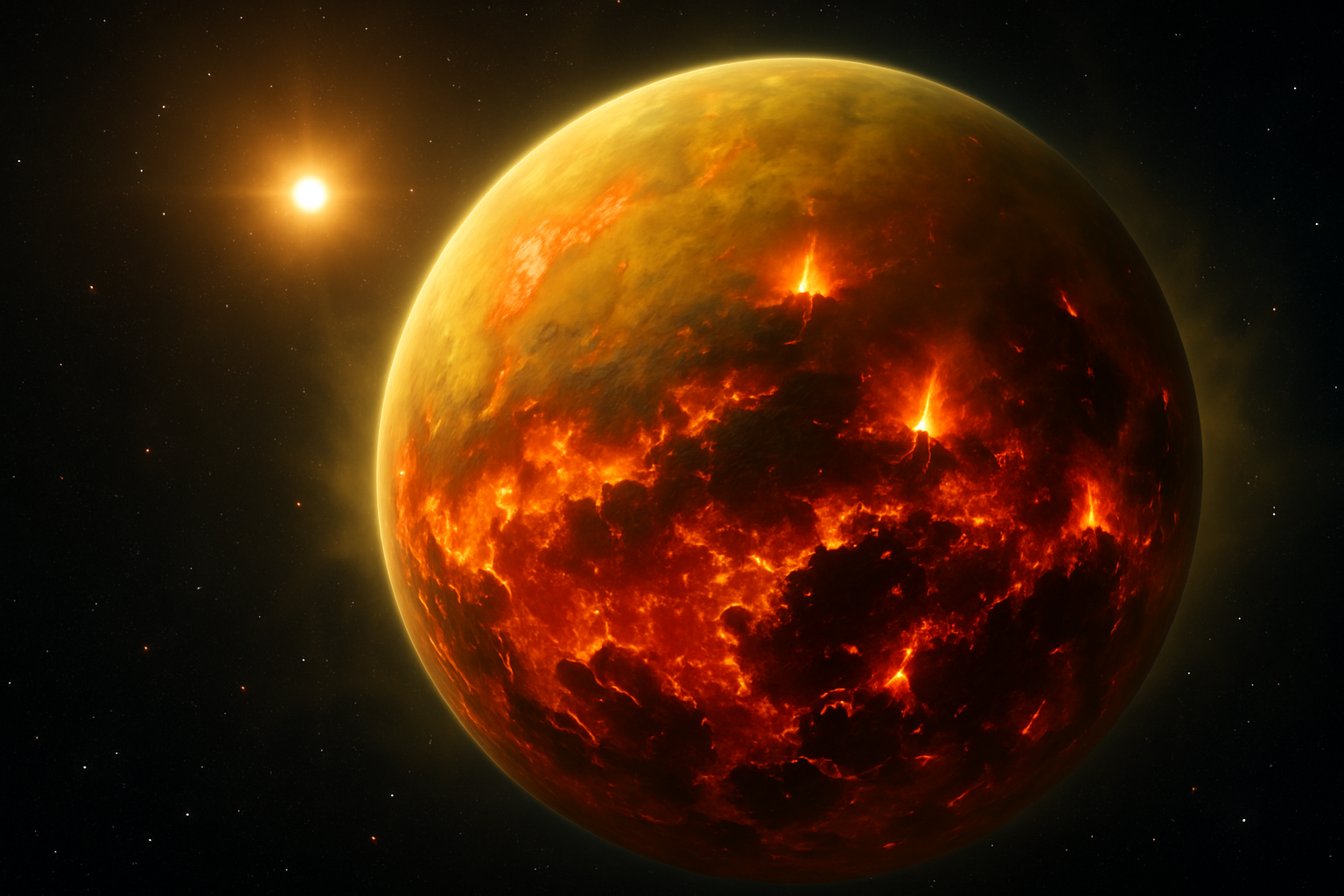
Oxford scientists have made a groundbreaking discovery of an extraordinary exoplanet featuring vast magma oceans and a sulfur-rich atmosphere, fundamentally challenging established theories about planetary formation and atmospheric evolution.
The remarkable world, measuring 1.6 times larger than Earth, exhibits a surprisingly low density despite its size, coupled with an unusual composition rich in volatile chemical compounds that defies conventional planetary science models. The discovery represents a significant milestone in our understanding of extreme planetary environments and the diversity of worlds that can exist beyond our solar system.
A World of Molten Seas
The newly discovered planet presents an alien landscape dominated by vast oceans of molten rock covering much of its surface. These magma seas, maintained at temperatures exceeding 2,000 degrees Celsius, create a dynamic environment where the boundary between solid surface and liquid rock constantly shifts based on volcanic activity and tidal forces from the host star.
According to the research team, the planet's magma oceans represent one of the most extreme surface conditions ever documented on an exoplanet. The molten rock seas exhibit complex circulation patterns driven by internal heat sources and stellar radiation, creating a planetary system unlike anything in our solar system.

Sulfur-Rich Atmospheric Composition
Perhaps even more intriguing than the magma oceans is the planet's thick atmosphere, composed primarily of sulfur compounds that create a dense, corrosive environment. The atmospheric composition includes hydrogen sulfide, sulfur dioxide, and other volatile sulfur species that would be toxic to Earth-based life forms.
This sulfur-dominated atmosphere challenges current models of atmospheric evolution, as most planetary formation theories predict atmospheres composed primarily of hydrogen, helium, water vapor, or carbon dioxide in various combinations. The prevalence of sulfur compounds suggests unique formation processes or subsequent atmospheric evolution pathways not previously documented.
The discovery builds upon recent breakthroughs in exoplanet atmospheric analysis, including European scientists' identification of the largest sulfur-containing organic molecules ever found in interstellar space, which was described as a "missing link" in understanding cosmic chemistry and life origins.
Challenging Planetary Formation Theories
The planet's unusual characteristics force astronomers to reconsider fundamental assumptions about how worlds form and evolve. Traditional planetary formation models suggest that worlds of this size should either be dense rocky planets or gas giants with substantial hydrogen-helium atmospheres.
This discovery joins a growing catalog of "impossible" planetary systems that are forcing revisions to established theories. Recent findings include planetary systems 116 light-years away that exhibit orbital configurations existing gravitational and accretion models suggested were impossible, and NASA's Juno mission revealing Jupiter is smaller and more flattened than believed for over 50 years.
"This discovery demonstrates that planetary formation processes are far more diverse than we previously understood. The combination of magma oceans with a sulfur-rich atmosphere suggests formation mechanisms that current theories cannot adequately explain."
— Dr. Sarah Mitchell, Oxford Planetary Sciences Department
Implications for Astrobiology
While the extreme conditions on this magma ocean world make it inhospitable to life as we know it, the discovery has important implications for astrobiology research. Understanding how such extreme environments form and evolve helps scientists better define the boundaries of potentially habitable worlds and the conditions that might support different types of life.
The sulfur-rich atmosphere particularly interests researchers studying extremophile organisms on Earth that thrive in sulfur-rich environments around volcanic vents and hot springs. These discoveries inform the search for life in extreme environments throughout the cosmos.
Recent research has shown that extremophile bacteria can survive conditions equivalent to asteroid impacts on Mars surface, providing experimental support for panspermia theory—the hypothesis that life can spread between planets through natural processes. Such research helps expand our understanding of life's resilience under extreme conditions.
Detection and Observation Techniques
The discovery was made possible through advanced spectroscopic analysis using cutting-edge space-based telescopes and ground-based observatories. The research team employed sophisticated algorithms to distinguish the planet's atmospheric signatures from stellar contamination and other sources of interference.
This achievement occurs during what astronomers call the "golden age of space observation," characterized by unprecedented international cooperation and advanced technology deployment. Recent extraordinary discoveries include cosmic ray detection in distant nebulae, James Webb Space Telescope observations revealing complex organic molecules in interstellar space, and breakthrough planetary atmospheric analysis techniques.
Context of Recent Space Discoveries
The magma ocean planet discovery comes amid a remarkable period of astronomical breakthroughs in 2026. Recent developments include the successful DART mission demonstrating humanity's ability to alter asteroid trajectories for planetary defense, ongoing Artemis program preparations for lunar exploration, and continued International Space Station research advancing space medicine for future deep space missions.
International cooperation continues to drive scientific advancement despite competitive dynamics in space exploration. Countries worldwide are expanding their space capabilities while maintaining collaborative frameworks for scientific discovery, reflecting the global nature of astronomical research.
Future Research Directions
The Oxford team plans extended observations of the magma ocean planet to better understand its atmospheric dynamics, surface composition changes over time, and potential for hosting moons or ring systems that might moderate some of its extreme conditions.
Future research will focus on identifying similar worlds to determine whether magma ocean planets represent a new class of exoplanets or extremely rare astronomical anomalies. Scientists are particularly interested in understanding the long-term stability of magma oceans and whether such worlds might eventually cool to form more Earth-like conditions.
Advanced space telescopes currently under development will provide enhanced capabilities for studying atmospheric composition and surface features of extreme exoplanets, potentially revealing additional worlds that challenge our understanding of planetary formation and evolution.
Broader Scientific Impact
This discovery contributes to humanity's expanding knowledge of cosmic diversity during a critical period of space exploration advancement. As commercial space companies prepare trillion-dollar valuations and nations accelerate space programs, fundamental research like this planetary discovery provides the scientific foundation for understanding the universe we're expanding into.
The finding also demonstrates the continued importance of basic scientific research in advancing human knowledge. While practical applications may not be immediately apparent, understanding extreme planetary environments informs everything from materials science to atmospheric modeling to the search for potentially habitable worlds around other stars.
The magma ocean planet discovery represents another milestone in humanity's quest to understand our place in the cosmos, revealing that the universe contains worlds far more diverse and extreme than we previously imagined. As space exploration enters a new golden age, such discoveries remind us that the cosmos still holds countless surprises waiting to be uncovered.