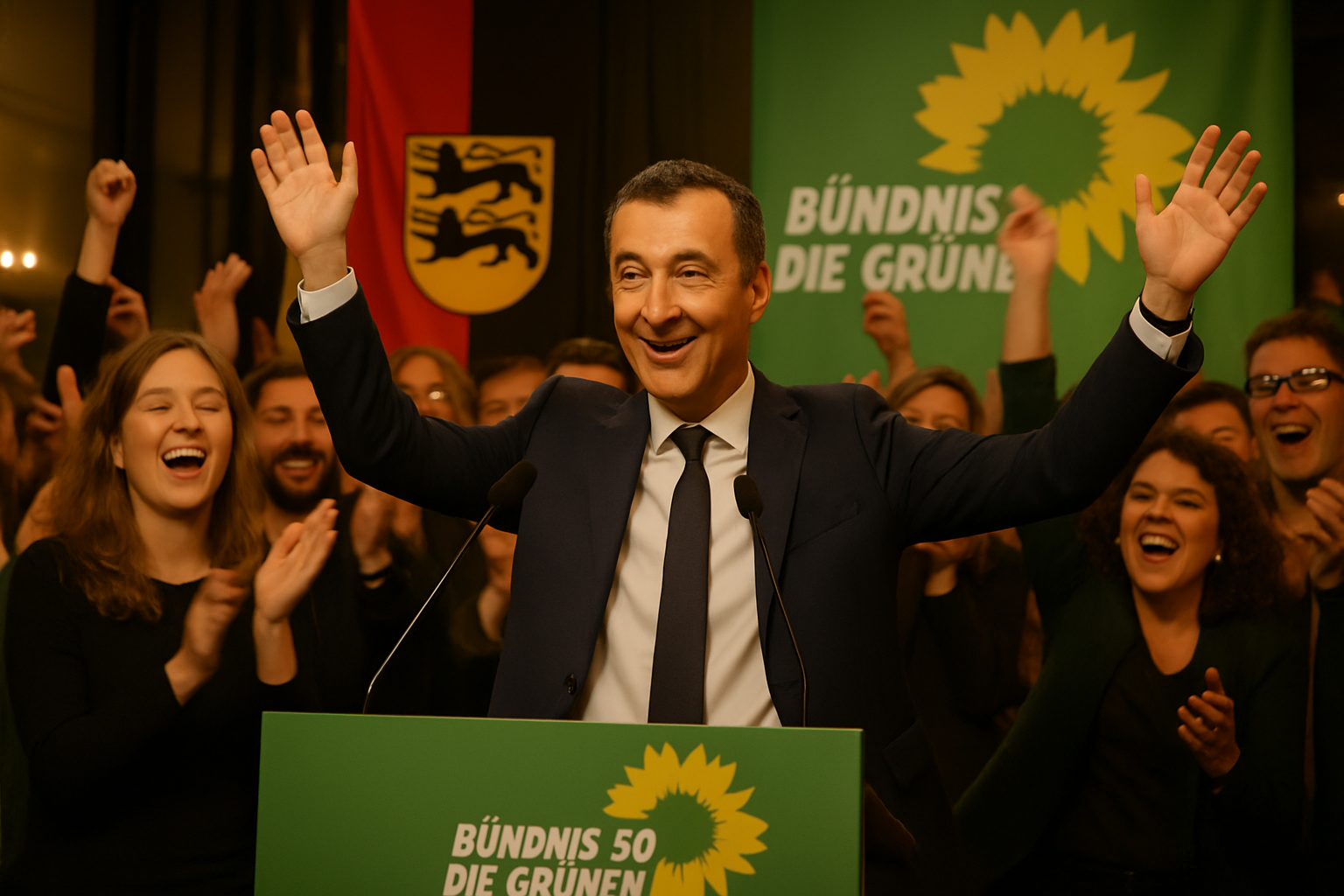
Environment Minister Cem Özdemir's Green Party secured a decisive victory in Baden-Württemberg's state election on Sunday, positioning him to become Germany's first state premier of Turkish heritage while dealing a significant blow to Chancellor Friedrich Merz's CDU in their first major electoral test.
The Greens maintained their leading position with 31.8% of the vote despite losses from their 2021 performance, successfully defending power in Germany's southwestern industrial heartland. The CDU, under Manuel Hagel's leadership, achieved a strong 29.6% showing but fell short of the predicted victory that would have reclaimed a state they governed for 58 years until 2011.
Özdemir's Personal Victory
Political analyst Jörg Schönenborn noted that "for every second Green voter, Özdemir was the decisive factor" in what he characterized as a successful Green "comeback on the home straight" after the CDU had led in earlier polls. The 58-year-old federal Environment Minister's candidacy proved to be the crucial element that transformed what appeared to be a likely CDU victory into a Green triumph.
Özdemir's success represents a remarkable political evolution from his early days as a Green Party co-leader to his current position as a potential state premier. His Turkish heritage adds historic significance to the victory, making him the first person of Turkish descent to lead a German state government.
"This victory shows that Germany is ready for leaders who represent our diverse society while delivering effective governance."
— Political observer, on the historic nature of Özdemir's win
Major Political Realignment
The election results signal a significant political realignment in Baden-Württemberg. The far-right Alternative for Germany (AfD) nearly doubled their 2021 result, securing third place with approximately 18% of the vote, representing their strongest showing yet in the traditionally conservative-liberal state.
Both the Free Democratic Party (FDP) and The Left failed to clear the 5% threshold, falling out of parliament entirely. The Social Democratic Party (SPD) narrowly maintained representation but recorded their worst-ever state result, highlighting the erosion of traditional party strongholds.
The results create complex coalition mathematics, with the most likely scenario being a continuation of the Green-CDU partnership that has governed the state, though now with the Greens clearly in the driver's seat rather than as junior partners.
Setback for Chancellor Merz
The defeat represents a significant setback for Chancellor Friedrich Merz, occurring during his first major electoral test since becoming party leader. The CDU had expected to reclaim a state they had governed for nearly six decades, making the loss particularly stinging for Merz's national authority.
French media characterized the result as a "bad surprise" for the Chancellor, coming after Merz secured a commanding 91.2% re-election at the Stuttgart party congress in February, where he vowed that the AfD would not "ruin our country." The election outcome demonstrates the continuing challenges facing Germany's traditional center-right party.
End of an Era
The election marks the end of Winfried Kretschmann's historic 15-year tenure as Germany's first Green Minister-President. Kretschmann's pragmatic, conservative style of Green politics helped establish the party as a credible governing force beyond its traditional environmental base, creating the foundation for Özdemir's victory.
The transition from Kretschmann to Özdemir represents both continuity and change for Baden-Württemberg's Green leadership, maintaining the party's governing competence while adding new dimensions of diversity and federal political experience.
AfD Breakthrough Raises Concerns
Despite the Green victory, the election's most troubling development was the AfD's breakthrough to nearly 18% of the vote, becoming the third-largest party in a state known for its economic prosperity and democratic stability. All established parties have ruled out cooperation with the AfD, but their strong showing reflects growing anti-establishment sentiment even in Germany's most successful regions.
The AfD's success in Baden-Württemberg, home to automotive giants like Mercedes-Benz and Porsche, challenges assumptions about the far-right party's appeal being limited to economically struggling areas in eastern Germany.
International and National Implications
The election results carry significance beyond Baden-Württemberg's borders. Coming during a period of severe European political crisis, the democratic resilience demonstrated despite challenging weather conditions and high political tensions provides a template for maintaining institutional stability.
For Germany's national politics, the results suggest continued challenges for traditional parties in adapting to changing voter preferences. The success of both the Greens and the AfD indicates a political landscape increasingly defined by environmental concerns on one side and anti-establishment sentiment on the other.
Economic and Policy Challenges Ahead
Özdemir's new government will face significant challenges in balancing Baden-Württemberg's economic competitiveness with environmental and social priorities. The state's automotive industry is undergoing rapid transformation toward electric vehicles, requiring careful policy management to maintain employment while advancing climate goals.
Housing costs, climate policies, and maintaining the state's prosperity while adapting to global economic shifts will test the new government's ability to deliver on voter expectations for effective governance combined with environmental leadership.
The election's outcome establishes Baden-Württemberg as a laboratory for demonstrating that ecological politics can succeed when combined with economic competence and inclusive representation, providing a potential model for Green parties across Europe facing similar electoral challenges.