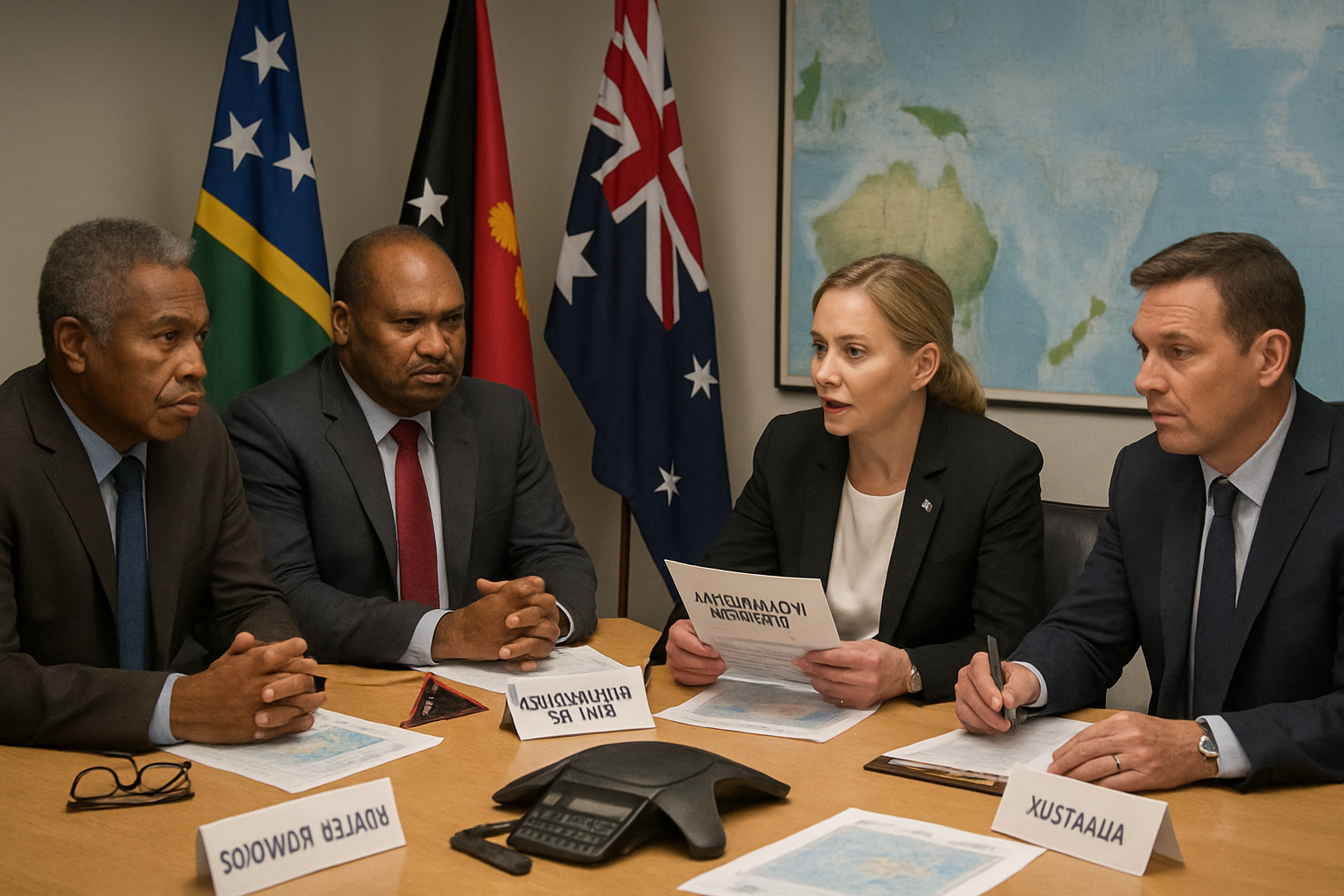
In an unprecedented display of regional solidarity, Pacific nations are forging new pathways for disaster response coordination as Solomon Islands formally requests Papua New Guinea police assistance for Cyclone Maila emergency operations, while Australia simultaneously announces expanded cyclone aid commitments to Pacific neighbors during what has become the longest sustained period of extreme global warming in recorded human history.
The coordinated response comes as the Pacific region faces its most challenging environmental period, with April 2026 marking the 24th consecutive month of global temperatures exceeding 1.5°C above pre-industrial levels—a milestone that has fundamentally altered atmospheric patterns and intensified tropical cyclone systems across the region.
Solomon Islands Requests Cross-Border Police Support
Solomon Islands has formally requested Papua New Guinea police assistance in responding to the devastating impacts of Cyclone Maila, marking a historic moment of Pacific regional cooperation in emergency response. The request represents the first formal cross-border police assistance sought between the two Melanesian nations for cyclone response operations.
Cyclone Maila, which reached Category 3 intensity with sustained winds of 120 km/h and gusts up to 165 km/h, has particularly impacted the Solomon Islands' infrastructure and emergency response capabilities. The storm's track through Milne Bay and Bougainville provinces in Papua New Guinea before affecting Solomon Islands created a shared disaster zone requiring coordinated international response.
"This represents a new model of Pacific solidarity," said a regional emergency management expert familiar with the arrangement. "When disasters cross borders, so must our response capabilities."
Australia's Expanded Pacific Cyclone Aid Framework
Australia has simultaneously announced an expanded cyclone aid framework for Pacific neighbors, building on existing TOGETHER program partnerships and recognizing the unprecedented frequency and intensity of tropical cyclone activity across the region. The pledge comes as emergency services globally operate beyond capacity limits, with traditional mutual aid mechanisms proving inadequate for simultaneous multi-national disasters.
The Australian commitment extends beyond immediate disaster response to include enhanced early warning systems, community preparedness programs, and infrastructure hardening initiatives designed to address the "new normal" of extreme weather frequency that has emerged during the current unprecedented warming period.
Australian authorities noted that the assistance framework incorporates lessons learned from recent Pacific disasters, including the sophisticated coordination demonstrated during previous cyclone responses and the growing recognition that climate adaptation requires sustained international cooperation rather than reactive crisis management.
Climate Context: Unprecedented Global Warming Period
The regional cooperation initiatives unfold against the backdrop of extraordinary climate conditions. January 2026 remains the hottest month ever recorded in human history, extending a warming streak that has completely overridden natural cooling mechanisms including La Niña effects.
The World Meteorological Organization indicates a 50-60% probability of El Niño conditions developing between July and September 2026, potentially driving temperatures into unprecedented territory through the combination of baseline warming plus natural cycle amplification. This "climate volatility paradox" enables both sustained global warming and devastating regional extremes through disrupted atmospheric circulation and polar vortex patterns.
"We're witnessing a fundamental shift in how Pacific nations must approach disaster preparedness and response. The frequency and intensity of these events requires us to think beyond traditional bilateral aid to genuine regional integration of emergency capabilities."
— Regional Emergency Management Official
Infrastructure Vulnerabilities Exposed
The current crisis has exposed critical infrastructure vulnerabilities across the Pacific region. Transportation networks, power grids, and communication systems designed for historical climate patterns are repeatedly failing as extreme weather exceeds operational parameters. Emergency services report operating at or beyond capacity limits, with traditional frameworks proving inadequate for simultaneous disasters across multiple nations.
Recovery timelines have fundamentally shifted from weeks to months or years, representing a permanent change in disaster response approaches. The concept of "building back better" has evolved from an optional enhancement to an essential survival strategy for Pacific island nations facing permanent climate volatility.
Papua New Guinea's ongoing challenges with the Connect PNG program—severely underfunded despite its vital importance for national integration across 800+ languages and scattered islands—illustrates the resource constraints that make regional cooperation essential for effective disaster response.
Regional Cooperation as Strategic Necessity
The emergence of coordinated Pacific disaster response reflects a broader recognition that environmental challenges transcend national boundaries. Atmospheric systems, ocean currents, and climate effects operate regardless of political borders, requiring unprecedented cooperation and enhanced coordination frameworks.
The Solomon Islands-PNG police cooperation and Australia's expanded aid commitments demonstrate how successful responses now require sophisticated synthesis of cutting-edge technology with traditional knowledge and community-based management. Advanced monitoring systems, satellite technology, and environmental DNA sampling provide rapid threat assessment, but effectiveness depends on community engagement and local expertise.
Regional frameworks allow smaller nations to access international expertise while contributing their own innovations to global knowledge networks, creating resilience against geopolitical volatility and providing templates for other regions facing similar challenges.
Emergency Management Evolution
Emergency management experts identify a fundamental paradigm shift from sequential isolated disasters to "compound disasters"—multiple emergency types occurring simultaneously across vast geographic areas. This evolution challenges traditional resource allocation and mutual aid mechanisms designed for historical patterns of regional disasters followed by recovery periods.
The current Pacific response demonstrates how emergency services must evolve beyond national boundaries to address climate-driven disasters that affect multiple countries simultaneously. Traditional assumptions about stable regions assisting others during emergencies break down when multiple continents face concurrent disasters.
Community resilience has also evolved, with Pacific communities demonstrating enhanced preparedness through improved communication networks, backup power systems, and social media coordination when traditional emergency systems become overwhelmed. Mental health services report increased demand for climate anxiety support as families face the prospect of losing homes multiple times per decade.
Economic and Social Implications
The coordinated disaster response efforts carry significant economic implications for the Pacific region. Agricultural operations face mounting losses as extreme weather destroys crops and disrupts supply chains during critical growing seasons. Tourism sectors experience extended cancellations and infrastructure damage during peak periods, while recovery costs escalate dramatically.
However, the emphasis on regional cooperation also presents opportunities. Countries implementing comprehensive disaster preparedness demonstrate economic resilience and attract sustainable investment in climate adaptation technologies. The prevention-first economic approach being adopted across the Pacific generates superior outcomes through reduced crisis intervention costs and improved long-term competitiveness.
Technology Integration Success Stories
The Pacific response showcases successful technology-tradition integration approaches that could serve as global models. Estonia's combination of agricultural wisdom with advanced climate monitoring, and Australia's integration of Indigenous fire management practices with modern meteorological forecasting, provide templates for sophisticated adaptation strategies.
Papua New Guinea's participation in international AI governance initiatives while maintaining strong traditional knowledge systems demonstrates how technological advancement can serve specific cultural and economic needs rather than replacing human relationships and community-based management systems.
Future Implications for Global Cooperation
The Pacific disaster response coordination efforts occurring during April 2026 represent a watershed moment in international cooperation frameworks. The choices being made regarding reactive crisis management versus transformative infrastructure adaptation will influence global disaster response approaches for decades.
Current conditions provide a preview of routine circumstances expected by the 2030s without comprehensive climate adaptation investment. The window for effective climate action continues to narrow as ecological systems approach critical thresholds with potentially irreversible changes to global food security, climate stability, and human settlements.
Tools, knowledge, and cooperation frameworks exist for comprehensive environmental protection, but success depends on unprecedented speed of coordination and sustained international cooperation with political commitment to environmental protection as essential infrastructure for human prosperity and planetary sustainability.
Strategic Significance for Global Community
The convergence of extreme weather events, infrastructure vulnerabilities, and emergency response limitations across the Pacific underscores the urgent need for coordinated international action. The question is no longer whether transformative climate action is needed, but whether humanity can organize and implement solutions rapidly enough to maintain planetary habitability during Earth's most environmentally challenging period in recorded history.
The Pacific region's approach to disaster response coordination—emphasizing regional solidarity, technology integration, and community resilience—offers valuable insights for other regions facing similar challenges. As additional weather systems develop across the Atlantic and Pacific, the persistence of these crisis patterns may establish a "new normal" of extreme weather frequency that permanently challenges traditional emergency response frameworks.
The success of Pacific regional cooperation during this unprecedented period will provide crucial lessons for global climate adaptation strategies affecting generations to come, demonstrating whether international solidarity can effectively respond to the permanent climate volatility era that now defines the Pacific century.