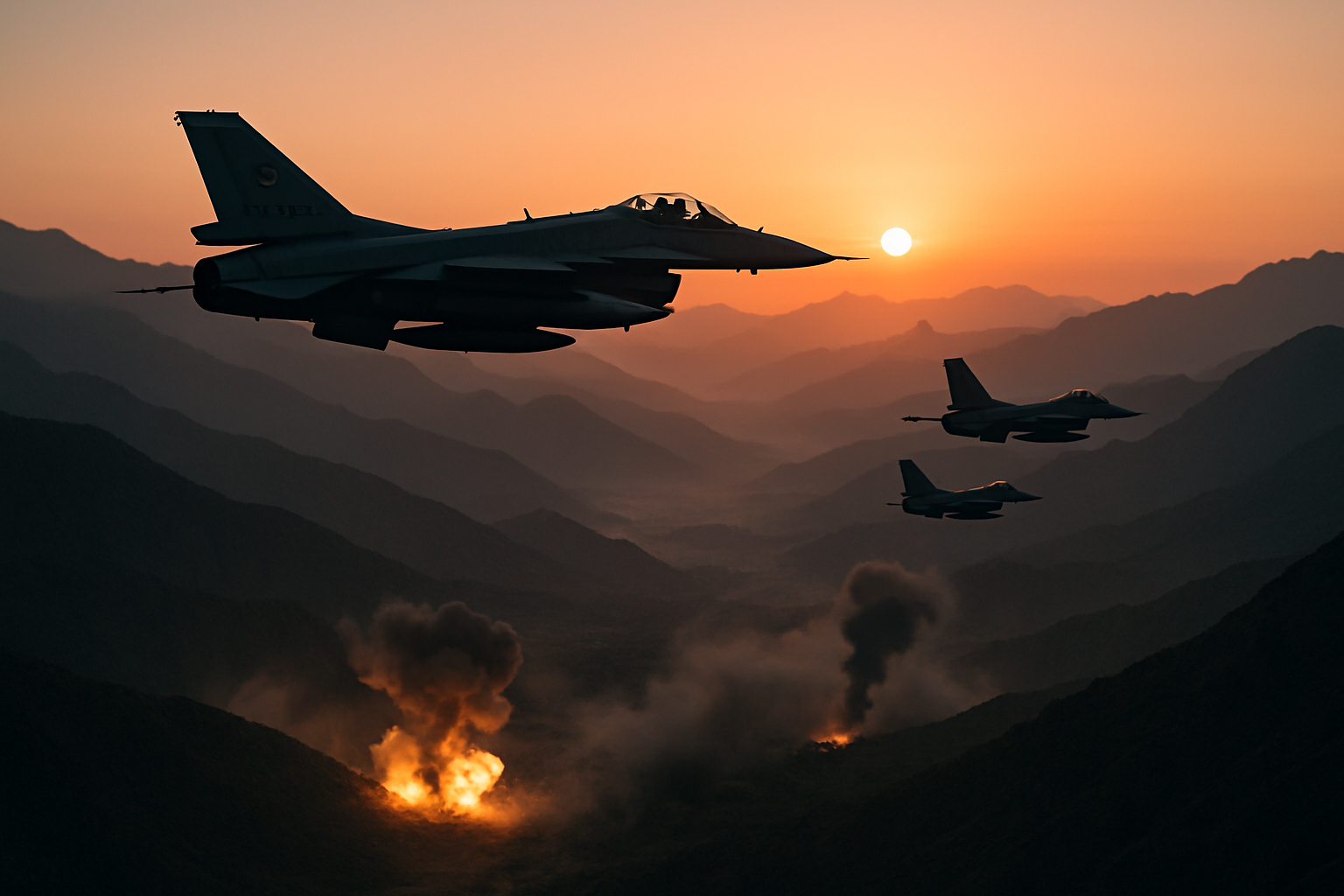
Pakistani airstrikes targeting seven militant camps across Afghanistan's eastern provinces have killed at least 80 militants according to Pakistani officials, while Taliban authorities report significant civilian casualties including eight schoolchildren among the dead, marking the most serious escalation in cross-border tensions in recent months.
The overnight strikes on February 21-22, 2026, targeted camps in Nangarhar and Paktika provinces that Pakistan claimed housed Tehreek-e-Taliban Pakistan (TTP) and ISIS-Khorasan Province militants responsible for recent deadly attacks on Pakistani soil. However, conflicting casualty reports and allegations of civilian deaths have intensified diplomatic tensions between Islamabad and the Taliban government.
Conflicting Casualty Reports Emerge
Pakistani Parliamentary Secretary Barrister Danyal Chaudhry defended the operations, stating that "national security is non-negotiable" and claiming that intelligence-based strikes eliminated over 80 terrorists operating from Afghan sanctuaries. According to Pakistani military sources, the precision operations targeted seven terrorist camps providing haven for militants planning attacks against Pakistani forces and civilians.
However, Taliban and United Nations sources paint a dramatically different picture. The UN Assistance Mission in Afghanistan (UNAMA) confirmed "credible reports of civilian casualties" from the airstrikes, which occurred between 23:45 on February 21 and 00:15 on February 22. UNAMA reported at least 13 civilians killed and seven others wounded, including women and children, in Behsud and Khogyani districts of Nangarhar province.
Most tragically, Afghan Ministry of Education officials confirmed that eight schoolchildren—five boys and three girls—were killed in the Behsud district strike. Education Ministry spokesman Mansoor Ahmad Hamza also reported a seminary student injured in Barmal district of Paktika province, highlighting the civilian impact of the military operations.
"At least eight schoolchildren — five boys and three girls — were killed in a Pakistani airstrike in Behsud district of Nangarhar province early Sunday."
— Afghan Ministry of Education Statement
Taliban Threatens "Measured Response"
The Taliban government has strongly condemned the strikes as violations of Afghan airspace and sovereignty. Taliban spokesman Zabihullah Mujahid warned of a "measured and appropriate response at suitable time," describing the protection of Afghanistan's sovereignty and population as "religious obligations and national duties."
In Nangarhar's Behsud district, which bore the brunt of the attacks, Taliban officials reported that strikes hit residential areas including a religious madrassa and civilian homes. Local sources described scenes of devastation with families trapped under rubble and emergency services struggling to reach affected areas.
The Taliban's Ministry of National Defense issued a formal statement condemning what it called "repeated violations of Afghanistan's airspace and bombing of civilian areas," rejecting Pakistan's justifications for the military action.
Context of Escalating Cross-Border Tensions
The airstrikes came in direct response to a February 16 attack on a Pakistani security checkpost in Bajaur district that killed 11 Pakistani soldiers. The assault, claimed by the TTP, involved a coordinated attack using a vehicle-borne improvised explosive device that collapsed infrastructure and damaged civilian buildings in the area.
Pakistani Defense Minister Khawaja Asif had previously threatened airstrikes against Afghanistan if cross-border attacks continued, arguing that TTP leadership operates "with impunity from Afghan soil" despite repeated Taliban assurances about controlling militant groups.
The strikes also followed the devastating February 6 Islamabad mosque bombing that killed 31 people and wounded 169 others during Friday prayers. The attack, claimed by ISIS-Khorasan Province, highlighted the persistent security threats facing Pakistan from groups allegedly operating from Afghan territory.
Diplomatic Efforts Prove Insufficient
The military escalation occurred despite recent Saudi-mediated diplomatic initiatives, including a February 2026 prisoner exchange that saw the Taliban release three Pakistani soldiers captured during October 2025 border clashes. The confidence-building measure, facilitated by Saudi Arabian mediation as part of Ramadan diplomatic efforts, proved insufficient to address underlying security challenges.
Pakistan has acknowledged its diminished regional influence over Afghanistan compared to wealthier powers including Turkey, the UAE, Qatar, Saudi Arabia, and China, potentially increasing its reliance on military solutions when diplomatic engagement fails to prevent terrorist incidents.
International Concerns Over Civilian Casualties
The targeting of civilian areas, including religious institutions and residential homes, has raised serious international humanitarian law concerns. The strikes during the holy month of Ramadan carry additional significance, as terrorist groups have frequently exploited religious periods for maximum psychological impact on targeted communities.
Chinese officials have previously warned the UN Security Council about the presence of ISIS-K, al-Qaeda, and the East Turkestan Islamic Movement (ETIM) in Afghanistan, contradicting Taliban claims of having "defeated terrorism" within the country's borders.
The sophisticated nature of recent attacks against Pakistani targets, including coordinated assaults and vehicle-borne improvised explosive devices, demonstrates that militant groups retain significant operational capabilities despite sustained military pressure from Pakistani forces.
Regional Security Architecture Under Strain
The escalation represents a critical test of both Taliban governance capability in controlling militant groups and Pakistan's resolve in using military action to secure its borders. The post-2021 Afghanistan security situation has created complex dynamics where international counter-terrorism concerns intersect with Taliban governance limitations and Pakistan's legitimate security needs.
Pakistan eliminated over 400 militants during February 2026 operations in Balochistan alone, demonstrating the multiple fronts the country faces in its counter-terrorism campaign. The difficult terrain, limited governance, and tribal dynamics along the Afghanistan-Pakistan border continue to provide challenges for militant sanctuary elimination requiring sustained international engagement.
Implications for Regional Stability
The success or failure of diplomatic versus military approaches to addressing cross-border terrorism will significantly influence future regional security architectures. The current crisis tests whether innovative diplomatic frameworks can balance legitimate security concerns with territorial integrity respect, or whether military escalation will dominate conflict management approaches.
Regional mediators, particularly Saudi Arabia, have demonstrated that diplomatic solutions can produce concrete humanitarian results, as evidenced by recent prisoner exchanges. However, the underlying security challenges persist when diplomatic engagement fails to prevent terrorist incidents that claim military and civilian lives.
The pattern demonstrates systematic challenges in addressing cross-border terrorism while respecting sovereignty, protecting civilians, and upholding international law principles. The resolution of this crisis may provide a template for similar regional challenges involving territorial sovereignty and transnational terrorism in the 21st century.
Looking Forward
As rescue operations continue in affected areas of Afghanistan and diplomatic channels remain active, the international community faces pressure to develop effective mechanisms that can prevent such escalations while addressing legitimate security concerns from all parties involved.
The tragedy of civilian casualties, particularly the loss of eight schoolchildren, underscores the urgent need for enhanced protection measures and sustainable diplomatic solutions that can address the root causes of cross-border terrorism while preventing further civilian suffering.
The coming weeks will prove critical in determining whether this escalation leads to broader regional conflict or serves as a catalyst for more comprehensive diplomatic engagement addressing the fundamental security challenges facing both Pakistan and Afghanistan.