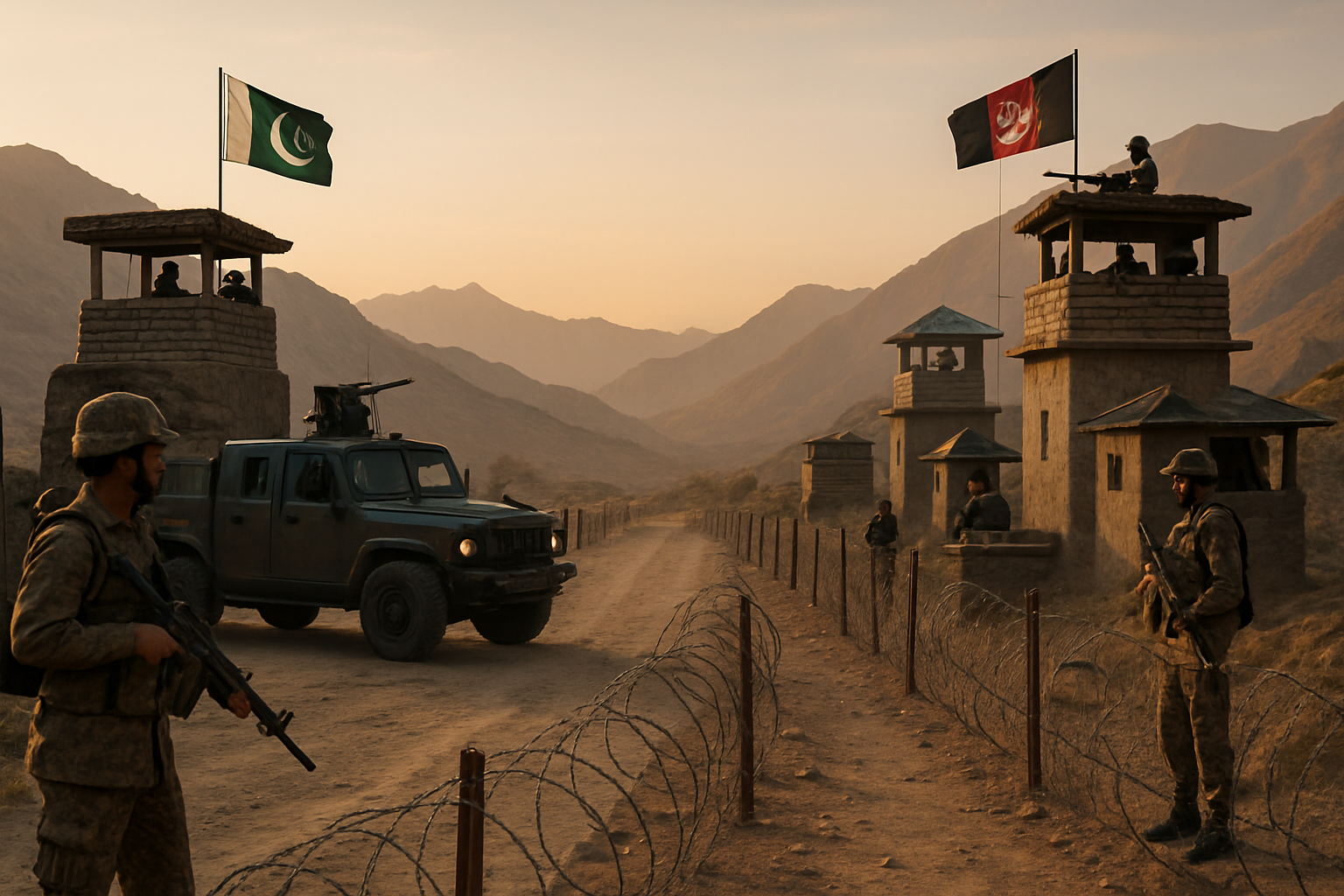
Pakistan's Defense Minister Khawaja Mohammad Asif formally declared "open war" against Afghanistan's Taliban government on February 27, 2026, following coordinated military strikes that have killed hundreds and prompted urgent international calls for dialogue and ceasefire.
The dramatic escalation represents the most serious military confrontation between the neighboring countries since the Taliban's return to power in August 2021, transforming months of border tensions into an unprecedented regional crisis that threatens to destabilize South Asia.
Military Operations Intensify Across Multiple Fronts
Pakistan launched Operation Ghazab-ul-Haq with coordinated airstrikes across Afghanistan's major cities including Kabul, Kandahar, Paktia, and Nangarhar provinces, targeting Taliban military facilities. Pakistani military spokesman Ahmed Sharif Chaudhry claimed the operation resulted in 274 Taliban officials and militants killed, while Pakistan lost 12 soldiers in the confrontations.
Heavy fighting erupted at the strategic Torkham border crossing, forcing the evacuation of dozens of families from returnee camps after shelling wounded seven people, including a woman. The conflict has evolved from isolated airstrikes to sustained territorial battles along the disputed 2,640-kilometer Durand Line.
Taliban forces responded with counter-strikes on Pakistani military targets in Islamabad, Nowshera, Jamrud, and Abbottabad at 11:00 AM local time. Afghanistan's Ministry of National Defense reported successful hits on military sites and facilities, while Pakistani forces captured five Afghan checkposts and raised Pakistani flags at Shawal, Angoor Adda, and Zarmilan positions.
Escalation Timeline and Immediate Triggers
The current crisis began with a February 16 terrorist attack in Pakistan's Bajaur district that killed 11 Pakistani soldiers using a vehicle-borne improvised explosive device. The assault, carried out by the banned Tehreek-e-Taliban Pakistan (TTP), prompted Pakistan to conduct retaliatory airstrikes on February 22 targeting seven terrorist camps in Afghanistan's Nangarhar and Paktika provinces.
"Pakistan will not change its approach toward Afghanistan following recent cross-border airstrikes,"
— Talal Chaudhry, Interior Ministry Official
While Pakistani sources claimed over 80 TTP and ISIS-K militants were eliminated in the February 22 strikes, the operations resulted in tragic civilian casualties, including 18 civilians and eight schoolchildren aged 5-15 years in Nangarhar's Behsud district. This civilian toll prompted Afghanistan to file a complaint with the UN Security Council through acting permanent representative Naseer Ahmad Faiq.
The Taliban warned of a "measured and appropriate response at suitable time," describing the protection of sovereignty as "religious obligations and national duties." This rhetoric escalation proved prophetic as the conflict spiraled toward the current military confrontation.
International Mediation Efforts Intensify
Multiple international actors have launched urgent mediation initiatives to prevent broader regional confrontation. Turkish Foreign Minister Hakan Fidan spearheaded diplomatic efforts, contacting Pakistani Foreign Minister Ishaq Dar, Afghan Foreign Minister Muttaqi, and counterparts in Qatar and Saudi Arabia to establish dialogue channels.
Iran has offered mediation services, warning that regional escalation could affect the broader Middle East. UN Secretary-General António Guterres expressed "deep concern" about the conflict's potential to destabilize regional security, while Hamas called for restraint and diplomatic dialogue between the neighboring Muslim nations.
The crisis has persisted despite previous diplomatic successes, including a February 2026 Saudi-mediated prisoner exchange that saw the Taliban release three Pakistani soldiers captured during October 2025 border clashes. This confidence-building measure, intended as a Ramadan goodwill gesture, proved insufficient to address underlying security challenges.
Economic Devastation and Humanitarian Impact
The military confrontation has accelerated the collapse of bilateral trade, which has already dropped 59% in the first seven months of the current fiscal year. Pakistan's exports to Afghanistan plummeted from over $550 million to $228 million, devastating border communities dependent on cross-border commerce.
The economic deterioration compounds Afghanistan's humanitarian crisis, where 88% of female-headed households cannot meet minimum living requirements according to UN data. Traditional trade routes through Chaman-Spin Boldak and Torkham have faced repeated closures, affecting civilian populations on both sides of the border.
Medical facilities in border regions have been overwhelmed treating wounded civilians, with rescue operations continuing for those trapped under rubble from the strikes. The targeting of civilian areas, including religious institutions during Ramadan, has raised serious international humanitarian law concerns.
Strategic Context and Regional Security
Pakistan acknowledges that it has lost traditional influence in Afghanistan to wealthier regional powers including Turkey, the UAE, Qatar, Saudi Arabia, and China. This diminished leverage has increased Pakistan's reliance on military solutions to address cross-border terrorism concerns.
Defense Minister Asif has maintained that TTP leadership operates "with impunity from Afghan soil" despite repeated Taliban assurances. The sophisticated nature of recent attacks, including coordinated assaults and vehicle-borne improvised explosive devices, demonstrates that militant groups retain significant operational capabilities despite sustained Pakistani counter-terrorism operations.
"The Taliban must make a clear choice between supporting terrorist organizations like TTP, BLA, Daesh, and Al Qaeda versus maintaining relations with Pakistan,"
— Lt. General Ahmed Sharif Chaudhry, DG ISPR
The Pakistan Senate passed a unanimous resolution condemning what it termed "unprovoked aggression" by Afghanistan and demanding the cessation of hostile actions. Prime Minister Shehbaz Sharif visited the General Headquarters and declared zero tolerance for any Taliban-TTP nexus.
Historical Significance of Border Disputes
The current conflict is rooted in century-old disputes over the Durand Line, the 2,640-kilometer border established by British colonial authorities in 1893. No Afghan government has ever formally recognized this boundary, viewing it as an artificial division of Pashtun tribal areas.
The porous and mountainous terrain along the border has provided sanctuary for militant groups, complicating bilateral relations for decades. Pakistan eliminated over 400 militants in February 2026 Balochistan operations alone, demonstrating the broader security challenges facing the country on multiple fronts.
Chinese officials have warned the UN Security Council about the continued presence of ISIS-K, al-Qaeda, and ETIM in Afghanistan, contradicting Taliban claims of having defeated terrorism. This international dimension adds complexity to the bilateral crisis, with spillover effects threatening regional stability.
Diplomatic Path Forward Uncertain
The declaration of "open war" represents an unprecedented escalation that tests whether diplomatic mechanisms can prevent broader regional confrontation. The success or failure of current mediation efforts could influence territorial sovereignty and transnational terrorism management globally, providing a template for 21st-century conflict resolution.
The Taliban has signaled openness to negotiations, with spokesman Zabihullah Mujahid stating that "its leaders are willing to negotiate with Pakistan as both sides claim to inflict heavy losses in fighting." However, fundamental disagreements over border control, militant sanctuaries, and sovereignty issues remain unresolved.
The crisis occurs at a critical juncture for Afghanistan's Taliban government, testing its capability to control militant groups operating from its territory while maintaining regional relationships. For Pakistan, it represents a test of resolve in using military action to secure its borders when diplomatic engagement appears insufficient.
International Community Response
The international community faces pressure to develop effective conflict prevention mechanisms before the crisis spreads to broader regional confrontation. Jordan has called for dialogue and restraint, emphasizing the importance of diplomatic solutions over military escalation.
The timing of the crisis, occurring during Ramadan and amid multiple global conflicts, adds urgency to resolution efforts. Regional powers recognize that instability along the Pakistan-Afghanistan border could affect broader Middle Eastern and South Asian security architectures.
UN observers have documented civilian casualties from Pakistani strikes, including children, raising questions about compliance with international humanitarian law. The systematic targeting of civilian areas during a holy month has drawn particular condemnation from international human rights organizations.
As military operations continue and diplomatic efforts intensify, the coming days will be critical in determining whether the "open war" declaration leads to sustained military confrontation or provides the crisis catalyst needed for comprehensive diplomatic resolution. The stakes extend far beyond the immediate border dispute, potentially reshaping regional security cooperation and international approaches to territorial sovereignty challenges in the 21st century.