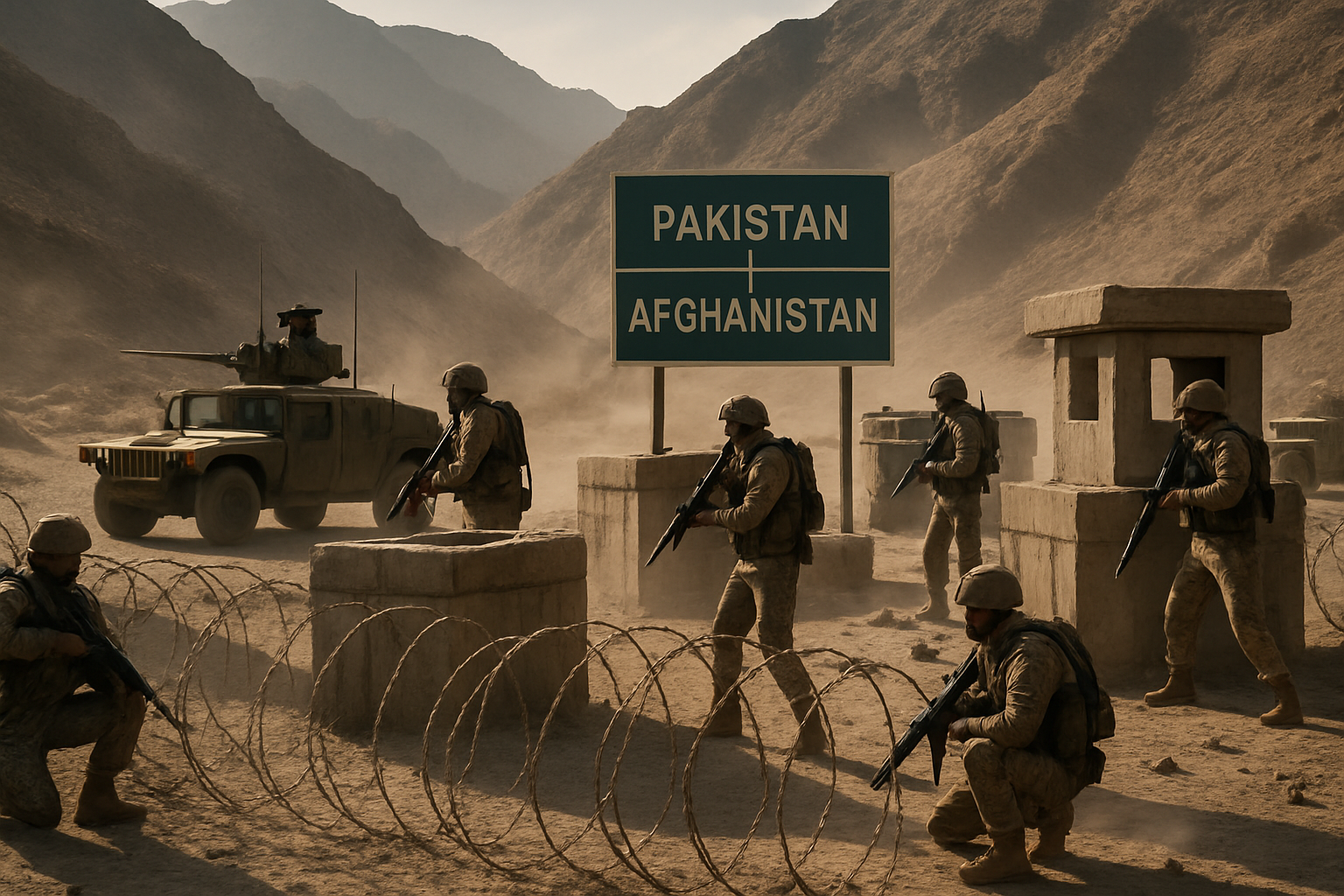
Heavy fighting erupted Wednesday evening between Pakistani security forces and Taliban fighters in the strategically vital Khyber region along the Pakistan-Afghanistan border, marking the latest escalation in a dangerous cycle of cross-border violence that has claimed hundreds of lives in recent months.
Security sources confirmed that intense clashes resumed Wednesday night in multiple locations across the Khyber border region, with exchanges of heavy gunfire and artillery continuing at several flashpoints. The fighting reportedly spread to the Zakhakhel market area, forcing local residents to seek shelter as both sides deployed heavy weapons in what observers describe as some of the most serious border confrontations in months.
Escalating Cross-Border Operations
The latest violence comes against a backdrop of dramatically deteriorating Pakistan-Afghanistan relations, with Pakistani forces conducting sweeping counter-terrorism operations that have eliminated over 400 militants across multiple provinces in February 2026 alone. According to Pakistan's Inter-Services Public Relations (ISPR), these intelligence-driven operations have targeted groups the military refers to as "Fitna Al Khwarij" and "Fitna Al Hindustan" – terms used to describe the banned Tehreek-e-Taliban Pakistan (TTP) and allied militant organizations.
The current confrontation follows a particularly deadly period that has seen Pakistani security forces intercept infiltrators at the border, storm militant hideouts in Lakki Marwat and Bannu, and engage in fierce gun battles in Mir Ali and Sambaza. Among the casualties reported from recent operations is Lieutenant Colonel Shahzada Gul Faraz, 43, who was martyred in a Bannu district operation when militants rammed an explosive-laden vehicle into a security convoy.
Pattern of Revenge and Retaliation
The escalating border violence represents a deadly pattern of attack and retaliation that has characterized Pakistan-Afghanistan relations since the Taliban's return to power in August 2021. Most significantly, Pakistan conducted coordinated airstrikes on February 22, targeting seven terrorist camps in Afghanistan's Nangarhar and Paktika provinces in response to a devastating February 16 attack in Bajaur district that killed 11 Pakistani soldiers.
"These operations demonstrate our resolve to protect Pakistani citizens from cross-border terrorism,"
— Pakistani Defense Official
Those airstrikes, described by Pakistan as "intelligence-based selective targeting," reportedly killed over 80 TTP and ISIS-K militants according to Pakistani sources. However, they also resulted in significant civilian casualties, including the deaths of 18 civilians among them eight schoolchildren – five boys and three girls – in Afghanistan's Behsud district, according to UN Assistance Mission in Afghanistan (UNAMA) confirmation.
Taliban Retaliation Threats Escalate
Afghanistan's Taliban government has responded to Pakistani military actions with increasingly aggressive rhetoric, warning of a "measured and appropriate response at suitable time." Taliban officials have described the protection of Afghanistan's sovereignty as "religious obligations and national duties," while filing formal complaints with the UN Security Council through acting permanent representative Naseer Ahmad Faiq.
The Taliban has categorically rejected Pakistan's claims that militant groups operate freely from Afghan soil, maintaining that no armed groups are based in Afghanistan territory. Taliban spokesman Zabihullah Mujahid has condemned Pakistani strikes as violations of airspace, sovereignty, and international law, particularly criticizing attacks on civilian areas including religious institutions during the holy month of Ramadan.
Diplomatic Mediation Efforts Fall Short
The current crisis has unfolded despite significant diplomatic efforts to reduce tensions between the two neighbors. Most notably, Saudi Arabia successfully mediated the release of three Pakistani soldiers in February 2026 who had been captured by Taliban forces during October 2025 border clashes. The prisoner exchange was facilitated through a Saudi delegation that traveled to Kabul specifically for this humanitarian gesture.
However, these confidence-building measures have proven insufficient to address the underlying security challenges that continue to destabilize the region. Pakistan's Foreign Office has repeatedly summoned Afghan officials, delivering formal demarches expressing "deep concern over the use of Afghan territory" for cross-border attacks.
Iranian mediation efforts have also been offered, with Foreign Ministry spokesman Esmaeil Baghaei warning that escalation could affect the broader region. Despite these diplomatic initiatives, the fundamental disagreements over militant sanctuaries and border security remain unresolved.
Economic Consequences Mount
Beyond the immediate security implications, the border violence has contributed to a devastating collapse in bilateral trade between Pakistan and Afghanistan. According to State Bank of Pakistan data, Pakistan's exports to Afghanistan have plunged from over $550 million to just $228 million in the first seven months of the current fiscal year – a staggering 59% decline that represents one of the steepest bilateral trade drops in recent regional history.
This economic deterioration compounds Afghanistan's broader humanitarian crisis, with UN reports indicating that 88% of female-headed households are unable to meet minimum living requirements. The repeated closure of traditional trade routes through Chaman-Spin Boldak and Torkham has particularly affected border communities dependent on cross-border commerce.
Regional Security Architecture Under Stress
The Pakistan-Afghanistan border crisis represents a critical test of the post-2021 security architecture in South Asia. China has warned the UN Security Council about the presence of ISIS-K, al-Qaeda, and ETIM in Afghanistan, contradicting Taliban claims to have "defeated terrorism." These concerns have been echoed by regional powers who fear spillover effects from continued instability.
Pakistan's Defense Minister Khawaja Asif has acknowledged the country's diminished influence in Afghanistan compared to wealthier regional powers including Turkey, the UAE, Qatar, Saudi Arabia, and China. This shifting dynamic has increased Pakistan's reliance on military solutions when diplomatic engagement fails to prevent terrorist incidents.
Civilian Impact and Humanitarian Concerns
The ongoing violence has taken a severe toll on civilian populations on both sides of the border. Pakistani security forces have documented over 1,600 systematic violations of previous ceasefire agreements, resulting in hundreds of civilian casualties. Medical facilities have been overwhelmed treating wounded from both military operations and terrorist attacks, while rescue operations continue for civilians trapped in conflict zones.
The attacks have specifically targeted religious minorities, with the February 6 ISIS-K bombing of an Islamabad mosque killing 31 people and wounding 169 others during Friday prayers. Such incidents demonstrate the calculated sectarian violence employed by extremist groups operating in the region.
International Monitoring and Concerns
The escalating tensions are being closely monitored by the international community, given their implications for regional stability. UN Secretary-General António Guterres has expressed "grave concern" over the deteriorating situation, while UN Special Rapporteur Richard Bennett has emphasized the need to uphold international law principles of distinction, proportionality, and precaution in military operations.
Amnesty International has called for thorough investigations into civilian casualties, noting a documented pattern of civilian harm along the Durand Line. The organization reported that between October and December 2025 alone, 70 civilians were killed and 478 injured in cross-border clashes.
Looking Forward: Challenges and Prospects
The current crisis represents the most serious Pakistan-Afghanistan border escalation in recent months, challenging the effectiveness of existing diplomatic frameworks and raising fundamental questions about territorial sovereignty versus transnational terrorism in the 21st century.
Success in resolving this crisis will depend on several critical factors: the Taliban's capability and willingness to control militant groups operating from Afghan territory, Pakistan's commitment to diplomatic engagement while addressing legitimate security concerns, and the continuation of regional mediation efforts supported by international confidence-building measures.
The stakes extend far beyond bilateral relations, as the resolution of this crisis could provide a template for addressing similar regional challenges where territorial sovereignty intersects with transnational terrorism. Failure to find diplomatic solutions risks further military escalation and continued civilian casualties, potentially destabilizing the broader South Asian security environment.
As both nations grapple with internal challenges – Pakistan's economic pressures and domestic security concerns, Afghanistan's humanitarian crisis and international isolation – the need for innovative diplomatic frameworks has never been more urgent. The international community's ability to facilitate dialogue and support confidence-building measures may ultimately determine whether this crisis escalates into broader regional conflict or serves as a catalyst for more effective bilateral cooperation mechanisms.