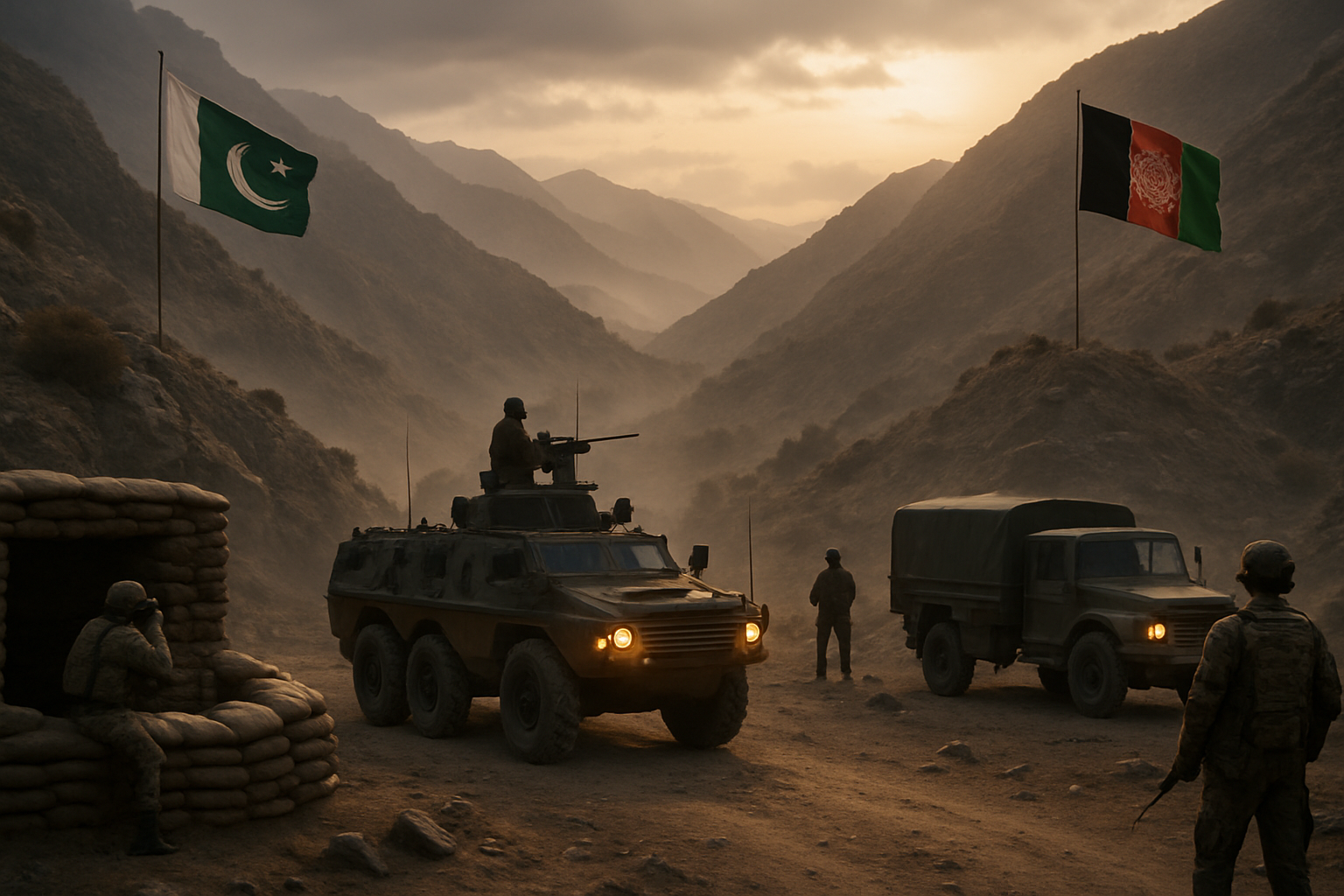
Fresh military clashes erupted along the Pakistan-Afghanistan border on Monday, with Pakistani forces launching artillery attacks in the Bajaur sector while Afghan authorities reported civilian casualties from continued cross-border shelling in Kunar province, marking the latest escalation in what has become the most serious confrontation between the two neighbors since the Taliban's return to power in 2021.
According to Afghan officials, Pakistani forces conducted heavy shelling targeting residential areas in eastern Afghanistan, leaving at least 16 people injured—mostly women and children—and one person killed in the latest round of violence. The Taliban's Deputy Spokesman, Hamdullah Fitrat, reported that Pakistani military forces fired mortars and heavy weapons at villages and civilian homes around 5 PM on Sunday in areas surrounding Asadabad, the provincial capital of Kunar Province.
Escalating Cross-Border Violence
The current crisis represents a dangerous escalation from what began as isolated border incidents into sustained military operations. Pakistani security sources confirmed that their forces "retaliated vigorously" after Afghan Taliban fighters opened fire with "small and large weapons" along different areas of the Bajaur sector in Khyber Pakhtunkhwa province.
"Pakistani security forces retaliated vigorously after Afghan Taliban fighters opened fire with small and large weapons along different areas of the border district."
— Pakistani Security Sources
The Pakistani military claimed their retaliatory fire successfully silenced enemy positions and destroyed several Afghan posts from which continuous firing had been conducted. However, Pakistani officials emphasized they "did not target any civilian population, but only targeted those posts from which continuous firing was being done."
International Protests and Diplomatic Fallout
The ongoing border tensions have sparked protests among the Afghan diaspora in major international cities. Hundreds of Afghans living abroad staged demonstrations in London and Oslo over the weekend, condemning what they described as continued military attacks by Pakistan that have led to rising civilian casualties in eastern Afghanistan.
In London, demonstrators marched through central streets, chanting slogans against the strikes and urging global powers to take urgent action. Protesters highlighted the deteriorating security situation along the disputed Durand Line, warning that repeated shelling risks further destabilizing already fragile communities along the border.
Members of the Afghan community in Oslo gathered outside the Norwegian Parliament, where they denounced the attacks and called for accountability. Protest organizers said a formal resolution was submitted to Norwegian authorities as well as to the United Nations, demanding international intervention to prevent further escalation.
Historical Context and Root Causes
The current tensions are rooted in longstanding disputes over the 2,640-kilometer Durand Line, the colonial-era border established by the British in 1893 that has never been officially recognized by any Afghan government. This disputed boundary runs through predominantly Pashtun tribal areas, creating a complex web of ethnic, territorial, and sovereignty issues that have plagued Pakistan-Afghanistan relations for decades.
The immediate trigger for the current escalation can be traced back to a February 16, 2026 attack in Bajaur that killed 11 Pakistani soldiers in a vehicle-borne improvised explosive device (VBIED) attack claimed by the banned Tehreek-e-Taliban Pakistan (TTP). Pakistan's subsequent airstrikes on February 22 targeting seven alleged terrorist camps resulted in civilian casualties, including eight schoolchildren, further inflaming tensions.
The crisis reached unprecedented levels when Pakistani Defense Minister Khawaja Mohammad Asif formally declared "open war" against Afghanistan's Taliban government on February 27, marking the most serious military confrontation between the neighbors since the Taliban's return to power.
Humanitarian Impact and Economic Consequences
The ongoing conflict has created a severe humanitarian crisis, with the UN Office for the Coordination of Humanitarian Affairs (OCHA) reporting that 16,370 families have been newly displaced across 10 Afghan provinces. The UN Assistance Mission in Afghanistan (UNAMA) has documented 185 civilian casualties since late February, including 56 deaths and 129 injuries, with the majority being women and children.
The World Health Organization has been forced to deliver emergency medical oxygen to only 23 hospitals, while hundreds of health centers have been forced to close due to security concerns and funding shortages. This compounds Afghanistan's existing humanitarian crisis, where 88% of female-headed households are unable to meet minimum living requirements.
Economic relations between the two countries have also suffered dramatically, with bilateral trade collapsing by 59% over seven months—Pakistani exports to Afghanistan falling from $550 million to just $228 million. Traditional trade routes through Chaman-Spin Boldak and Torkham have faced repeated closures, severely affecting border communities that depend on cross-border commerce.
International Mediation Efforts
Despite intensive diplomatic efforts by multiple regional and international actors, mediation attempts have thus far failed to produce lasting results. Saudi Arabia mediated a prisoner exchange in February 2026 that secured the release of three Pakistani soldiers, while Turkey, Iran, Russia, and China have all offered mediation services.
Religious scholars have also attempted to intervene, with Islamic scholar Ali al-Qaradaghi issuing fatwas calling for ceasefires during the holy month of Ramadan. A temporary ceasefire was achieved during Eid al-Fitr (March 18-23) through Saudi-Qatar-Turkey coordination, representing the first significant de-escalation since the crisis began. However, this truce was immediately violated, highlighting the fragility of current diplomatic arrangements.
Nuclear Dimensions and Regional Security
The involvement of nuclear-armed Pakistan adds a particularly dangerous dimension to the conflict, requiring careful international monitoring to prevent escalation beyond conventional military operations. The crisis represents the most serious test of the post-2021 South Asian security architecture since the Taliban's return to power.
Pakistan has acknowledged that its traditional influence in Afghanistan has diminished compared to wealthier regional powers including Turkey, the UAE, Qatar, Saudi Arabia, and China, forcing it to increasingly rely on military solutions to address security concerns.
Chinese officials have issued warnings to the UN about the presence of ISIS-K, al-Qaeda, and the East Turkestan Islamic Movement (ETIM) in Afghanistan, contradicting Taliban claims about having defeated terrorist organizations and secured the country.
Current Status and Future Prospects
The Taliban government maintains that "the path of talks remains open" and continues to seek resolution through "mutual understanding and respect." However, Pakistan has indicated there is "no rush" to end the military campaign until concrete anti-militant measures are implemented by the Afghan authorities.
Pakistan continues to maintain that the TTP operates "with impunity from Afghan soil," while the Taliban categorically denies providing sanctuary to militant groups or allowing Afghan territory to be used for attacks against neighboring countries.
"Once again, the militias of the Pakistani military regime conducted shelling on rural areas and civilian residences located on the outskirts of Asadabad using mortars and other heavy weapons."
— Hamdullah Fitrat, Taliban Deputy Spokesman
Template for 21st Century Conflict Resolution
The Pakistan-Afghanistan border crisis has become a template-setting conflict for how the international community addresses the intersection of territorial sovereignty and transnational terrorism in the 21st century. The success or failure of diplomatic containment efforts will likely influence approaches to similar regional security challenges worldwide.
The crisis demonstrates both the potential and limitations of faith-based diplomacy, with religious and cultural considerations providing temporary peace leverage but proving insufficient to address underlying structural security challenges without sustained international engagement.
As the conflict continues, the international community faces mounting pressure to develop innovative diplomatic frameworks that can effectively balance legitimate security concerns with respect for territorial integrity, civilian protection, and compliance with international law. The stakes extend far beyond bilateral relations between Pakistan and Afghanistan, with implications for regional stability and global security architecture in an era where nuclear-armed neighbors face off over disputed territories and cross-border terrorism concerns.