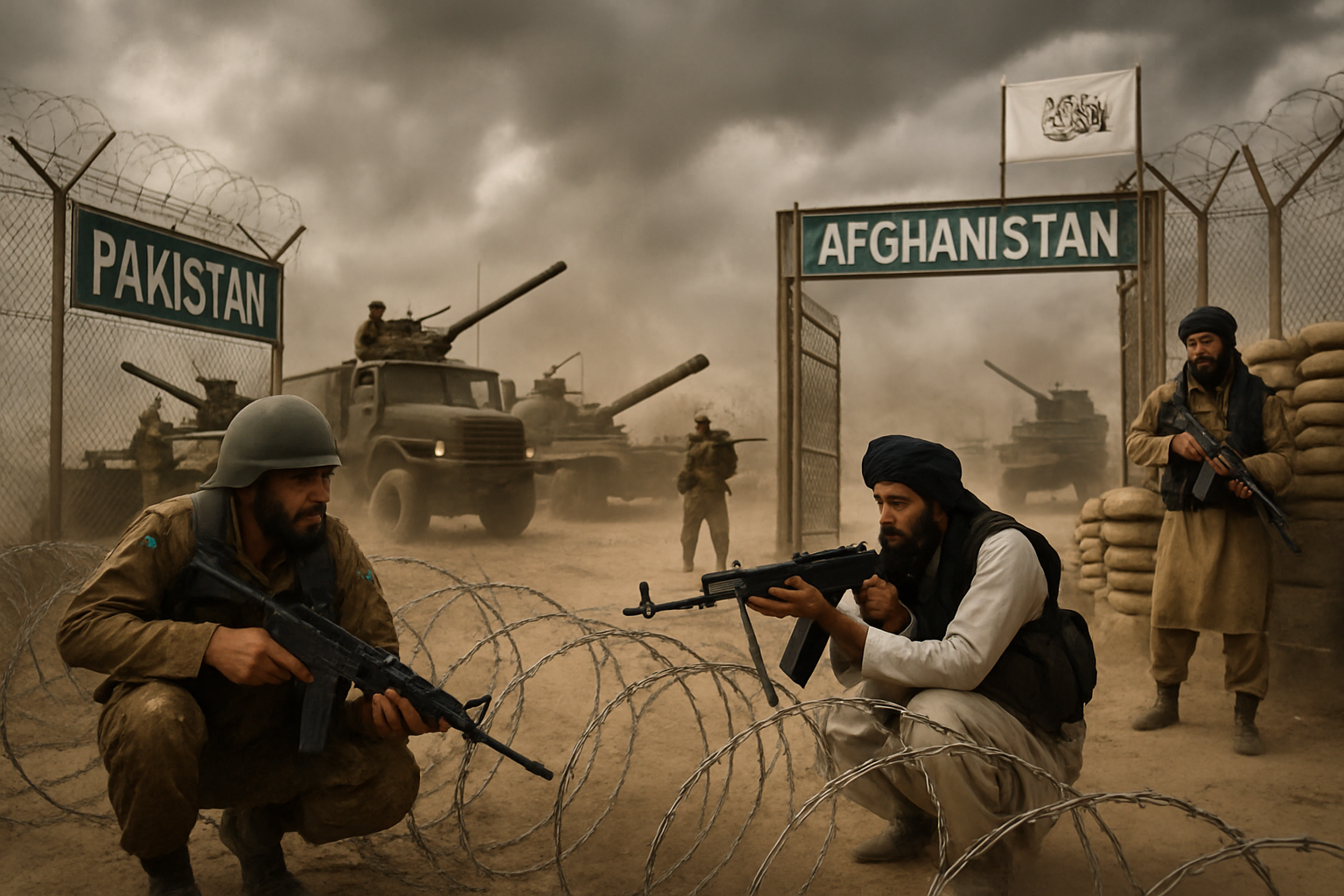
Fresh military confrontations between Pakistan and Afghanistan have intensified along their contested border, with Pakistani forces claiming to have captured 32 square kilometers of Afghan territory while Taliban officials report significant civilian casualties from cross-border operations.
According to Pakistani sources, the military operation named "Ghazb-Lil-Haq" has resulted in Pakistan's security forces taking control of approximately 32 square kilometers of territory in the Zhob District sector, an area now being referred to as the "Ghudwana Enclave." The operation represents a dramatic escalation in cross-border tensions that have been building since February 2026.
Mounting Civilian Casualties
Taliban deputy spokesman Hamdullah Fitrat claimed that 52 people have been killed and 66 others wounded in Pakistani attacks since February 26, with most victims reportedly being women and children. The casualties allegedly stem from what Afghan officials describe as indiscriminate bombing of civilian areas in Afghanistan's eastern provinces.
The escalation follows a series of incidents that began with a February 16 attack in Pakistan's Bajaur district, where 11 Pakistani soldiers were killed in a coordinated assault by the banned Tehreek-e-Taliban Pakistan (TTP). The attack involved a vehicle-borne improvised explosive device that collapsed security infrastructure and damaged nearby civilian buildings.
"The escalation followed what he described as the bombing of a farmer's family by Pakistani forces in Nangarhar."
— Hamdullah Fitrat, Taliban Deputy Spokesman
Pakistan's Military Response
Pakistan's response has been swift and comprehensive. Following the Bajaur attack, Pakistani forces conducted airstrikes on what they claimed were seven terrorist camps in Afghanistan's Nangarhar and Paktika provinces, targeting TTP and ISIS-K positions. Pakistani military sources report eliminating over 80 militants in these operations.
The military campaign has evolved beyond airstrikes to include ground operations. Pakistan's Information Ministry has rejected Taliban claims about a Pakistani military aircraft being shot down, with officials dismissing these reports as "amplified by Indian media and Afghan propaganda outlets."
Defense Minister Khawaja Asif has taken an increasingly hardline stance, previously threatening continued military action if cross-border attacks persist. Pakistan maintains that TTP leadership operates "with impunity from Afghan soil" despite repeated Taliban assurances about preventing territorial use for attacks against neighboring countries.
International Diplomatic Response
The European Union has called for urgent de-escalation and cessation of the conflict, warning that the confrontation could have serious consequences for regional stability. The EU's intervention represents growing international concern about the potential for the crisis to destabilize South Asia more broadly.
Afghanistan's Interior Minister Khalifa Sirajuddin Haqqani has engaged in diplomatic outreach, holding telephone conversations with Syria's Foreign Minister to discuss the deteriorating situation with Pakistan. The Taliban leadership has emphasized that "the path of talks remains open" despite the military escalation.
Iran has offered mediation services, warning of broader regional implications if the conflict continues to escalate. The crisis has also drawn attention from other regional powers concerned about spillover effects.
Historical Context and Border Disputes
The current crisis unfolds against the backdrop of the disputed Durand Line, a 2,640-kilometer colonial-era border established by the British in 1893. Afghan governments have never formally recognized this boundary, viewing it as an artificial division of Pashtun tribal areas.
The porous mountainous terrain along the border has historically provided sanctuary for militant groups, complicating bilateral relations and security cooperation. Pakistan has conducted extensive counter-terrorism operations in 2026, eliminating over 400 militants in Balochistan province alone, demonstrating the scope of the security challenges.
Previous diplomatic efforts, including a Saudi-mediated prisoner exchange in February 2026 that secured the release of three Pakistani soldiers captured by the Taliban, have proven insufficient to address underlying security concerns. These confidence-building measures were overshadowed by continued militant attacks from Afghan territory.
Economic and Humanitarian Impact
The military confrontation has devastated bilateral economic relations, with trade between the two countries collapsing by 59%. Pakistan's exports to Afghanistan dropped from $550 million to $228 million over a seven-month period, severely affecting border communities dependent on cross-border commerce.
This economic disruption compounds Afghanistan's humanitarian crisis, where according to UN data, 88% of female-headed households are unable to meet minimum living requirements. The Taliban's employment restrictions since August 2021 have affected approximately half of the workforce, creating widespread economic hardship.
Traditional trade routes through Chaman-Spin Boldak and Torkham crossing points have faced repeated closures, disrupting the livelihoods of merchants, transporters, and border communities who depend on cross-border economic activity.
Regional Security Architecture Under Strain
The Pakistan-Afghanistan confrontation represents the most serious test of post-2021 South Asian security arrangements since the Taliban's return to power. Pakistan acknowledges having diminished regional influence compared to wealthier powers like Turkey, UAE, Qatar, Saudi Arabia, and China, which may be pushing Islamabad toward military solutions.
Chinese warnings at the UN Security Council about the presence of ISIS-K, al-Qaeda, and ETIM (East Turkestan Islamic Movement) in Afghanistan contradict Taliban claims of having "defeated terrorism." These assessments suggest that the security challenges extend beyond bilateral Pakistan-Afghanistan tensions to broader regional stability concerns.
The crisis also intersects with other recent security incidents, including a February 6 ISIS-K attack on an Islamabad mosque that killed 31 people and wounded 169 others, demonstrating the persistent threat from Afghan-based militant groups.
Prospects for Resolution
Despite the military escalation, Taliban officials continue to emphasize diplomatic solutions. Senior Taliban leaders, including Zabihullah Mujahid and Foreign Minister Amir Khan Muttaqi, have stated that dialogue remains the preferred path forward, seeking resolution through "mutual understanding and respect."
However, Pakistan's public commitment to maintaining tough security policies suggests that diplomatic progress will be difficult without concrete Taliban action against militant groups operating from Afghan territory. The success or failure of current mediation efforts by Iran, Saudi Arabia, and other regional powers will be crucial in determining whether the crisis escalates further or finds a negotiated resolution.
The international community faces pressure to develop effective conflict prevention mechanisms before the confrontation evolves into a broader regional war. The current crisis represents a critical test of whether diplomatic frameworks can manage territorial sovereignty disputes intersecting with transnational terrorism in the 21st century.
As military operations continue and civilian casualties mount, the Pakistan-Afghanistan border crisis has become emblematic of the complex challenges facing post-conflict governance in Afghanistan and regional security cooperation in South Asia. The coming days will be decisive in determining whether international mediation can prevent further escalation or if the region faces prolonged military confrontation between nuclear-armed neighbors.