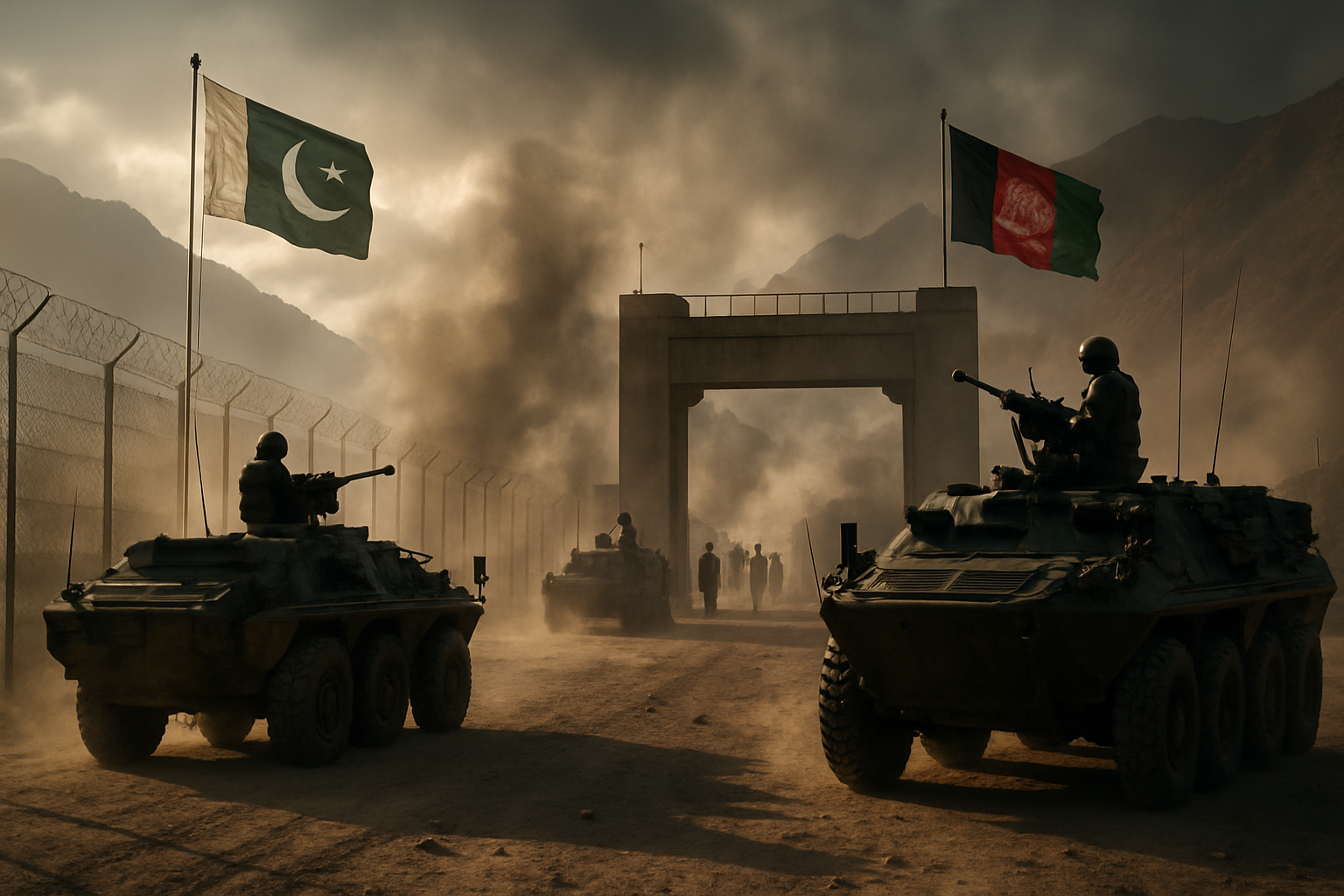
Pakistani Defense Minister Khawaja Asif formally declared "open war" against Afghanistan's Taliban government on Friday, following a dramatic escalation of cross-border military operations that has plunged the region into its most serious crisis since the Taliban's return to power in 2021.
The declaration came after Pakistan conducted coordinated airstrikes across Afghanistan's major cities, including Kabul, Kandahar, and Paktia, while Afghanistan retaliated with its own military operations targeting Pakistani positions. The unprecedented escalation has shattered the fragile peace along the disputed 2,640-kilometer Durand Line border.
Immediate Trigger and Military Operations
"Our cup of patience has overflowed. Now it is open war between us and you," Defense Minister Asif announced on Friday, marking the first time Pakistan has formally declared such hostilities against its neighbor since Afghanistan's establishment.
Pakistani military sources claim their Operation Ghazab-ul-Haq strikes killed 133 Taliban fighters, wounded over 200, and destroyed more than 80 armored vehicles. The operations targeted Taliban military facilities across multiple provinces in what Pakistan described as retaliation for cross-border terrorism.
Afghanistan's Ministry of National Defense confirmed extensive bombing operations but disputed casualty figures. Taliban spokesman Zabihullah Mujahid described the strikes as violations of sovereignty while confirming Afghanistan had launched its own counter-strikes against Pakistani military installations.
Border Clashes Intensify
Heavy fighting erupted at the strategic Torkham border crossing, with Taliban forces conducting airstrikes against Pakistani military targets in Islamabad, Nowshera, Jamrud, and Abbottabad. Afghanistan's Ministry of Defense reported successful hits on key military sites and facilities during operations conducted at 11:00 AM local time.
Pakistani armed forces responded by capturing five Afghan checkposts and raising Pakistani flags at strategic positions along the border, including areas opposite Shawal, Angoor Adda, and Zarmilan. The ground confrontation represents an evolution from previous airstrikes to sustained territorial battles.
At least seven people were wounded, including a woman, when shelling hit a returnees' camp in Nangarhar province, forcing dozens of families to evacuate as the conflict spread beyond military targets.
Historical Context and Escalation Timeline
The current crisis stems from a deadly cycle of violence that began with a February 16 attack in Pakistan's Bajaur district, where militants affiliated with the banned Tehreek-e-Taliban Pakistan (TTP) killed 11 Pakistani soldiers using a vehicle-borne improvised explosive device.
Pakistan retaliated on February 22 with airstrikes on seven alleged terrorist camps in Afghanistan's Nangarhar and Paktika provinces, claiming to eliminate over 80 militants but causing civilian casualties including eight schoolchildren in Behsud district.
The Taliban had warned of a "measured and appropriate response" to Pakistani airstrikes, describing the protection of Afghanistan's sovereignty as "religious obligations and national duties."
International Mediation Efforts
Turkey's Foreign Minister Hakan Fidan launched diplomatic initiatives Friday, conducting phone conversations with both Pakistani Foreign Minister Mohammed Ishaq Dar and Afghan Foreign Minister Amir Khan Muttaqi. Fidan also engaged with regional partners, including Qatari and Saudi foreign ministers, in efforts to de-escalate tensions.
Iran has offered mediation services, warning that escalation could affect the broader region. Russia's presidential spokesman Dmitry Peskov emphasized Moscow was closely monitoring the situation, expressing hope that clashes would end soon.
The crisis has unfolded despite recent diplomatic efforts, including a Saudi-mediated prisoner exchange in February 2026 that saw the Taliban release three Pakistani soldiers captured during October 2025 border clashes.
Economic and Humanitarian Impact
The conflict has devastated bilateral trade, with Pakistan's exports to Afghanistan collapsing 59% from over $550 million to $228 million in the first seven months of the current fiscal year. This economic deterioration affects border communities dependent on cross-border commerce and compounds Afghanistan's humanitarian crisis.
According to UN assessments, 88% of female-headed households in Afghanistan are unable to meet minimum living requirements, while the broader population struggles amid the worst humanitarian crisis in 25 years.
Regional and Global Implications
Pakistan acknowledges its diminished regional influence over Afghanistan compared to wealthier powers including Turkey, UAE, Qatar, Saudi Arabia, and China. This reduced diplomatic leverage has increased Pakistan's reliance on military solutions to address cross-border terrorism concerns.
Pakistani officials maintain that TTP leadership operates "with impunity from Afghan soil" despite Taliban assurances about preventing territorial use for attacks against neighboring countries. The conflict tests the Taliban's governance capabilities and commitment to controlling militant groups operating from Afghanistan.
Chinese officials have warned the UN Security Council about the continued presence of ISIS-K, al-Qaeda, and other terrorist groups in Afghanistan, contradicting Taliban claims of having "defeated terrorism."
"This represents the most serious Pakistan-Afghanistan confrontation in decades," according to regional security analysts.
— Security Expert Assessment
Civilian Response and National Unity
Despite the military escalation, reports from Kabul indicate that life in Afghanistan's capital remains relatively calm, with residents continuing their daily routines without widespread fear or anxiety. Many Kabul residents have expressed support for the Taliban's retaliatory operations.
Afghan citizens across the country have demonstrated strong resolve, with some describing Pakistan's actions as aggression against Islam and humanity. Community leaders emphasize Afghanistan's historical resistance to foreign interventions and current unity against perceived Pakistani aggression.
Strategic Significance
The "open war" declaration represents an unprecedented escalation that could reshape South Asian security dynamics. Success or failure in managing this crisis will influence regional approaches to territorial sovereignty versus transnational terrorism challenges.
The conflict occurs along the colonial-era Durand Line, a boundary that Afghanistan's governments have never formally recognized and which they view as an artificial division of Pashtun tribal areas. The porous mountainous terrain has historically provided sanctuaries for militant groups, complicating bilateral relations.
International observers describe the situation as a critical test of 21st-century conflict resolution mechanisms, with implications extending far beyond the immediate region.
Path Forward
The coming days will determine whether diplomatic interventions can contain the escalation or if sustained military confrontation will emerge. Pakistan's commitment to maintaining its tough security policy suggests continued military action if cross-border attacks persist.
The Taliban's retaliation threats and "open war" capabilities indicate potential for significant escalation that could affect broader regional stability. International mediation efforts by Turkey, Iran, and other regional powers will be crucial for preventing a wider conflict.
The crisis represents a comprehensive challenge requiring innovative diplomatic frameworks that balance legitimate security concerns with territorial integrity, civilian protection, and international law compliance. The resolution may provide a template for addressing similar territorial sovereignty and transnational terrorism intersections in contemporary global governance.