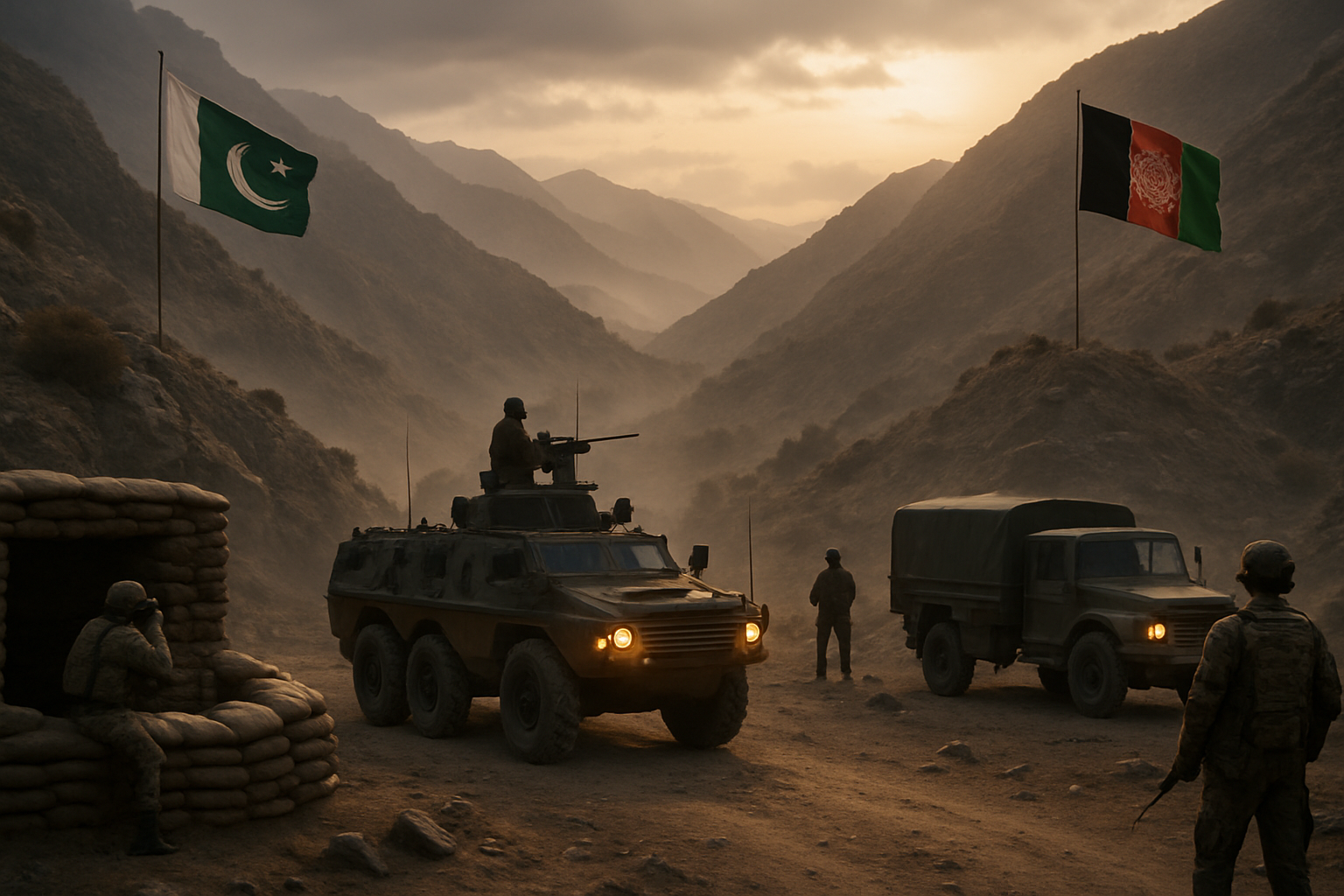
Pakistan and Afghanistan announced a temporary suspension of military operations for Eid al-Fitr following weeks of deadly cross-border violence that has killed hundreds and displaced thousands, marking the most serious confrontation between the neighbors since the Taliban's 2021 return to power.
The ceasefire, effective March 18-23, comes after sustained diplomatic pressure from Saudi Arabia, Qatar, and Turkey, providing the first significant de-escalation since Pakistani Defense Minister Khawaja Asif declared "open war" on February 27. However, the pause follows a month of devastating violence that has fundamentally altered the security landscape of South Asia.
The Crisis Unfolds
The current confrontation began on February 16 when a Tehreek-e-Taliban Pakistan (TTP) vehicle-borne improvised explosive device killed 11 Pakistani soldiers at a security checkpoint in Bajaur district. Pakistan's response escalated rapidly from targeted airstrikes to sustained military operations under "Operation Ghazab lil-Haq."
On February 22, Pakistani forces conducted coordinated strikes on seven alleged terrorist camps across Afghanistan's Nangarhar and Paktika provinces, claiming to have killed over 80 militants. However, the strikes also resulted in significant civilian casualties, including eight schoolchildren aged 5-15 in Behsud district, according to UN documentation.
"The Secretary-General strongly condemns the airstrike in Kabul, the capital of Afghanistan, on March 16, which reportedly resulted in the deaths and injuries of civilians at a medical facility."
— UN Secretary-General António Guterres
Disputed Hospital Attack Sparks International Outrage
The most controversial incident occurred on March 16, when Taliban officials claimed Pakistani airstrikes hit the Omid Addiction Treatment Hospital in Kabul's Pul-e-Charkhi area, allegedly killing over 400 people and wounding 250 others at the 2,000-bed facility. Pakistan categorically denied targeting the hospital, maintaining that strikes hit the Camp Phoenix military installation "several kilometers away."
The disputed hospital attack became a catalyst for international condemnation and intensified diplomatic efforts. UN Secretary-General António Guterres called for an independent investigation, emphasizing that medical facilities must be protected under international humanitarian law.
Humanitarian Catastrophe
The month-long conflict has created a severe humanitarian crisis. The UN Office for the Coordination of Humanitarian Affairs (OCHA) reports that 16,370 families have been newly displaced across 10 Afghan provinces, with Paktia accounting for 7,000 families, Kunar 3,500, and Khost and Nangarhar 2,500 each.
The UN Assistance Mission in Afghanistan (UNAMA) documented 185 civilian casualties between February 26 and March 5, with 56 killed and 129 wounded, the majority being women and children. The World Health Organization has been able to deliver emergency medical oxygen to only 23 hospitals, while hundreds of health centers have closed due to security concerns.
The economic impact has been equally devastating. Bilateral trade between the two countries collapsed by 59%, with Pakistan's exports to Afghanistan plummeting from $550 million to $228 million over seven months. Traditional trade routes through Chaman-Spin Boldak and Torkham have faced repeated closures, severely affecting border communities dependent on cross-border commerce.
The Durand Line Dispute
At the heart of the conflict lies the disputed status of the 2,640-kilometer Durand Line, established by British colonial authorities in 1893. No Afghan government has ever formally recognized this border, viewing it as an artificial division of Pashtun tribal territories.
Pakistan maintains that TTP and other militant groups operate "with impunity from Afghan soil," using the porous mountainous terrain as sanctuary for attacks against Pakistani forces. The Taliban government categorically denies providing sanctuary to militant groups or allowing Afghan territory to be used for attacks against neighboring countries.
International Mediation Efforts
Multiple diplomatic initiatives have attempted to de-escalate the crisis. In February 2026, Saudi Arabia mediated a prisoner exchange that saw three Pakistani soldiers released from Taliban custody, captured during October 2025 border clashes. Turkish Foreign Minister Hakan Fidan launched shuttle diplomacy, contacting his Pakistani and Afghan counterparts as well as officials from Qatar and Saudi Arabia.
Iran, Russia, and China have all offered mediation services, with Chinese Foreign Minister Wang Yi expressing readiness to assist in resolution through direct talks between Kabul and Islamabad. Religious scholars, including Ali al-Qaradaghi of the International Union of Muslim Scholars, issued fatwas calling for a ceasefire during Ramadan.
"China hopes both sides maintain calm, conduct face-to-face talks as soon as possible, establish a ceasefire, and resolve disputes through dialogue."
— Chinese Foreign Minister Wang Yi
Nuclear Implications
The confrontation carries particular gravity given Pakistan's nuclear arsenal. U.S. Director of National Intelligence Tulsi Gabbard recently testified that Pakistan ranks among the most significant nuclear threats to the United States, alongside Russia, China, and North Korea. The intelligence community projects that missiles capable of reaching the U.S. homeland could increase from 3,000 today to over 16,000 by 2035.
The crisis represents the most serious test of post-2021 South Asian security architecture, with international observers closely monitoring to prevent escalation beyond conventional operations.
Regional and Global Implications
Pakistan has acknowledged its diminished influence in Afghanistan compared to wealthier regional powers including Turkey, the UAE, Qatar, Saudi Arabia, and China. This shift has forced Islamabad to rely increasingly on military solutions rather than diplomatic leverage.
The conflict serves as a template for 21st-century challenges where territorial sovereignty intersects with transnational terrorism concerns. Chinese warnings at the UN about the presence of ISIS-K, al-Qaeda, and the East Turkestan Islamic Movement (ETIM) in Afghanistan contradict Taliban claims of having defeated terrorism.
The Path Forward
Despite the temporary ceasefire, the underlying issues remain unresolved. Taliban officials maintain that "the path of talks remains open" while seeking "mutual understanding and respect." Pakistan, however, indicates there is "no rush" to end the military campaign without concrete measures against militant groups.
The five-day Eid ceasefire provides a crucial window for intensive diplomatic engagement, but the fundamental disagreements over cross-border terrorism, disputed borders, and competing sovereignty claims require sustained international mediation efforts.
The success or failure of current diplomatic initiatives will influence global approaches to managing territorial sovereignty versus transnational terrorism challenges, with implications extending far beyond the bilateral relationship to affect regional stability and international conflict resolution mechanisms worldwide.
Looking Ahead
As both nations observe the temporary ceasefire, the international community faces pressure to develop innovative diplomatic frameworks that balance legitimate security concerns with territorial integrity, civilian protection, and international law compliance. The stakes extend beyond bilateral relations, potentially setting precedents for how nuclear-armed neighbors manage disputes in an era of complex, asymmetric threats.
The coming days will prove critical in determining whether this religious and cultural diplomacy breakthrough can transform into a sustainable peace framework, or whether the region will return to military confrontation after the Eid celebrations conclude. The resolution of this crisis may well serve as a defining moment for regional stability and global conflict prevention mechanisms in the 21st century.