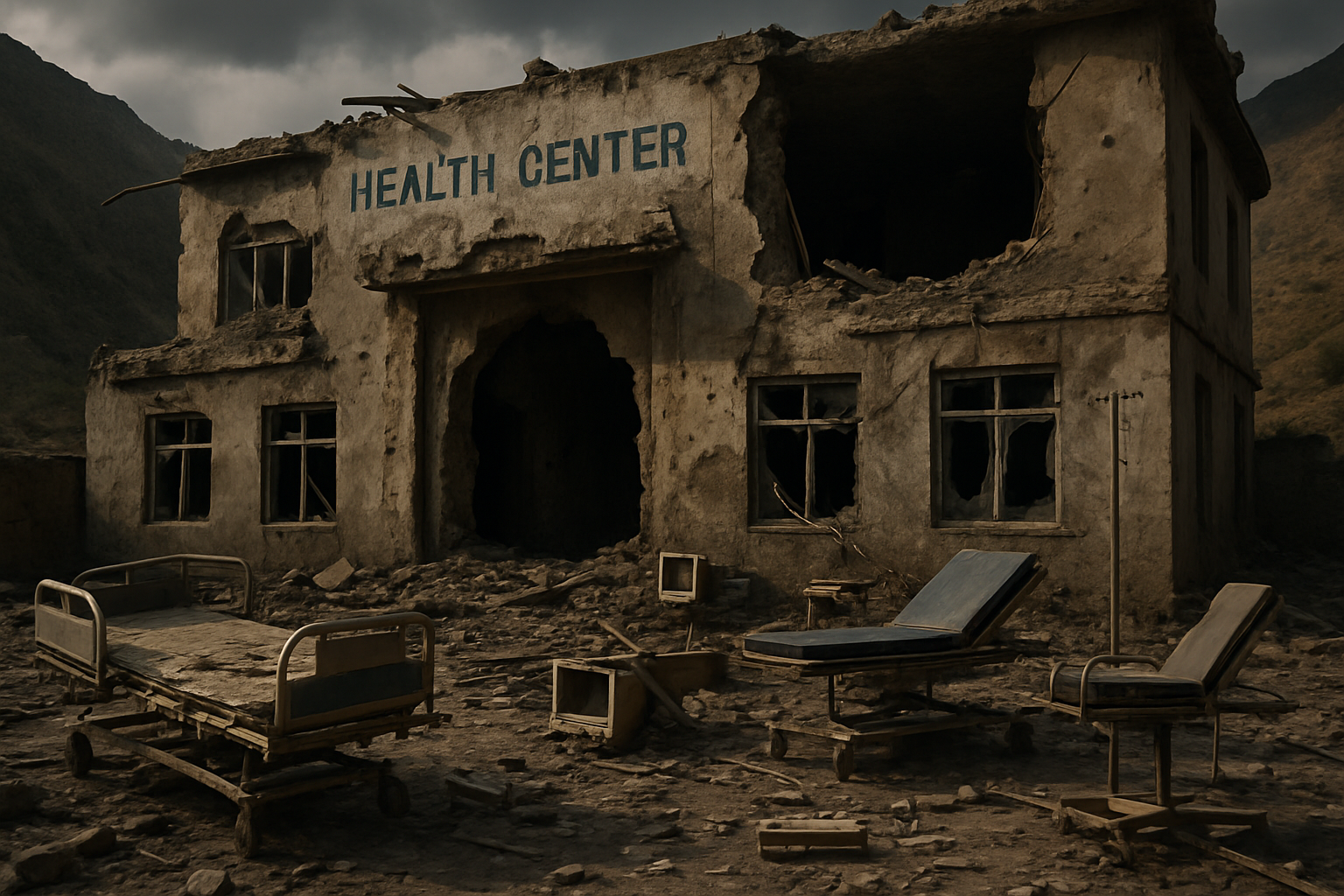
Cross-border violence between Pakistan and Afghanistan has reached alarming new heights as rocket fire from Pakistani forces severely damaged a vital health center in Afghanistan's Kunar province, forcing the facility to shut down and leaving vulnerable populations without access to critical medical services.
The Taliban government reported that at least 10 rockets struck the health facility in Kunar province, destroying key sections including the operating room, laboratory, and maternity ward. The attack represents a dangerous escalation in the ongoing military confrontation that has devastated communities along the disputed Durand Line for over two months.
Education System Under Siege
The humanitarian crisis extends far beyond health infrastructure. In the village of Barikot in Kunar province, schools have been directly hit by Pakistani shelling, leading to the destruction of classrooms and forcing many residents to flee. The UN Office for the Coordination of Humanitarian Affairs (OCHA) highlighted that at least 22 schools have been damaged or destroyed in the fighting.
"This is the school where I studied. I feel very sad," one local resident told international media, reflecting the deep emotional toll the destruction has had on communities that have called these border regions home for generations.
"Thousands of Afghan children are now without access to education due to the fighting along the Durand Line."
— UN Office for the Coordination of Humanitarian Affairs
Historical Context of the Crisis
The current escalation builds upon months of deteriorating Pakistan-Afghanistan relations that reached a breaking point in February 2026. The crisis began with a devastating attack by the Tehreek-e-Taliban Pakistan (TTP) on February 16, which killed 11 Pakistani soldiers in Bajaur using a vehicle-borne improvised explosive device.
Pakistan's retaliation was swift and comprehensive. On February 22, Pakistani forces conducted airstrikes on seven alleged terrorist camps in Afghanistan's Nangarhar and Paktika provinces, claiming to have killed over 80 militants. However, these strikes also resulted in significant civilian casualties, including eight schoolchildren in what would become a recurring pattern of civilian harm.
The situation deteriorated dramatically when Pakistani Defense Minister Khawaja Mohammad Asif declared "open war" against the Taliban government on February 27, 2026 – marking the most serious military confrontation between the neighbors since the Taliban's return to power in August 2021.
Humanitarian Catastrophe Unfolds
The human cost of this conflict has been staggering. According to UN documentation, at least 185 civilian casualties have been recorded since late February, with 56 killed and 129 wounded. The majority of these casualties are women and children, highlighting the disproportionate impact on vulnerable populations.
The displacement crisis is equally severe. OCHA reports that 16,370 families have been newly displaced across 10 Afghan provinces, with Paktia province bearing the heaviest burden with 7,000 displaced families, followed by Kunar with 3,500 families forced from their homes.
Healthcare systems on both sides of the border are buckling under pressure. The World Health Organization has been forced to deliver emergency medical oxygen to only 23 hospitals in Afghanistan, while hundreds of health centers have closed due to security concerns and funding shortfalls. The attack on the Kunar health center represents just the latest blow to an already fragile medical infrastructure.
The Disputed Durand Line
At the heart of this conflict lies the 2,640-kilometer Durand Line, a colonial-era border established by the British in 1893 that has never been formally recognized by any Afghan government. Afghan authorities view this boundary as an artificial division of Pashtun tribal areas and reject its legitimacy.
Pakistan maintains that militant groups, particularly the TTP, operate "with impunity from Afghan soil," using the porous mountainous terrain along the border as sanctuary for planning attacks against Pakistani forces and civilians. The Taliban government categorically denies providing sanctuary to militant groups or allowing its territory to be used for attacks against neighboring countries.
Economic Warfare and Isolation
Beyond the immediate military confrontation, the crisis has devastated economic ties between the two countries. Bilateral trade has collapsed by 59% over seven months, with Pakistani exports to Afghanistan falling from $550 million to just $228 million.
Traditional trade routes including Chaman-Spin Boldak and Torkham have faced repeated closures, severely affecting border communities that depend on cross-border commerce for their livelihoods. This economic warfare compounds Afghanistan's existing humanitarian crisis, where 88% of female-headed households are unable to meet minimum living requirements according to UN data.
Failed International Mediation
Multiple diplomatic initiatives have attempted to de-escalate the crisis with limited success. Saudi Arabia, Qatar, and Turkey achieved a temporary ceasefire during Eid al-Fitr in March through faith-based diplomacy, but the truce was immediately violated with continued shelling and attacks.
Chinese Foreign Minister Wang Yi has conducted intensive shuttle diplomacy between Kabul and Islamabad, while Iran, Russia, and Turkey have all offered mediation services. However, the fundamental disagreements over cross-border terrorism and territorial sovereignty remain unresolved.
Pakistan acknowledges that it has lost much of its traditional influence over Afghanistan to wealthier regional powers including Turkey, the UAE, Qatar, Saudi Arabia, and China, forcing it to rely increasingly on military solutions rather than diplomatic engagement.
Nuclear Dimensions and Regional Security
The involvement of nuclear-armed Pakistan adds a particularly dangerous dimension to this conflict that requires careful international monitoring. This represents the most serious military confrontation involving Pakistan since the Taliban's return to power, testing the post-2021 South Asian security architecture.
Chinese officials have warned the UN Security Council about the continued presence of ISIS-K, al-Qaeda, and the East Turkestan Islamic Movement (ETIM) operating from Afghan soil, contradicting Taliban claims that terrorism has been defeated within Afghanistan's borders.
Looking Forward
As the crisis enters what observers describe as a critical phase, the Taliban maintains that the "path of talks remains open" and seeks "mutual understanding and respect" with Pakistan. However, Pakistani officials indicate there is "no rush" to end military operations until concrete anti-militant measures are implemented by the Taliban government.
The success or failure of diplomatic efforts to contain this crisis will likely influence global approaches to managing conflicts where territorial sovereignty intersects with transnational terrorism challenges. The stakes extend far beyond the bilateral relationship, affecting regional stability mechanisms and international security architecture worldwide.
With thousands of children now unable to attend school, families displaced from their homes, and critical health infrastructure under attack, the human cost of this confrontation continues to mount. The international community faces mounting pressure to develop innovative diplomatic frameworks that can balance legitimate security concerns with the protection of civilian populations and respect for international law.