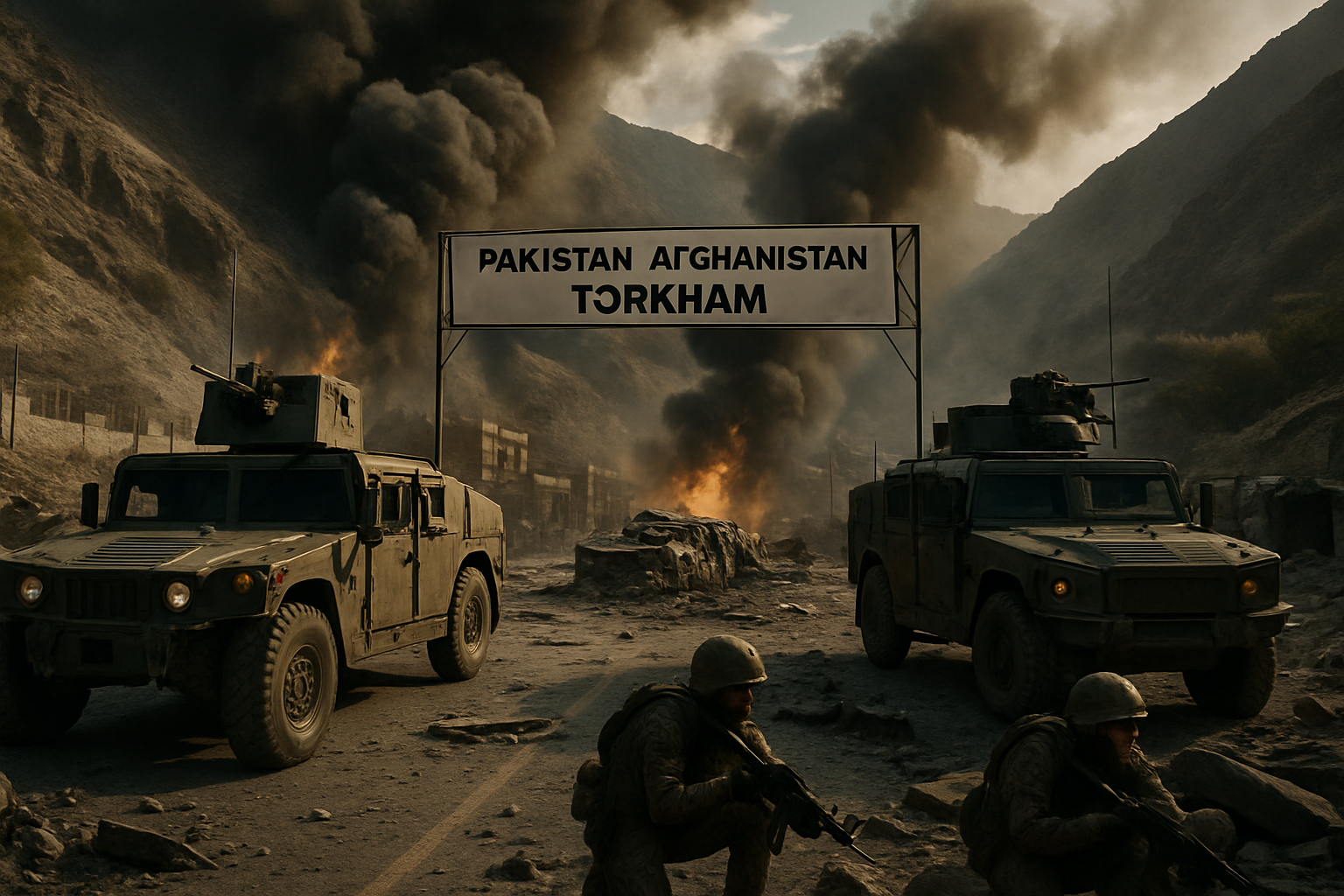
Cross-border strikes were reported overnight in Afghanistan's eastern Paktia province, where Pakistani forces were accused of carrying out attacks in the Samkani district, targeting civilian homes according to local sources and further escalating the volatile Pakistan-Afghanistan border crisis.
Radio Television Afghanistan reported on Wednesday, March 4, that the strikes occurred late the previous night, with Taliban officials condemning what they described as continued violations of Afghan sovereignty. The latest incident adds to a dangerous pattern of cross-border violence that has intensified dramatically since February 2026, transforming from isolated incidents into what Pakistani Defense Minister Khawaja Asif has formally declared an "open war" against Afghanistan's Taliban government.
Escalating Pattern of Cross-Border Violence
The most recent Paktia strikes represent a continuation of hostilities that began with the February 16 Bajaur district attack, where Tehreek-e-Taliban Pakistan (TTP) militants killed 11 Pakistani soldiers using a vehicle-borne improvised explosive device. This assault prompted Pakistan's February 22 retaliation airstrikes targeting seven alleged terrorist camps in Afghanistan's Nangarhar and Paktika provinces, resulting in over 80 militant casualties but also causing significant civilian deaths, including eight schoolchildren.
Former United States Special Representative for Afghanistan Reconciliation Zalmay Khalilzad has emerged as a vocal critic of Pakistan's military approach, stating he does not believe the Pakistani people support policies that have resulted in civilian casualties. Khalilzad's remarks, referencing recent United Nations reports on civilian casualties, suggest a growing disconnect between Pakistan's governing establishment and its population regarding cross-border operations.
"The gap between the Pakistani people and the country's ruling structure appears to be widening,"
— Zalmay Khalilzad, Former US Special Representative
International Humanitarian Concerns Mount
The World Food Programme has warned that escalating violence along Afghanistan's eastern, southern, and western borders has significantly worsened the country's humanitarian crisis. Afghanistan is currently facing one of the world's most severe food security emergencies amid ongoing insecurity and mass displacement, with 88% of female-headed households unable to meet minimum living requirements according to UN data.
John Aylieff, the WFP representative in Afghanistan, emphasized that the border violence compounds an already desperate situation for millions of Afghans dependent on international humanitarian assistance. The organization has struggled to maintain operations amid the deteriorating security environment, with traditional supply routes through the Chaman-Spin Boldak and Torkham crossings facing repeated closures.
Pakistan's Strategic Justification and International Response
Bloomberg reported that a senior Pakistani security official, speaking on condition of anonymity, clarified that Islamabad is not seeking regime change in Afghanistan. According to the official's statement sent to journalists on Tuesday, March 3, Pakistan's military operations are focused specifically on militant groups operating from Afghan territory, with officials stating they have "no rush" to end the military campaign and will continue strikes as necessary to protect Pakistani citizens.
Pakistan maintains that TTP leadership operates "with impunity from Afghan soil" despite repeated Taliban assurances about controlling militant groups within their territory. Pakistani officials argue that their country has legitimate security concerns given the sophisticated nature of recent attacks, including coordinated assaults and vehicle-borne explosive devices that demonstrate retained operational capabilities by terrorist organizations.
Economic and Diplomatic Fallout
The crisis has devastated bilateral trade relationships, with economic exchanges collapsing by 59% over seven months. Pakistan's exports to Afghanistan dropped from over $550 million to just $228 million, affecting thousands of families and businesses dependent on cross-border commerce. This economic disruption compounds Afghanistan's existing humanitarian emergency, where the Taliban government struggles with international isolation and limited recognition.
Despite multiple mediation attempts—including Saudi Arabia's February 2026 prisoner exchange that saw three Pakistani soldiers released from Taliban custody, and Iranian offers of diplomatic intervention—confidence-building measures have proven insufficient to address underlying security challenges. The failure of these diplomatic initiatives has led Pakistan to acknowledge its diminished regional influence compared to wealthier powers like Turkey, UAE, Qatar, Saudi Arabia, and China, forcing greater reliance on military solutions.
The Durand Line Dispute at the Heart of Tensions
Central to the ongoing crisis is the disputed status of the 2,640-kilometer Durand Line, the colonial-era border established by Britain in 1893. No Afghan government has ever formally recognized this boundary, viewing it as an artificial division of Pashtun tribal areas. The porous, mountainous terrain provides natural sanctuary for militant groups while complicating security operations for both Pakistani and Afghan forces.
The difficult geography, combined with limited government control in border regions and complex tribal dynamics, creates persistent challenges that extend far beyond immediate military responses. Intelligence officials suggest that effective solutions require comprehensive approaches addressing economic development, governance gaps, and regional cooperation mechanisms rather than solely military intervention.
Regional Security Architecture Under Strain
The Pakistan-Afghanistan crisis represents a critical test of post-2021 South Asian security arrangements following the Taliban's return to power. Chinese warnings at the UN Security Council about the presence of ISIS-K, al-Qaeda, and East Turkestan Islamic Movement (ETIM) in Afghanistan contradict Taliban claims of having "defeated terrorism" within their territory.
Regional powers have watched with growing concern as the conflict threatens broader stability. The success or failure of diplomatic efforts to contain this crisis may provide a template for managing similar challenges where territorial sovereignty intersects with transnational terrorism concerns—a defining issue of 21st-century conflict management.
International Mediation Efforts and Future Prospects
Multiple international actors have attempted to broker dialogue between Islamabad and Kabul. Turkish Foreign Minister Hakan Fidan launched mediation initiatives, contacting both Pakistani and Afghan foreign ministers as well as counterparts in Qatar and Saudi Arabia. Iran has also offered mediation services, warning that continued escalation could destabilize the broader region.
However, fundamental positions remain far apart. Pakistan demands immediate, concrete, and verifiable measures against all terrorist groups operating from Afghan soil, while the Taliban maintains that no armed groups use their territory for attacks against neighboring countries. The Taliban describes protection of sovereignty and population as "religious obligations and national duties," suggesting limited willingness to compromise on what they view as matters of national dignity.
The international community faces mounting pressure to develop effective conflict prevention mechanisms before the situation spirals into a broader regional confrontation. The nuclear dimension—with Pakistan being a nuclear-armed state—adds urgency to diplomatic efforts and raises the stakes considerably for regional stability.
As cross-border violence continues to claim civilian lives and disrupt humanitarian operations, the need for innovative diplomatic frameworks that can balance legitimate security concerns with territorial integrity principles becomes increasingly critical. The coming weeks will be decisive in determining whether sustained international engagement can overcome military escalation or if the region will witness a prolonged confrontation between two neighbors whose relationship is fundamental to South Asian stability.