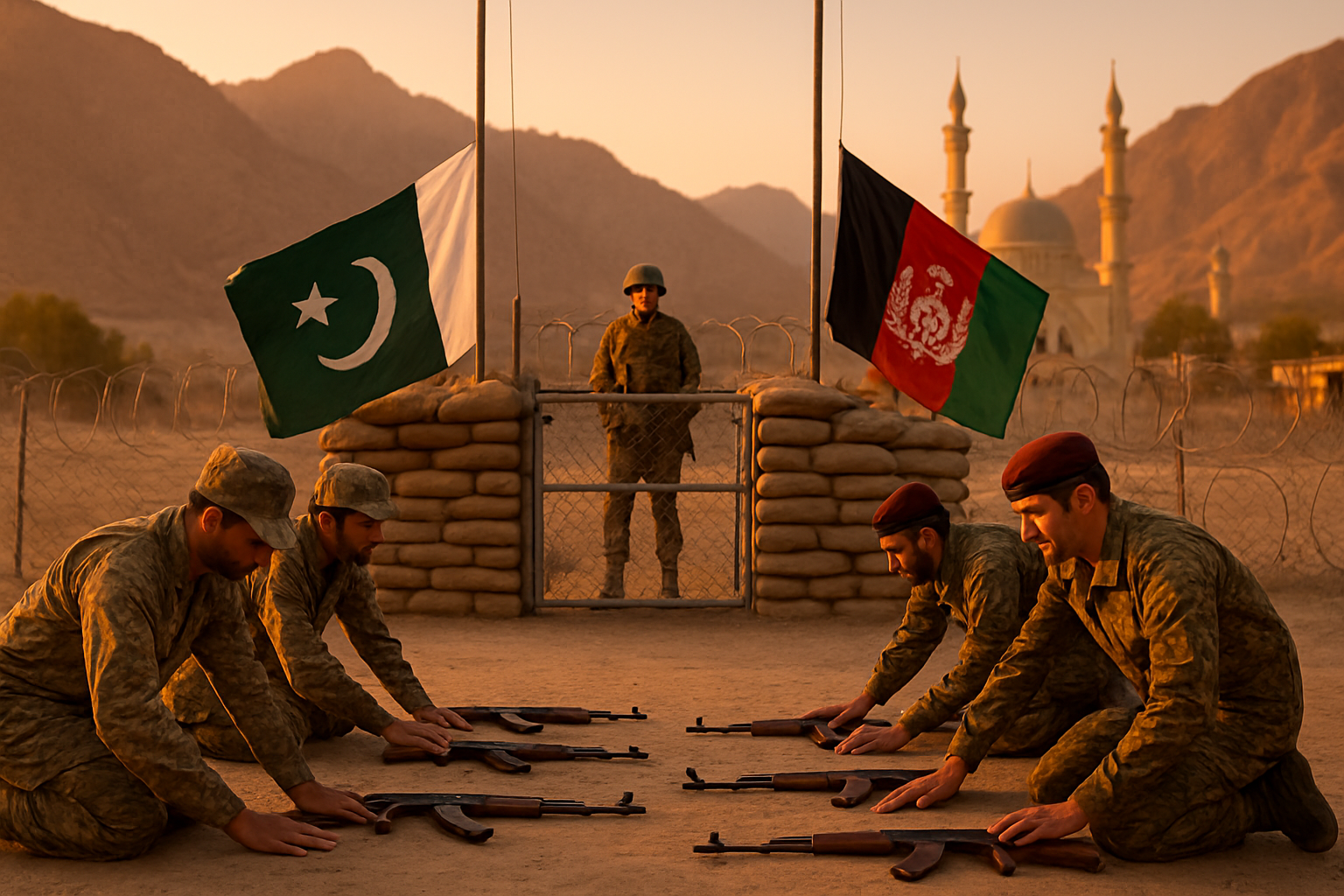
Pakistan and Afghanistan announced a temporary suspension of military operations along their disputed border for the upcoming Eid al-Fitr celebrations, following sustained diplomatic pressure from Saudi Arabia, Qatar, and Turkey. The ceasefire represents the first significant de-escalation since Pakistan's Defense Minister declared "open war" against the Taliban government in February.
Pakistani Information Minister Attaullah Tarar confirmed the pause in strikes against "terrorists and their support infrastructure in Afghanistan" would take effect at midnight Wednesday, March 18, and remain in place until midnight Monday, March 23. The announcement comes after weeks of the most serious military confrontation between the neighbors since the Taliban's return to power in August 2021.
"Pakistan offers this gesture in good faith and in keeping with the spirit of the holy month of Ramadan and the upcoming festival of Eid al-Fitr," Tarar stated, emphasizing the decision came "at the request of brotherly Islamic countries of the Kingdom of Saudi Arabia, the State of Qatar and the Republic of Turkey."
Taliban Response and Conditions
The Islamic Emirate of Afghanistan reciprocated with its own announcement, with spokesman Zabiullah Mujahid declaring that Taliban security forces would temporarily halt their "Rad al-Zulm" (Response to Oppression) defensive operation. However, the Taliban's statement carried a clear warning about future confrontations.
"The Islamic Emirate, while appreciating the goodwill of friendly and mediating countries, emphasizes that maintaining Afghanistan's national security, territorial integrity, and the safety of Afghan lives is its national and religious duty, and it will bravely respond to any aggression in case of a threat."
— Zabiullah Mujahid, Taliban Spokesman
The Taliban's conditional acceptance underscores the fragile nature of this temporary peace, with both sides maintaining their fundamental positions on the underlying dispute over cross-border terrorism and territorial sovereignty.
International Diplomatic Pressure
The ceasefire announcement follows intensive international mediation efforts, particularly from regional Muslim powers who have invested significant diplomatic capital in preventing further escalation. Saudi Arabia, Qatar, and Turkey have emerged as key mediators, leveraging their economic ties and religious influence to broker this temporary pause.
The timing during the final days of Ramadan and ahead of Eid al-Fitr celebrations provided crucial religious and cultural leverage for the mediating countries. Islamic scholars, including prominent figures like Ali al-Qaradaghi of the International Union of Muslim Scholars, had issued fatwas calling for an immediate ceasefire during the holy month, describing fighting between Muslim nations as contradicting Islamic teachings.
China has also played a significant role, with Foreign Minister Wang Yi conducting telephone discussions with Pakistani Deputy Prime Minister Mohammad Ishaq Dar and Afghan Foreign Minister Amir Khan Muttaqi, urging diplomatic solutions to prevent further escalation. Chinese special envoys have been shuttling between Kabul and Islamabad, promoting dialogue and reconciliation.
The Crisis That Led to War
The current conflict began on February 16, 2026, when Tehreek-e-Taliban Pakistan (TTP) militants launched a devastating attack in Pakistan's Bajaur district, killing 11 Pakistani soldiers with a vehicle-borne improvised explosive device. The sophisticated assault marked a significant escalation in cross-border terrorism that has plagued Pakistan-Afghanistan relations since the Taliban's return to power.
Pakistan's military response came on February 22 with coordinated airstrikes across Afghanistan's Nangarhar and Paktika provinces, targeting what Islamabad claimed were seven terrorist camps. While Pakistan reported killing over 80 militants, the strikes also resulted in significant civilian casualties, including eight schoolchildren in Behsud district, according to UN documentation.
The situation escalated dramatically on February 27 when Pakistani Defense Minister Khawaja Asif made the unprecedented declaration of "open war" against the Taliban government. This formal declaration marked the first such announcement between the neighboring countries since Afghanistan's establishment as a modern state.
Humanitarian Catastrophe
The month-long conflict has created a severe humanitarian crisis on both sides of the border. The United Nations Assistance Mission in Afghanistan (UNAMA) has documented 185 civilian casualties since late February, with 56 killed and 129 wounded, the majority being women and children. The Office for the Coordination of Humanitarian Affairs (OCHA) reports that 16,370 families have been newly displaced across 10 Afghan provinces.
The World Health Organization has been forced to deliver emergency medical oxygen to only 23 functioning hospitals in Afghanistan, while hundreds of health centers have closed due to the conflict and ongoing funding shortages. The healthcare system, already severely strained by Afghanistan's broader humanitarian crisis, has been pushed to the breaking point.
One of the most contentious incidents occurred on March 16, when Pakistan allegedly struck the Omid Addiction Treatment Hospital in Kabul's Pul-e-Charkhi area. Taliban officials claimed the attack killed over 400 people and wounded 260 others at the 2,000-bed facility. Pakistan categorically denied targeting the hospital, maintaining its strikes hit the Camp Phoenix military installation "several kilometers away."
The UN later revised the casualty figures from this incident to 143 killed, but the dispute over targeting civilian infrastructure has become a major point of contention and potential violation of international humanitarian law.
Economic Devastation
Beyond the human toll, the conflict has devastated economic relations between the two countries. Bilateral trade has collapsed by 59% over seven months, with Pakistani exports to Afghanistan dropping from $550 million to just $228 million. The closure of traditional trade routes through Chaman-Spin Boldak and Torkham crossings has severely impacted border communities that depend on cross-border commerce.
This economic disruption compounds Afghanistan's existing humanitarian crisis, where 88% of female-headed households are unable to meet minimum living requirements according to UN data. The Taliban government, already struggling with international sanctions and limited recognition, faces mounting pressure to address both security and economic challenges.
The Durand Line Dispute
At the heart of the Pakistan-Afghanistan conflict lies the disputed 2,640-kilometer Durand Line, established by British colonial authorities in 1893. No Afghan government has ever formally recognized this border, viewing it as an artificial division of Pashtun tribal territories imposed by colonial powers.
Pakistan maintains that TTP and other militant groups operate "with impunity from Afghan soil," using the porous mountainous terrain along the border as sanctuaries for planning and launching attacks. The Taliban government categorically denies providing sanctuary to militant groups or allowing Afghan territory to be used for attacks against neighboring countries.
This fundamental disagreement over territorial sovereignty versus cross-border terrorism has proven intractable through traditional diplomatic channels. Pakistan has acknowledged its diminished influence in Afghanistan compared to wealthier regional powers like Turkey, the UAE, Qatar, Saudi Arabia, and China, leading to increased reliance on military solutions.
Failed Mediation Attempts
Before the current ceasefire announcement, multiple mediation efforts had failed to prevent the escalation. In February 2026, Saudi Arabia successfully mediated the release of three Pakistani soldiers captured during border clashes in October 2025, but this confidence-building measure proved insufficient to address the underlying security challenges.
Turkish Foreign Minister Hakan Fidan launched comprehensive mediation initiatives, contacting Pakistani and Afghan foreign ministers as well as counterparts from Qatar and Saudi Arabia. Iran offered mediation services while warning of regional destabilization risks. Russia also attempted diplomatic intervention through Special Envoy Zamir Kabulov, emphasizing that disputes should be resolved through dialogue and diplomacy.
Despite these efforts, military operations continued to escalate, with both sides conducting airstrikes on strategic installations and even capital cities. The failure of previous diplomatic initiatives made the current ceasefire announcement all the more significant as a breakthrough in international mediation efforts.
Nuclear Dimension and Regional Security
The Pakistan-Afghanistan conflict carries particular gravity due to Pakistan's nuclear weapons capability, making it the most serious confrontation involving a nuclear-armed nation in the region since the Taliban's return to power. International observers have closely monitored the situation to prevent escalation beyond conventional military operations.
Chinese warnings at the UN about the presence of ISIS-K, al-Qaeda, and the East Turkestan Islamic Movement (ETIM) in Afghanistan contradict Taliban claims of having defeated terrorism. This has added complexity to international efforts to engage constructively with the Taliban government while addressing legitimate counter-terrorism concerns.
The crisis represents a critical test of the post-2021 South Asian security architecture and could set precedents for how the international community manages conflicts where territorial sovereignty intersects with transnational terrorism challenges.
Looking Forward: Fragile Hope
While the temporary ceasefire offers hope for de-escalation, significant challenges remain. The Taliban maintains that "the path of talks remains open" and seeks "mutual understanding and respect," while Pakistan has indicated there is "no rush" to end its military campaign without concrete anti-militant measures from Afghanistan.
The five-day pause provides a crucial window for intensive diplomatic engagement. Success will depend on the Taliban's capability and willingness to control militant groups operating from its territory, Pakistan's commitment to diplomatic rather than military solutions, and sustained international mediation efforts.
The ceasefire also represents a template for 21st-century conflict resolution, where religious and cultural considerations can provide leverage for peace even in seemingly intractable disputes. The role of Islamic scholarship and religious authority in calling for peace during Ramadan demonstrates the continued relevance of faith-based diplomacy in contemporary international relations.
As both nations prepare for Eid al-Fitr celebrations, the temporary cessation of hostilities offers families on both sides of the border a respite from weeks of violence. However, the underlying issues that sparked this conflict—cross-border terrorism, disputed borders, and competing claims of sovereignty—remain unresolved and will require sustained diplomatic effort to address comprehensively.
The success or failure of this ceasefire and subsequent diplomatic efforts will have implications far beyond Pakistan and Afghanistan, potentially influencing how the international community approaches similar territorial sovereignty versus transnational terrorism challenges worldwide. For now, the guns have fallen silent, but the path to lasting peace remains uncertain.