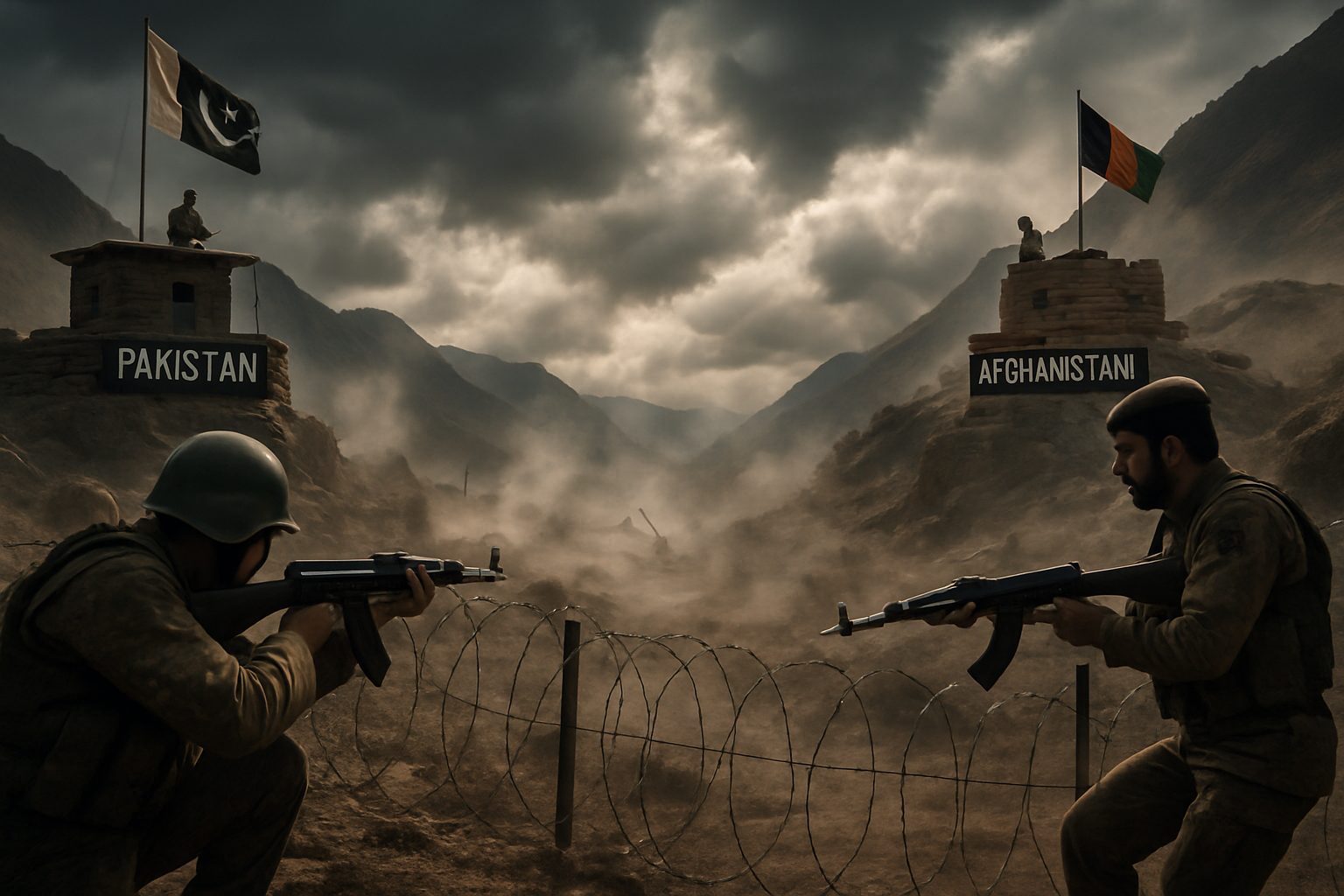
Pakistan military forces continued rocket attacks on Afghanistan's Kunar province despite an internationally brokered ceasefire for Eid al-Fitr, according to Afghan Taliban officials who accused the Pakistani regime of violating the temporary truce within hours of its announcement.
Farid Dehqan, spokesperson for the Khas Kunar police command, confirmed that Pakistani military forces fired approximately 25 shells in several areas of Nari district overnight, with heavy weapons fire reportedly continuing. The attacks occurred despite earlier announcements by the Pakistani military of a temporary ceasefire for the Islamic holiday.
Pakistan's Information Ministry has categorically rejected Afghan claims as "frivolous" and "absolutely false," maintaining that no violation of the temporary pause has taken place along the western border. The ministry suggested the allegations may be "propaganda initiated by detractors within the Taliban regime, aimed at creating false pretext for some Afghan Taliban regime-directed terrorism."
Historic Ceasefire Already Under Strain
The alleged violations came just hours after both nations announced a temporary suspension of military operations for Eid al-Fitr (March 18-23), marking the first significant de-escalation since Pakistani Defense Minister Khawaja Asif declared "open war" on February 27.
The ceasefire breakthrough was achieved through intensive faith-based diplomacy led by Saudi Arabia, Qatar, and Turkey, leveraging religious and cultural influence during Ramadan. Pakistani Information Minister Attaullah Tarar had announced a pause in Operation Ghazab lil-Haq against "terrorists and their support infrastructure in Afghanistan," while Taliban spokesman Zabiullah Mujahid reciprocated by temporarily halting "Rad al-Zulm" defensive operations.
Afghanistan's Chief of Armed Forces, Fasihuddin Fitrat, had earlier accused Pakistan's military regime of violating the ceasefire along the disputed Durand Line in his Eid message, stating that several civilians were killed in attacks carried out by Pakistani forces in border areas. He warned that if such attacks continue, "the ceasefire will become meaningless," and the Islamic Emirate would deliver a "decisive response" to Pakistan's actions.
Month-Long Military Confrontation
The current crisis represents the most serious Pakistan-Afghanistan confrontation since the Taliban's return to power in 2021. The conflict began with a February 16 TTP (Tehreek-e-Taliban Pakistan) attack in Bajaur that killed 11 Pakistani soldiers, followed by Pakistani airstrikes on February 22 targeting seven alleged terrorist camps that resulted in civilian casualties, including eight schoolchildren.
The situation escalated dramatically when Defense Minister Khawaja Asif declared "open war" against the Taliban government on February 27, launching Operation Ghazab lil-Haq with coordinated airstrikes across multiple Afghan provinces, including the capital Kabul and strategic installations like Bagram Airfield.
"The continuation of Pakistan's attacks despite the ceasefire demonstrates a lack of commitment and deception on the part of the country."
— Fasihuddin Fitrat, Afghanistan's Chief of Armed Forces
According to UN documentation, the conflict has resulted in devastating humanitarian consequences. The UN Office for the Coordination of Humanitarian Affairs (OCHA) reports 16,370 families newly displaced across 10 provinces, while the UN Assistance Mission in Afghanistan (UNAMA) has documented 185 civilian casualties (56 killed, 129 wounded) between February 26 and March 5.
Disputed Durand Line at the Heart of Conflict
At the core of the Pakistan-Afghanistan tensions lies the disputed 2,640-kilometer Durand Line, the colonial-era border established in 1893 that has never been recognized by any Afghan government. Pakistan maintains that TTP operates "with impunity from Afghan soil," while the Taliban categorically denies providing sanctuary to militant groups.
The porous mountainous terrain along the border has historically provided challenges for both governments in controlling militant movements, complicating bilateral relations and security operations on both sides.
Pakistan acknowledges it has lost traditional influence in Afghanistan to wealthier regional powers including Turkey, UAE, Qatar, Saudi Arabia, and China, forcing it to increasingly rely on military solutions to address security concerns.
Economic and Humanitarian Catastrophe
The military confrontation has caused severe economic devastation, with bilateral trade collapsing by 59% as Pakistan's exports to Afghanistan dropped from $550 million to $228 million over seven months. Traditional trade routes at Chaman-Spin Boldak and Torkham have faced repeated closures, affecting border communities dependent on cross-border commerce.
The crisis compounds Afghanistan's existing humanitarian emergency, where 88% of female-headed households are unable to meet minimum living requirements according to UN data. The World Health Organization (WHO) is providing emergency medical oxygen to only 23 hospitals, while hundreds of health centers have closed due to funding and security concerns.
International Mediation Efforts
Multiple international actors have attempted to mediate the crisis, with varying degrees of success. The current Eid ceasefire was achieved through coordination between Saudi Arabia, Qatar, and Turkey, using religious diplomacy during Ramadan. Chinese Foreign Minister Wang Yi has also been actively involved, with special envoys shuttling between capitals.
Previous mediation attempts, including a Saudi-mediated prisoner exchange in February 2026 that saw three Pakistani soldiers released from Taliban custody, and initiatives by Turkish Foreign Minister Hakan Fidan, Iranian mediation offers, and Russian Special Envoy efforts, proved insufficient to address the underlying security challenges.
Religious scholars, including Ali al-Qaradaghi of the International Union of Muslim Scholars, issued fatwas calling for Muslim nations to observe ceasefires during the holy month of Ramadan, adding moral pressure to diplomatic efforts.
Nuclear Implications and Regional Security
The confrontation carries serious nuclear implications as it involves Pakistan, a nuclear-armed nation, in its most serious military confrontation with Afghanistan in decades. The crisis tests the post-2021 South Asian security architecture and requires careful international monitoring to prevent escalation beyond conventional operations.
Chinese UN warnings about the presence of ISIS-K, al-Qaeda, and ETIM in Afghanistan contradict Taliban claims of having defeated terrorism, adding complexity to the security landscape that both countries must navigate.
Template for 21st-Century Conflict Resolution
The Pakistan-Afghanistan crisis is being closely watched as a template for managing 21st-century challenges where territorial sovereignty intersects with transnational terrorism concerns. The success or failure of diplomatic containment efforts influences broader global approaches to similar regional conflicts.
The faith-based diplomacy that achieved the current ceasefire demonstrates the potential effectiveness of religious and cultural frameworks in conflict resolution, particularly in regions where traditional Western-led mediation efforts may face limitations.
Uncertain Future Despite Ceasefire
Despite the ceasefire announcement, the Taliban maintains that "the path of talks remains open" while seeking "mutual understanding and respect." However, Pakistan has indicated there is "no rush" to end its military campaign without concrete anti-militant measures from the Afghan side.
The five-day Eid ceasefire window provides a crucial opportunity for intensive diplomatic engagement to address underlying issues including cross-border terrorism, disputed borders, and competing sovereignty claims. However, the immediate allegations of violations raise serious questions about the sustainability of the peace efforts.
The coming days will be critical in determining whether the temporary ceasefire can be transformed into a sustainable peace framework or whether the region will return to military confrontation after Eid celebrations conclude. The stakes extend far beyond bilateral relations, affecting regional stability mechanisms and international conflict resolution approaches with global implications for managing disputes between nuclear-armed neighbors.