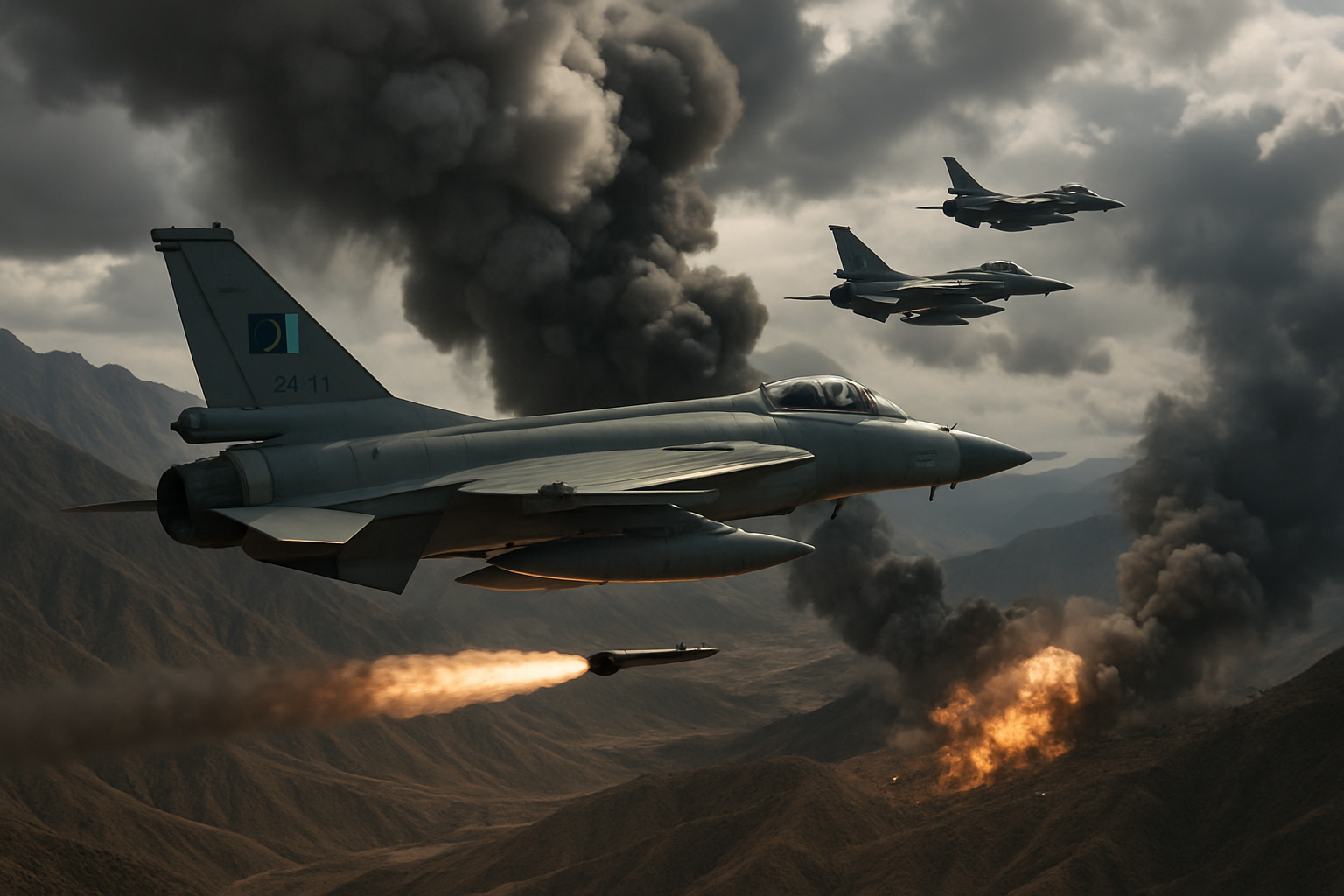
Pakistan launched deadly airstrikes on Afghanistan's Nangarhar and Paktika provinces on Sunday, targeting what Islamabad claims were militant hideouts but resulting in civilian casualties including women and children, escalating already volatile relations between the neighboring countries as Taliban authorities vowed "measured and appropriate response."
The strikes represent the most significant cross-border military action in recent months, coming just days after a devastating February 16 attack in Pakistan's Bajaur district that killed 11 Pakistani soldiers. Pakistan's military confirmed conducting operations against what it described as "seven terrorist camps and hideouts" along the Afghanistan border, while Afghan officials condemned the attacks as violations of sovereignty that killed dozens of innocent civilians.
Taliban Condemns "Clear Breach of Sovereignty"
Afghanistan's Ministry of National Defense issued a strongly-worded statement Sunday condemning what it called Pakistan's violation of Afghan airspace through coordinated strikes in the two eastern provinces. The ministry said the attacks targeted a religious madrasa and several civilian homes, resulting in civilian casualties that included women and children.
"The Ministry strongly condemned the airstrikes, calling them a clear breach of Afghanistan's national sovereignty, as well as a violation of international law, Islamic principles, and the norms of neighborly relations."
— Afghanistan Ministry of National Defense Statement
The Taliban government warned that safeguarding the country's sovereignty and protecting its population are "both religious obligations and national duties" of Afghanistan's defense forces. In an ominous escalation of rhetoric, officials pledged that a "measured and appropriate response" would be taken at a suitable time.
Pakistan's Strategic Justification
Pakistani officials described the operations as precision strikes targeting militant sanctuaries that have been used to plan and launch attacks against Pakistani security forces and civilians. Intelligence sources suggest the strikes were aimed at camps providing shelter to militants affiliated with the banned Tehreek-i-Taliban Pakistan (TTP), which Pakistan's military refers to as "Fitna al-Khwarij."
The timing of the strikes is significant, coming after weeks of escalating cross-border attacks that have tested Pakistan's patience with Taliban assurances about controlling militant groups operating from Afghan soil. The February 16 Bajaur attack, which used a vehicle-borne improvised explosive device followed by coordinated gunfire, represented one of the deadliest recent incidents against Pakistani forces.
Italian media reports indicated that Pakistan confirmed hitting seven camps and terrorist hideouts, describing the operations as intelligence-based strikes designed to neutralize immediate threats to Pakistani security.
Recent Context of Escalating Tensions
The cross-border strikes occurred against a backdrop of deteriorating Pakistan-Afghanistan relations despite diplomatic efforts. Pakistan Defense Minister Khawaja Asif had previously threatened airstrikes if cross-border attacks continued, warning that Pakistan would not hesitate to take military action against militants operating freely from Afghan territory.
Recent weeks have witnessed a concerning pattern of attacks:
- February 6: Devastating Islamabad mosque bombing killed 31 people, claimed by ISIS-K
- February 16: Bajaur district attack killed 11 Pakistani soldiers
- February 21: Twin counter-terrorism operations in Bannu and Dera Ismail Khan resulted in military casualties
These incidents have occurred despite Saudi-mediated prisoner exchanges in February 2026, which saw the Taliban release three Pakistani soldiers captured during October 2025 border clashes. The diplomatic gesture, intended as a confidence-building measure during Ramadan, proved insufficient to address underlying security challenges.
International Implications and Regional Security
The escalation comes at a time when multiple international actors have expressed concerns about Afghanistan's security situation. Chinese officials recently warned the UN Security Council about the presence of ISIS-K, al-Qaeda, and the East Turkestan Islamic Movement (ETIM) in Afghanistan, contradicting Taliban claims of having defeated terrorist groups.
The strikes also highlight the complex regional security architecture in post-2021 Afghanistan, where international concerns about terrorist sanctuaries intersect with Taliban governance challenges and Pakistan's legitimate security needs.
"We are starved, tortured, betrayed, deceived, disappointed, and one of our own has been killed."
— Recent Student Protests in Senegal, Illustrating Regional Frustrations
Regional powers including Saudi Arabia have attempted to mediate between Pakistan and Afghanistan, but Sunday's strikes demonstrate the limitations of diplomatic solutions when cross-border terrorism persists.
Civilian Casualties and Humanitarian Concerns
Afghan sources reported that the Pakistani strikes caused significant civilian casualties, with targets including educational and residential facilities. The attacks on a religious madrasa and civilian homes have drawn particular condemnation, with Afghan officials arguing that such strikes violate international humanitarian law and Islamic principles.
The civilian casualties threaten to further complicate an already tense relationship between the two countries, both of which face significant internal security challenges. Pakistan has been conducting intensive counter-terrorism operations, with over 400 militants eliminated in February 2026 operations in Balochistan alone.
Strategic Challenges and Future Implications
The cross-border strikes represent a watershed moment in Pakistan-Afghanistan relations, testing the Taliban's capacity to control militant groups while challenging Pakistan's approach to border security. The situation highlights several critical issues:
- The Taliban's ability and willingness to effectively control militant groups operating from Afghan territory
- Pakistan's evolving security calculus in dealing with cross-border terrorism
- The effectiveness of diplomatic engagement versus military pressure in addressing regional security challenges
- International community responses to violations of Afghan sovereignty amid terrorism concerns
Intelligence suggests that the targeted camps in Nangarhar and Paktika provinces had been providing sanctuary to militants planning attacks against Pakistani installations. The sophisticated nature of recent attacks, including coordinated assaults and vehicle-borne improvised explosive devices, demonstrates retained operational capabilities despite sustained military pressure on both sides of the border.
Path Forward Uncertain
The Taliban's promise of a "measured and appropriate response" raises concerns about potential retaliation that could escalate tensions beyond current levels. Both countries face internal challenges that complicate their ability to manage bilateral relations: Pakistan deals with economic pressures and domestic security concerns, while Afghanistan grapples with international isolation and governance challenges.
The strikes occur at a time when Pakistan has acknowledged diminishing regional influence in Afghanistan compared to wealthier powers including Turkey, UAE, Qatar, Saudi Arabia, and China. This shifting dynamic affects Pakistan's traditional leverage in Afghan affairs while increasing reliance on military solutions to security challenges.
Regional observers note that successful conflict resolution will require addressing underlying challenges including the difficult terrain, limited governance in border areas, tribal dynamics, and economic factors that contribute to militant sanctuary. The current crisis tests whether diplomatic solutions can prevail over military escalation in managing one of South Asia's most complex security relationships.
As both nations navigate this latest escalation, the international community watches closely, recognizing that stability between Pakistan and Afghanistan has implications extending far beyond their shared border to regional security architecture and global counter-terrorism efforts.