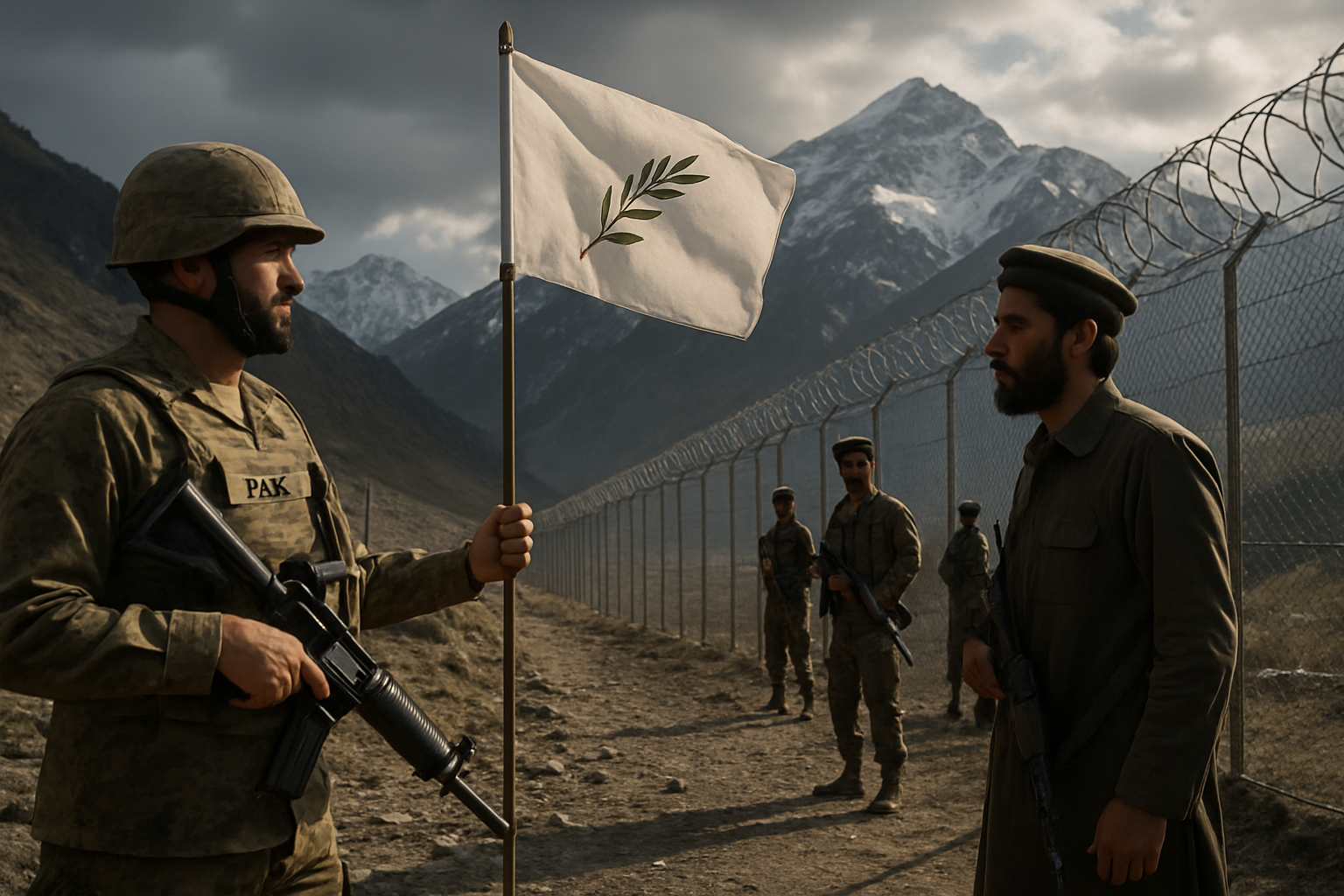
Pakistan and Afghanistan announced a historic temporary ceasefire for Eid al-Fitr on March 19, 2026, providing the first significant respite in a month-long military confrontation that has claimed hundreds of civilian lives and displaced over 16,000 families across the disputed border region.
The breakthrough came through intensive diplomatic pressure from Saudi Arabia, Qatar, and Turkey, leveraging religious and cultural influence during the holy month of Ramadan. Pakistani Information Minister Attaullah Tarar announced Pakistan would pause Operation Ghazab lil-Haq against "terrorists and their support infrastructure in Afghanistan" from midnight March 18 through midnight March 23.
Taliban spokesman Zabihullah Mujahid reciprocated, temporarily halting the "Rad al-Zulm" (Response to Oppression) defensive operations while warning of a "brave response to any aggression" if attacks resumed.
Religious Diplomacy Breakthrough
The ceasefire represents a rare success for faith-based diplomacy in contemporary international relations. Religious scholars, including prominent Islamic leader Ali al-Qaradaghi, had issued fatwas calling for Muslim nations to cease hostilities during Ramadan, adding moral pressure to ongoing mediation efforts.
"This ceasefire represents an important opportunity to build trust and pave the way toward reaching a permanent ceasefire, in a manner that contributes to stopping the bloodshed of civilians and achieving security and stability in the region."
— Egypt Foreign Ministry Statement
The announcement drew immediate international support. Egypt welcomed the truce as "a positive move that contributes to reducing escalation and creating a conducive environment for resuming the path of de-escalation between the two countries."
Month of Unprecedented Warfare
The conflict began February 16 when the banned Tehreek-i-Taliban Pakistan (TTP) launched a devastating attack in Bajaur district, killing 11 Pakistani soldiers with a vehicle-borne improvised explosive device. Pakistan responded February 22 with airstrikes on seven alleged terrorist camps in Afghanistan's Nangarhar and Paktika provinces, claiming to kill over 80 militants but causing civilian casualties including eight schoolchildren.
The crisis escalated dramatically on February 27 when Pakistani Defense Minister Khawaja Asif made an unprecedented declaration of "open war" against Afghanistan's Taliban government—the most serious military confrontation since the Taliban's return to power in August 2021.
What followed was sustained cross-border warfare that expanded from border regions to capitals and strategic installations. Pakistani forces struck targets in Kabul, including the strategic Bagram Airfield, while Taliban forces conducted drone attacks on Pakistani cities including Quetta, Kohat, and Rawalpindi.
Devastating Humanitarian Crisis
The month-long conflict has exacted a terrible toll on civilian populations. The United Nations Assistance Mission in Afghanistan (UNAMA) documented 185 civilian casualties—56 killed and 129 wounded—between February 26 and March 5 alone, with the majority being women and children.
The UN Office for the Coordination of Humanitarian Affairs (OCHA) reports that 16,370 families have been newly displaced across 10 Afghan provinces, with Paktia province bearing the heaviest burden at 7,000 displaced families, followed by Kunar with 3,500, and Khost and Nangarhar with 2,500 each.
The World Health Organization has been forced to deliver emergency medical oxygen to only 23 hospitals, while hundreds of health centers have closed due to funding cuts and security concerns. The bilateral trade relationship has collapsed by 59%, with Pakistani exports to Afghanistan dropping from $550 million to $228 million over seven months, devastating border communities dependent on cross-border commerce.
The Disputed Hospital Attack
The crisis reached its most controversial point on March 16 when Pakistani airstrikes allegedly hit the Omid Addiction Treatment Hospital in Kabul's Pul-e-Charkhi area. Taliban officials claimed over 400 people were killed and 260 wounded at the 2,000-bed drug rehabilitation facility, making it potentially one of the deadliest single incidents in the conflict.
Pakistan categorically denied targeting the hospital, maintaining that strikes hit the Camp Phoenix military installation "several kilometers away." The disputed incident sparked international condemnation and added urgency to ceasefire negotiations.
"This is a horrific sound that shook our home, with smoke and dust filling the area. Pakistan is seeking to create anarchy and weakness in Afghanistan through destabilizing policies that harm both countries."
— Hamid Karzai, Former Afghan President and Eyewitness
Core of the Dispute: The Durand Line
At the heart of this conflict lies the disputed Durand Line—a 2,640-kilometer colonial-era border established by the British in 1893 that has never been recognized by any Afghan government. Afghanistan views the boundary as an artificial division of Pashtun tribal lands, while Pakistan maintains it as its legitimate international border.
Pakistan insists that the TTP operates "with impunity from Afghan soil," using Afghanistan's mountainous border regions as sanctuaries for planning attacks against Pakistani security forces and civilians. The Taliban government categorically denies providing sanctuary to militant groups and maintains that no armed groups operate from Afghan territory against neighboring countries.
The porous, mountainous terrain along the border creates operational challenges for both governments, with limited state control in remote areas providing opportunities for militant exploitation.
International Mediation Efforts
The ceasefire breakthrough came after comprehensive diplomatic failures throughout February and early March. A Saudi-mediated prisoner exchange in February 2026 that secured the release of three Pakistani soldiers proved insufficient to address underlying security challenges.
Multiple regional powers attempted mediation, including Turkish Foreign Minister Hakan Fidan's shuttle diplomacy, Iranian offers to mediate with warnings about regional destabilization risks, and Chinese Foreign Minister Wang Yi's engagement with both sides urging dialogue over military confrontation.
Pakistan acknowledged during the crisis that it had lost much of its traditional influence over Afghanistan to wealthier regional powers including Turkey, the UAE, Qatar, Saudi Arabia, and China, forcing greater reliance on military solutions.
Nuclear Dimension and Regional Implications
The conflict carried particularly serious implications due to Pakistan's nuclear capabilities, requiring careful international monitoring to prevent escalation beyond conventional military operations. Chinese officials warned the UN Security Council about the presence of ISIS-K, al-Qaeda, and East Turkestan Islamic Movement (ETIM) militants in Afghanistan, contradicting Taliban claims to have defeated terrorism.
The crisis represents the most serious test of the post-2021 South Asian security architecture, with success or failure of diplomatic containment likely to influence approaches to territorial sovereignty versus transnational terrorism challenges globally.
Economic Warfare and Regional Stability
Beyond the military confrontation, the conflict has involved elements of economic warfare. Traditional cross-border routes at Chaman-Spin Boldak and Torkham have faced repeated closures, severely impacting communities on both sides of the border who depend on trade for their livelihoods.
This economic disruption compounds Afghanistan's existing humanitarian crisis, where 88% of female-headed households are unable to meet minimum living requirements according to UN data. Afghanistan already ranks 181st out of 181 countries on Georgetown University's Women, Peace and Security Index.
Looking Forward: Fragile Peace
The five-day Eid ceasefire window provides a critical opportunity for intensive diplomatic engagement, but underlying issues remain unresolved. Pakistan maintains it will show "no rush" in ending its military campaign without concrete anti-militant measures from the Taliban, while the Taliban insists the "path of talks remains open" for achieving "mutual understanding and respect."
The success or failure of this temporary truce in transforming into a sustainable peace framework will be closely watched by the international community. The crisis has demonstrated both the devastating human cost of diplomatic failure and the potential for religious and cultural diplomacy to provide face-saving solutions in contemporary conflicts.
"In view of the upcoming Islamic festival of Eid al-Fitr, upon its own initiative as well as on the request from the brotherly Islamic countries of the Kingdom of Saudi Arabia, the State of Qatar and the Republic of Turkey, the government of Pakistan has decided to announce a temporary pause."
— Attaullah Tarar, Pakistani Information Minister
As both nations observe Eid al-Fitr, the temporary cessation of hostilities offers hope that sustained diplomatic engagement can address the complex intersection of historical disputes, cross-border terrorism concerns, humanitarian obligations, and regional security needs that have driven this devastating conflict.
The international community will be watching closely to see whether this faith-based diplomatic breakthrough can provide a template for managing similar 21st-century challenges where territorial sovereignty disputes intersect with transnational terrorism concerns, potentially influencing conflict resolution approaches worldwide.