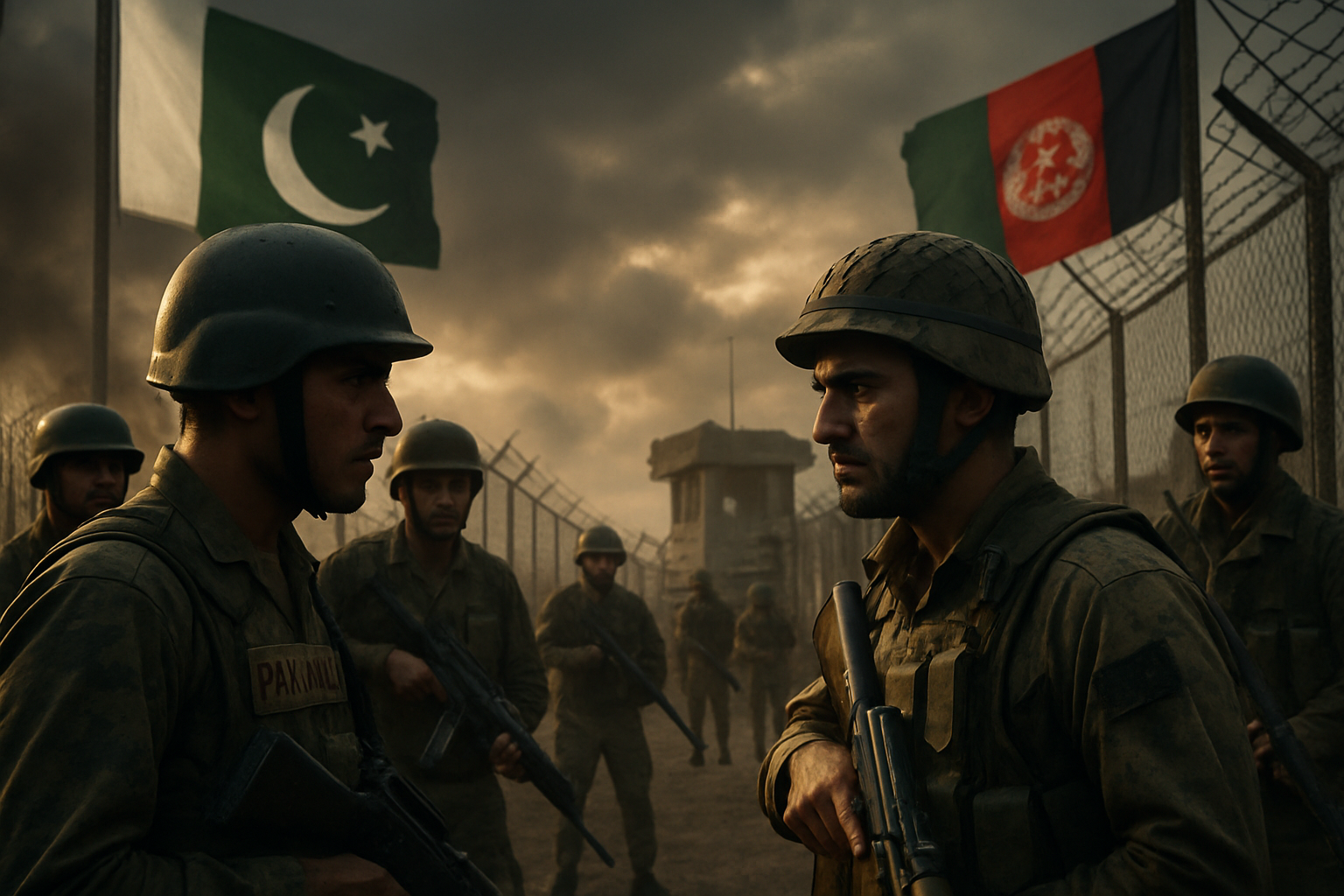
Pakistan's Defense Minister Khawaja Mohammad Asif formally declared "open war" against Afghanistan's Taliban government on Friday, following unprecedented cross-border airstrikes and ground clashes that have dramatically escalated tensions between the nuclear-armed neighbors.
The declaration came after Pakistan launched Operation Ghazab-ul-Haq, a comprehensive military campaign targeting what Islamabad claims are terrorist camps inside Afghanistan. Pakistani military spokesman Ahmed Sharif Chaudhry confirmed that the operation has resulted in significant casualties on both sides, with Pakistani forces claiming to have killed 274 Taliban officials and militants while losing 12 Pakistani soldiers in the exchanges.
Military Operations Intensify Along Durand Line
The conflict began Thursday evening when Afghan Taliban forces launched what Pakistan described as "unprovoked firing" on Pakistani border positions, killing two Pakistani soldiers and wounding three others. In response, Pakistan deployed fighter jets and artillery in coordinated strikes across multiple Afghan provinces, including Kabul, Kandahar, and Paktia.
Taliban spokesman Zabihullah Mujahid confirmed that Pakistani aircraft conducted extensive bombing operations but disputed the casualty figures provided by Islamabad. Speaking at a press conference in Kandahar province, Mujahid accused "a special circle in Pakistan" of launching "a mission to destabilize the region" and urged regional countries to intervene.
"Afghan air forces had precisely targeted Pakistani military centers in response to these provocations. We seek a peaceful resolution of issues, but the Pakistani side has consistently attempted to destabilize our sovereignty."
— Zabihullah Mujahid, Taliban Spokesman
The fighting has spread to strategic locations along the 2,640-kilometer Durand Line, the disputed colonial-era border that Afghanistan has never formally recognized. Heavy clashes erupted at the Torkham border crossing, a vital trade route between the two countries, forcing the evacuation of dozens of families from nearby returnee camps.
Escalation from Diplomatic Crisis
The current military confrontation represents a dramatic escalation from months of deteriorating relations between Islamabad and the Taliban government. The immediate trigger was a February 16 attack in Pakistan's Bajaur district that killed 11 Pakistani soldiers, carried out by the banned Tehreek-i-Taliban Pakistan (TTP) using a vehicle-borne improvised explosive device.
Pakistan responded on February 22 with airstrikes targeting seven terrorist camps across Afghanistan's Nangarhar and Paktika provinces. While Pakistan claimed to have eliminated over 80 militants, the strikes also resulted in civilian casualties, including eight schoolchildren, according to UN monitoring agencies.
The humanitarian toll has been devastating. Reports from the ground indicate that 18 civilians, including women and children, have been killed in Pakistani airstrikes, while Taliban forces have launched retaliatory drone attacks on Pakistani cities including Islamabad, Nowshera, and Abbottabad.
Regional and International Response
The escalation has prompted urgent diplomatic intervention from regional powers. Turkey's Foreign Minister Hakan Fidan has initiated a mediation effort, contacting both Pakistani Foreign Minister Ishaq Dar and Afghan Foreign Minister Amir Khan Muttaqi, as well as counterparts from Qatar and Saudi Arabia.
Iran has also offered mediation services, warning that the conflict could affect broader regional stability. Despite previous Saudi-mediated prisoner exchanges in February 2026 that secured the release of three Pakistani soldiers from Taliban custody, diplomatic efforts have failed to prevent the military escalation.
The conflict has severely impacted economic relations between the neighbors. Bilateral trade has collapsed by 59%, with Pakistan's exports to Afghanistan plummeting from $550 million to $228 million over seven months of the current fiscal year. This economic devastation compounds Afghanistan's humanitarian crisis, where 88% of female-headed households are unable to meet minimum living requirements according to UN data.
Pakistan's Strategic Shift
Pakistan's military leadership has issued stark ultimatums to the Taliban government. Director General of Inter-Services Public Relations Lieutenant General Ahmed Sharif Chaudhry told reporters that "the oppressive Afghan Taliban regime has to make a clear choice" between supporting terrorist organizations and maintaining relations with Pakistan.
"They have to choose between Tehreek-i-Taliban Pakistan, Baloch Liberation Army, Daesh, Al Qaeda, and Pakistan. Our choice is absolutely clear. It will always be Pakistan over everything else."
— Lt. General Ahmed Sharif Chaudhry, Pakistan Military Spokesman
The Pakistani Senate unanimously adopted a resolution condemning what it termed "unprovoked aggression" by the Afghan Taliban, demanding that Afghanistan immediately cease hostile actions and prevent the use of its territory for terrorism against Pakistan. The resolution described any attempt to challenge Pakistan's sovereignty as "a direct affront to the dignity of the nation."
Prime Minister Shehbaz Sharif visited the General Headquarters in Rawalpindi for detailed military briefings, declaring zero tolerance for what Pakistan calls the "nexus between the Afghan Taliban and Fitna al-Khawarij" – the state's term for TTP terrorists.
Taliban's Defiant Response
Afghanistan's Taliban government has firmly rejected Pakistan's accusations and threatened measured retaliation. The Afghan Ministry of National Defense warned of "appropriate responses at suitable times," describing the protection of sovereignty as both "religious obligations and national duties."
Taliban officials maintain that no armed groups operate from Afghan soil against neighboring countries, rejecting Pakistan's claims as "unfounded." They have filed complaints with the UN Security Council through acting permanent representative Naseer Ahmad Faiq, condemning the airstrikes as violations of international law.
The Taliban has also confirmed conducting counter-strikes against Pakistani military positions, claiming successful hits on facilities in Islamabad, Nowshera, Jamrud, and Abbottabad. Pakistani forces have reportedly captured five Afghan checkposts and raised Pakistani flags at strategic positions including Shawal, Angoor Adda, and Zarmilan.
Broader Security Implications
The conflict represents the most serious challenge to post-2021 South Asian security architecture since the Taliban returned to power. Pakistan has acknowledged its diminished regional influence to wealthier powers including Turkey, UAE, Qatar, Saudi Arabia, and China, forcing greater reliance on military solutions for border security.
The crisis occurs against a backdrop of persistent cross-border terrorism. In addition to the Bajaur attack, Pakistan has faced mounting security challenges, including a February 6 ISIS-K bombing at an Islamabad mosque that killed 31 people and wounded 169 others. Pakistan eliminated over 400 militants in Balochistan operations during February 2026 alone, demonstrating the scale of ongoing counter-terrorism efforts.
International observers warn that the escalation could embolden various armed groups operating in the region and destabilize both countries. Chinese officials have warned the UN Security Council about the presence of ISIS-K, al-Qaeda, and other international terrorist groups in Afghanistan, contradicting Taliban claims of having "defeated terrorism."
Path to Resolution Uncertain
The international community faces mounting pressure to prevent a broader regional confrontation between two neighbors that share deep cultural, linguistic, and historical ties. The Hamas movement has called on both Pakistan and Afghanistan to exercise restraint and prioritize dialogue over military action.
However, both sides have adopted hardline positions that complicate diplomatic resolution. Pakistan demands "immediate, concrete, and verifiable measures" against all terrorist groups operating from Afghan soil, while the Taliban maintains its territorial integrity and rejects external interference in its governance.
The Foreign Office in Islamabad has warned that any further provocation by the Taliban regime will be met with "measured, decisive and befitting response," while Taliban officials describe their military actions as necessary to protect Afghanistan's sovereignty and territorial integrity.
As the conflict enters its most dangerous phase, the coming days will be critical in determining whether diplomatic intervention can contain the crisis or if the region faces a sustained military confrontation with potentially devastating consequences for both nations and broader regional stability.
The dispute over the Durand Line – the 1893 British colonial boundary that has never been formally recognized by any Afghan government – remains at the heart of the border tensions. The porous, mountainous terrain provides militant sanctuaries that complicate bilateral relations and create ongoing security challenges that have persisted for decades.
This escalation represents a watershed moment that will test the Taliban's governance capabilities, Pakistan's military resolve, and the international community's ability to prevent conflicts from spiraling into broader regional confrontations in an increasingly complex geopolitical landscape.