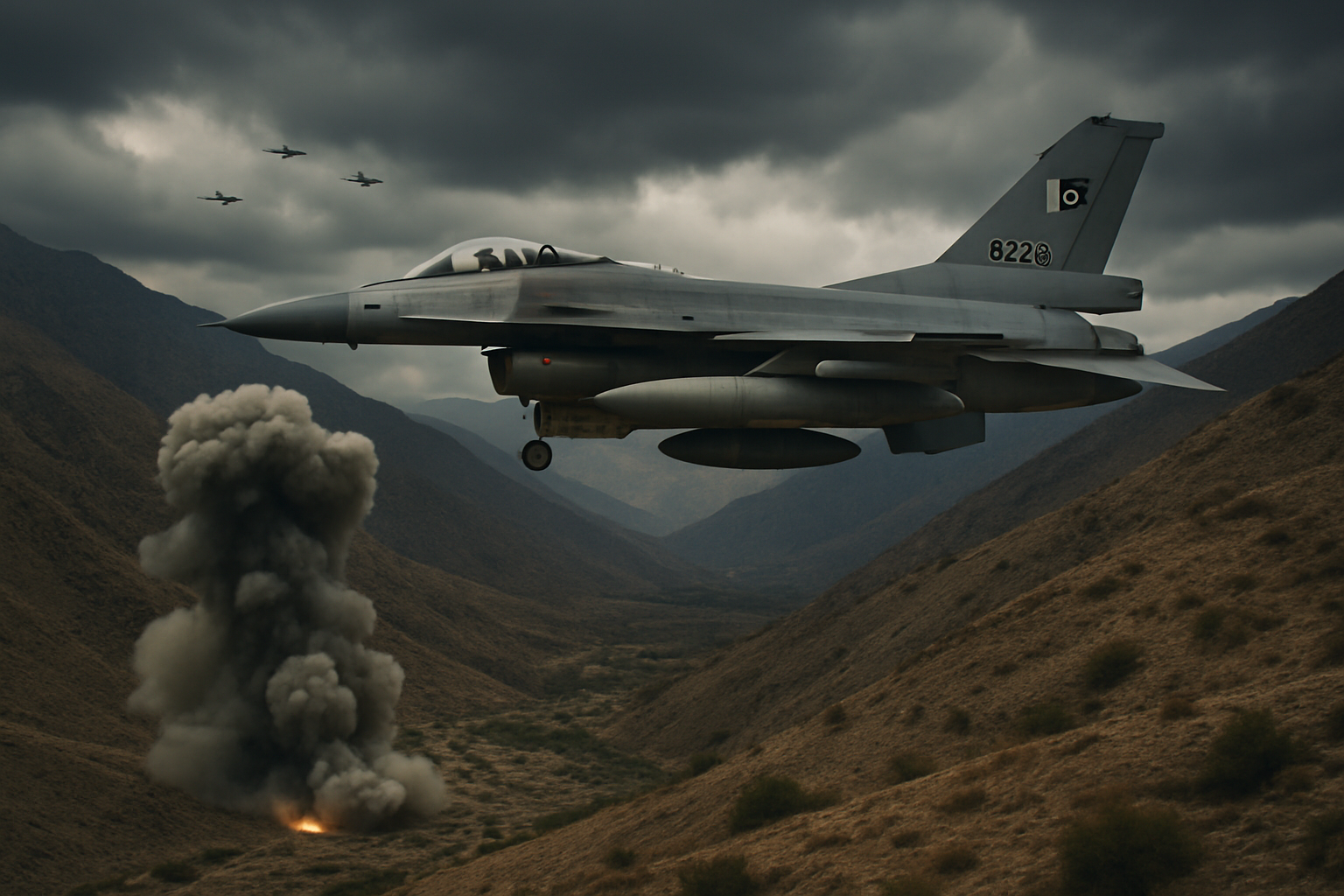
Pakistan conducted coordinated airstrikes on Afghanistan's eastern provinces over the weekend, targeting what it claimed were terrorist camps but killing at least 18 civilians including eight schoolchildren, triggering a major diplomatic crisis and threatening regional stability.
The strikes, which occurred in the early hours of Sunday morning across Nangarhar and Paktika provinces, represent the most significant cross-border military escalation in recent months, coming just days after a deadly terrorist attack that killed 11 Pakistani soldiers in Bajaur district.
Civilian Casualties Spark International Outcry
According to United Nations Assistance Mission in Afghanistan (UNAMA) and Taliban officials, the airstrikes resulted in devastating civilian casualties. In Nangarhar's Behsud district alone, 13 members of a single family were reportedly killed, including women and children. The Afghan Ministry of Education confirmed eight schoolchildren died in the attacks - five boys and three girls - while a seminary student was injured in Paktika's Barmal district.
Richard Bennett, the UN Special Rapporteur on human rights in Afghanistan, expressed "grave concern" over the civilian casualties, calling on both sides to exercise maximum restraint and comply with international law. "I am deeply concerned by reports of numerous children and other civilians being killed following renewed conflict between Pakistan and Afghanistan," Bennett stated on social media.
"These reports of harm to civilians are deeply troubling and must be urgently examined. Civilian protection is a fundamental obligation under international law."
— Amnesty International spokesperson
Pakistan's Military Justification
Pakistan's Ministry of Information described the operations as "intelligence-based selective targeting" against seven terrorist camps housing militants from Tehreek-e-Taliban Pakistan (TTP) and ISIS-Khorasan Province. Pakistani officials claimed over 80 militants were eliminated in the strikes, which targeted camps in Nangarhar's Behsud and Khogyani districts, as well as Paktika's Barmal and Urgun districts.
The strikes were a direct response to the February 16 Bajaur district attack, where TTP militants used a vehicle-borne improvised explosive device to kill 11 Pakistani soldiers at a security checkpost. Defense Minister Khawaja Asif had previously threatened airstrikes if cross-border attacks continued, maintaining that TTP leadership operates "with impunity from Afghan soil."
Parliamentary Secretary Barrister Danyal Chaudhry defended the operations as necessary self-defense, stating that "national security is non-negotiable" after Afghan soil was used for proxy attacks against Pakistan.
Taliban's Fierce Condemnation and Retaliation Threats
The Taliban government issued its strongest condemnation yet, with spokesman Zabihullah Mujahid describing the strikes as violations of Afghanistan's airspace, sovereignty, and international law. The Taliban warned of a "measured and appropriate response at suitable time," describing the protection of sovereignty and population as "religious obligations and national duties."
Afghanistan's Foreign Ministry summoned the Pakistani ambassador to deliver a formal protest note, while the country filed a complaint with the UN Security Council through acting permanent representative Naseer Ahmad Faiq. Former Afghan President Hamid Karzai called the strikes a "clear violation of Afghanistan's sovereignty," urging a civilized neighborly policy.
Afghanistan's Foreign Minister Amir Khan Muttaqi spoke with UN Under-Secretary-General Rosemary DiCarlo, maintaining that no armed individuals were killed in the strikes and rejecting Pakistan's claims as unfounded. "The foreign minister stressed that no armed groups are operating inside Afghanistan," officials said.
Regional and International Response
Iran quickly positioned itself as a potential mediator in the escalating crisis. Iranian Foreign Ministry spokesman Esmaeil Baghaei expressed deep concern about rising tensions between Kabul and Islamabad, warning that further escalation could have consequences beyond the two neighboring states.
"We are concerned about this situation, and we have every right to be concerned, because both countries are our neighbors and Muslim nations. Any escalation between them will have repercussions beyond these two countries," Baghaei stated at a press conference.
Iran's ambassador to Pakistan, Reza Amiri-Moghaddam, urged restraint and dialogue during a speech at the Institute of Strategic Studies in Islamabad, warning that continued confrontation would benefit no one and could destabilize the wider region.
Amnesty International called for a thorough, independent, and impartial investigation into the civilian casualties, emphasizing that the strikes followed a disturbing pattern of civilian harm along the disputed Durand Line between Afghanistan and Pakistan.
Historical Context of Border Tensions
The latest escalation comes despite recent diplomatic efforts to improve relations. Just weeks earlier, Saudi Arabia had mediated the release of three Pakistani soldiers captured by the Taliban during October 2025 border clashes, in what was seen as a confidence-building measure during Ramadan.
However, the underlying security challenges have persisted. Between October and December 2025, UNAMA reported that 70 civilians were killed and 478 others injured during clashes between Afghan forces and the Pakistan military. The porous, mountainous border has long served as a sanctuary for militant groups, complicating counter-terrorism efforts.
Pakistan has been conducting intensive counter-terrorism operations, with security forces eliminating over 400 militants in Balochistan province alone during February 2026. The recent Bajaur attack demonstrated that militant groups retain sophisticated operational capabilities, including coordinated assaults and vehicle-borne explosive devices.
Diplomatic Failures and Mediation Efforts
The current crisis highlights the failure of previous diplomatic initiatives. Despite Saudi Arabia's mediation efforts and the February 2026 prisoner exchange, the fundamental security challenges remained unaddressed. Pakistan has repeatedly demanded "immediate, concrete and verifiable measures against all terror groups operating from Afghan soil," representing a clear ultimatum to the Taliban.
The Taliban, for its part, has consistently denied providing sanctuary to militant groups, instead claiming that Afghanistan no longer harbors terrorists. However, Chinese officials have warned the UN Security Council about the continued presence of ISIS-K, al-Qaeda, and other terrorist organizations in Afghanistan, contradicting Taliban claims of having defeated terrorism.
Recent border incidents have also involved civilian casualties, with two Afghan women killed as Pakistani forces opened fire on a vehicle near the Iranian border after it failed to stop at a checkpoint, further straining bilateral relations.
Ramadan Timing Adds Complexity
The timing of the strikes during the holy month of Ramadan has added additional significance to the crisis. Recent terrorist attacks, including the February 6 Islamabad mosque bombing that killed 31 people during Friday prayers, specifically targeted religious gatherings, demonstrating calculated sectarian violence by extremist groups.
The strikes on civilian areas, including a religious madrasa and residential homes, during this sacred period have been condemned by the Taliban as violations of both international law and Islamic principles, further complicating any potential diplomatic resolution.
Strategic Implications for Regional Stability
The current crisis represents a critical test of the Taliban's governance capabilities and their willingness or ability to control militant groups operating from Afghan territory. It also tests Pakistan's resolve to use military action to secure its borders while managing diplomatic relationships.
The success or failure of international mediation efforts will influence future approaches to regional security cooperation and may set precedents for how territorial sovereignty and transnational terrorism challenges are addressed in the 21st century.
Pakistan has acknowledged its diminished regional influence compared to wealthier powers like Turkey, UAE, Qatar, Saudi Arabia, and China, which has increased its reliance on military solutions when diplomatic leverage proves insufficient.
The international community, including regional mediators, continues to monitor the situation closely given its implications for broader South Asian stability. The challenge lies in developing innovative diplomatic frameworks that balance legitimate security concerns with territorial integrity respect and civilian protection.
Ongoing Humanitarian Impact
Medical facilities in the affected areas have been overwhelmed treating the wounded, with rescue operations continuing for civilians trapped under rubble. The strikes have disrupted normal life in border communities already struggling with poverty and limited services.
The humanitarian impact extends beyond immediate casualties, affecting community displacement, psychological trauma, and economic disruption in regions that have endured decades of conflict. Emergency services have struggled to reach some affected areas in Nangarhar's devastated Behsud district.
As tensions escalate, the focus remains on whether diplomatic solutions can arrest the cycle of violence or whether the region faces broader military escalation that could destabilize the entire Afghanistan-Pakistan border area and beyond.