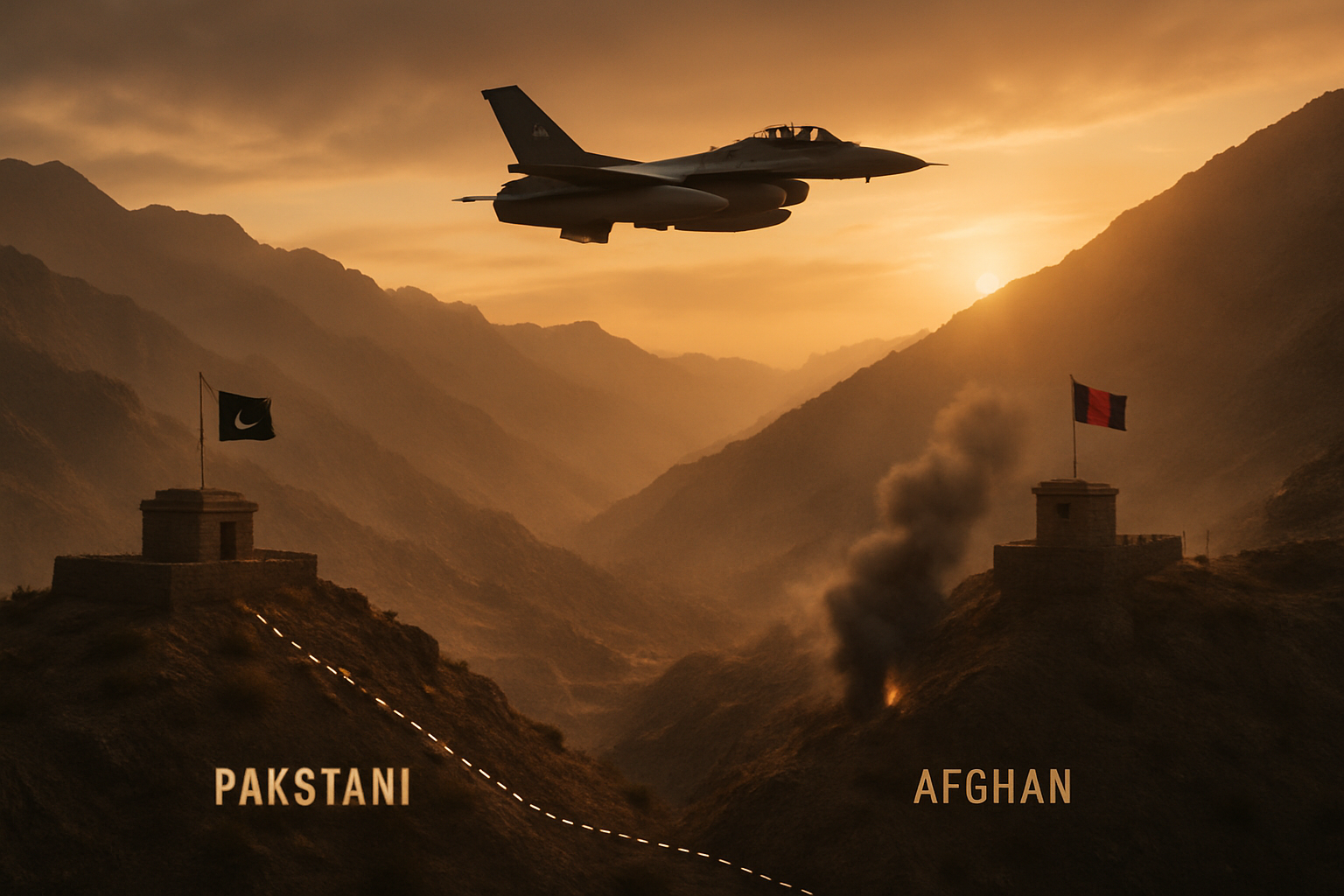
Pakistan conducted fresh airstrikes on Afghanistan's capital Kabul and border provinces overnight, killing several people including women and children, according to Afghan authorities, marking the latest escalation in a month-long military confrontation that has become the most serious crisis between the neighboring countries since the Taliban's return to power in 2021.
The strikes targeted areas in Kabul and Afghanistan's eastern border provinces, with Taliban officials confirming multiple civilian casualties. A Pakistani security official confirmed the operations were aimed at targeting Pakistani Taliban (TTP) positions, continuing Pakistan's military campaign that began following a February 16 terrorist attack in Bajaur district that killed 11 Pakistani soldiers.
Escalating Military Confrontation
The latest airstrikes represent a dangerous escalation of what Pakistani Defense Minister Khawaja Asif formally declared as "open war" against Afghanistan's Taliban government on February 27, 2026. This unprecedented declaration marked the first time Pakistan has formally announced open warfare against Afghanistan since the Taliban's August 2021 return to power.
Afghan authorities have documented mounting civilian casualties from the sustained military operations. The UN Assistance Mission in Afghanistan (UNAMA) reported 185 civilian casualties—56 killed and 129 wounded—between February 26 and March 5, with more than half being women and children. The latest strikes add to this tragic toll as the conflict enters its fourth week.
"Afghan authorities said Friday that Pakistani air strikes hit Kabul and border provinces overnight, killing four people in the capital."
— France 24 International News Report
Crisis Timeline and Triggers
The current crisis began with a devastating February 16 attack in Pakistan's Bajaur district, where Tehrik-e-Taliban Pakistan (TTP) militants used a vehicle-borne improvised explosive device to kill 11 Pakistani soldiers at a joint security checkpoint. The sophisticated assault involved coordinated gunfire and a suicide bombing that collapsed infrastructure and damaged nearby civilian buildings.
Pakistan responded on February 22 with airstrikes targeting seven alleged terrorist camps in Afghanistan's Nangarhar and Paktika provinces. While Pakistani officials claimed to have killed over 80 militants, the strikes caused significant civilian casualties, including eight schoolchildren aged 5-15 years in Behsud district, according to UNAMA confirmation.
The Taliban government condemned these strikes as violations of Afghan sovereignty and international law, warning of "measured and appropriate response" and describing the protection of sovereignty as "religious obligations and national duties." This set the stage for an unprecedented cycle of military escalation between the nuclear-armed neighbors.
Economic and Humanitarian Devastation
The military confrontation has created severe economic consequences for both nations. Bilateral trade has collapsed by 59%, with Pakistan's exports to Afghanistan dropping from $550 million to $228 million over seven months, devastating border communities dependent on cross-border commerce.
Traditional trade routes through Chaman-Spin Boldak and Torkham have faced repeated closures, compounding Afghanistan's humanitarian crisis where 88% of female-headed households are unable to meet minimum living requirements, according to UN data.

The World Health Organization has been forced to deliver emergency medical oxygen to only 23 hospitals, while hundreds of health centers have closed due to funding cuts and security concerns. The ongoing violence has also displaced over 16,370 families across 10 Afghan provinces, according to UN humanitarian officials.
The Durand Line Dispute
At the heart of this crisis lies the disputed 2,640-kilometer Durand Line, the colonial-era border established by Britain in 1893 that has never been recognized by any Afghan government. Afghanistan views this boundary as an artificial division of Pashtun tribal areas, while Pakistan maintains it as its legitimate international border.
Pakistan alleges that TTP militants operate "with impunity from Afghan soil," using the porous mountainous terrain along the disputed border as sanctuaries for planning attacks against Pakistani targets. The Taliban government categorically denies providing sanctuary to militant groups, insisting that no armed organizations operate from Afghan territory.
This fundamental disagreement over territorial sovereignty versus cross-border terrorism has proven to be the core issue preventing diplomatic resolution of the crisis.
International Mediation Efforts
Multiple international powers have attempted to mediate the escalating conflict, with limited success. Saudi Arabia facilitated a prisoner exchange in February 2026, securing the release of three Pakistani soldiers captured during October 2025 border clashes. However, this confidence-building measure proved insufficient to address the underlying security challenges.
Turkey, Iran, Russia, and China have all offered mediation services. Turkish Foreign Minister Hakan Fidan launched comprehensive diplomatic initiatives, contacting both Pakistani and Afghan foreign ministers along with Qatari and Saudi counterparts. Russian Foreign Minister Sergey Lavrov held telephone discussions with Afghan Foreign Minister Amir Khan Muttaqi, urging "political and diplomatic means" to resolve the differences.
"The path of talks remains open, and we seek resolution through mutual understanding and respect."
— Taliban Spokesperson, emphasizing diplomatic solutions
Despite these intensive diplomatic efforts, Pakistan has acknowledged its diminished regional influence compared to wealthier powers including Turkey, UAE, Qatar, Saudi Arabia, and China, leading to increased reliance on military solutions rather than traditional diplomatic leverage.
Nuclear Implications and Regional Security
The involvement of nuclear-armed Pakistan adds a dangerous dimension to this conflict that requires careful international monitoring to prevent escalation beyond conventional military operations. This represents the most serious Pakistan-Afghanistan confrontation in decades, testing the post-2021 South Asian security architecture.
Chinese warnings to the UN Security Council about the presence of ISIS-K, al-Qaeda, and East Turkestan Islamic Movement (ETIM) in Afghanistan contradict Taliban claims of having "defeated terrorism." These revelations highlight the complex security challenges facing the region beyond the immediate bilateral dispute.
The crisis has also coincided with other regional tensions, including continued threats from ISIS-K, which claimed responsibility for a devastating February 6 mosque bombing in Islamabad that killed 31 people and wounded 169 others, demonstrating the persistent cross-border security challenges.
Civilian Impact and International Law Concerns
The targeting of civilian areas, including residential neighborhoods, educational institutions, and religious sites during the holy month of Ramadan, has raised serious concerns about violations of international humanitarian law. Medical facilities have been overwhelmed treating wounded civilians, while rescue operations continue for those trapped under bombardment rubble.
The pattern of civilian casualties has drawn condemnation from human rights organizations and UN officials. The strikes during Ramadan carry additional significance as they occur during Islam's holiest period, when both countries' populations are observing religious obligations.
Afghan civilians, already facing one of the world's worst humanitarian crises, are bearing the brunt of the military escalation. The disruption of aid operations and closure of border crossings has severely restricted humanitarian access when assistance is most desperately needed.
Strategic Implications and Future Outlook
This crisis represents a critical test of whether 21st-century diplomatic frameworks can effectively manage conflicts where territorial sovereignty intersects with transnational terrorism challenges. The success or failure of current mediation efforts will influence future approaches to similar regional disputes globally.
The confrontation also tests the Taliban's governance capabilities and their ability to control militant groups operating from Afghan territory, while simultaneously challenging Pakistan's resolve to balance legitimate security concerns with diplomatic engagement and international law compliance.
As the conflict enters its second month, the international community faces mounting pressure to develop more effective conflict prevention mechanisms before the crisis expands into a broader regional confrontation with potentially catastrophic consequences.
Conclusion
The latest Pakistani airstrikes on Afghanistan represent a dangerous escalation of an already unprecedented military confrontation between nuclear-armed neighbors. With civilian casualties mounting, economic devastation spreading, and diplomatic solutions remaining elusive, the crisis has become a template-setting challenge for contemporary international relations.
The coming days will be critical in determining whether sustained international mediation can overcome military escalation, or if this border conflict will evolve into a prolonged regional war with implications extending far beyond the Afghanistan-Pakistan relationship. The stakes could not be higher for regional stability, international law enforcement, and global conflict resolution mechanisms in the modern era.