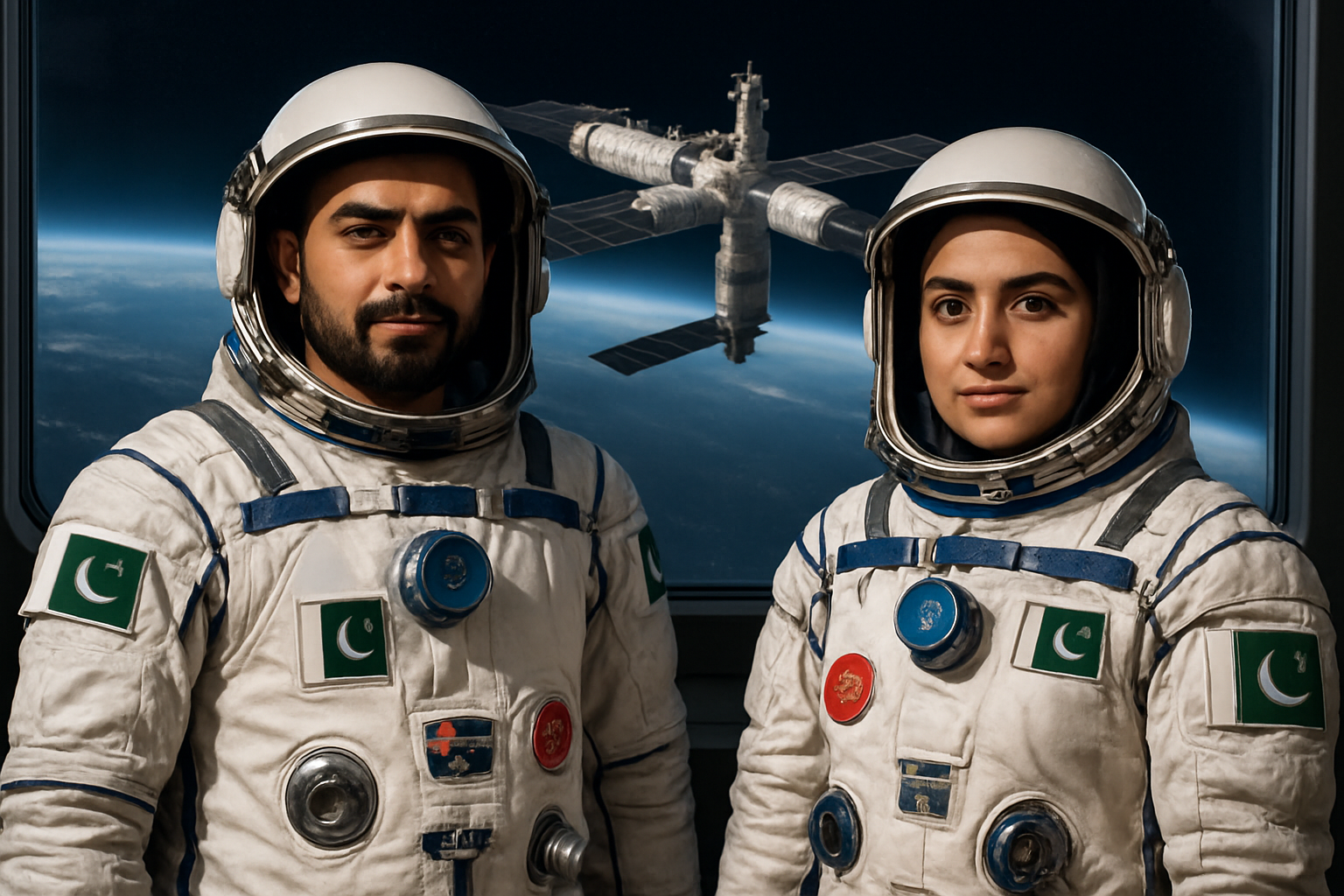
China has officially named Muhammad Zeeshan Ali and Khurram Daud as Pakistan's first astronaut candidates for training aboard the Tiangong space station, marking a historic milestone that will see one of them become the first foreign astronaut to enter China's orbital laboratory.
The announcement, made by China's state news agency Xinhua on Wednesday, represents a groundbreaking achievement for Pakistan's space program and a significant expansion of China's international space cooperation initiatives. After rigorous assessments, one of the two Pakistani candidates will serve as a payload specialist on a space mission alongside Chinese crew members, scheduled for October-November 2026.
A Historic Partnership Takes Flight
The selection of Ali and Daud follows a bilateral Astronaut Cooperation Agreement signed between Pakistan's Space and Upper Atmosphere Research Commission (SUPARCO) and the China Manned Space Agency (CMSA) in February 2025. Both candidates underwent comprehensive medical, psychological, and aptitude assessments at China's Astronauts Centre (ACC), meeting rigorous international standards that have positioned Pakistan among an elite group of nations with human spaceflight capabilities.
According to the China Manned Space Agency, both astronauts will soon arrive in China to begin an intensive six-month advanced training program. This comprehensive preparation will cover spacecraft operations, emergency procedures, scientific protocols, and the unique challenges of operating in the microgravity environment of the Tiangong station.
"This represents a major breakthrough for South Asian space exploration and Pakistan's entry into the elite group of human spaceflight nations."
— China Manned Space Agency Statement
Building on Decades of Space Cooperation
The astronaut selection builds upon a robust foundation of Pakistan-China space collaboration that has intensified significantly in recent years. In February 2026, Pakistan successfully launched its second indigenous Earth Observation satellite, EO-2, from China's Yangjiang Seashore Launch Centre, demonstrating the depth of their technological partnership.
Developed by SUPARCO, the EO-2 satellite enhanced Pakistan's autonomous earth observation capabilities, supporting national development planning, climate adaptation strategies, precision agriculture, and disaster management systems. This achievement positioned Pakistan within an elite group of nations with indigenous satellite design, development, and operation capabilities.
The space partnership has evolved beyond mere launch services to encompass comprehensive technology transfer, joint research initiatives, and now human spaceflight cooperation. This model demonstrates how emerging nations can achieve space advancement through strategic partnerships rather than massive independent infrastructure investments.
A Gateway to the Space Economy
The Pakistani astronaut mission occurs during what space industry analysts call the "space economy golden age," with the global space economy projected to exceed $1 trillion by 2030. China's Tiangong space station serves as a crucial platform for international collaboration, scientific research, and technology demonstration that will define the next phase of human space exploration.
The October-November 2026 timeline positions Pakistan's inaugural human spaceflight mission amid unprecedented space activity. NASA's Artemis II mission successfully completed humanity's first crewed lunar flyby in 54 years in April 2026, while SpaceX prepares for a potentially trillion-dollar IPO in June 2026. This convergence of international achievements and commercial expansion marks a watershed moment for spacefaring civilization development.
Scientific and Strategic Implications
The Pakistani astronauts will contribute to ongoing research aboard Tiangong, including materials science experiments, biological studies in microgravity, Earth observation, and space medicine protocols essential for future lunar missions. Their participation adds valuable perspectives from South Asian scientific communities to the growing body of space-based research.
Recent developments in space medicine research, including studies on Space-Associated Neuro-Ocular Syndrome (SANS) and tissue cultivation in microgravity, have provided crucial insights for extended missions beyond Earth's protective magnetic field. Pakistani contributions to this research will inform protocols for sustainable lunar presence and Mars exploration missions where astronauts may spend years without the possibility of medical evacuation to Earth.
International Space Cooperation Renaissance
The Pakistan-China collaboration exemplifies the democratization of space capabilities beyond traditional spacefaring nations. This trend includes Thailand's leadership in UN space governance, Germany's €10 billion satellite system investments, and Sweden's Isar Aerospace facility producing 30 engines monthly for European space independence.
China's systematic approach to international space cooperation contrasts with the competitive dynamics often seen in space exploration. Through the Tiangong station, China has created a platform for peaceful international collaboration that complements existing frameworks like NASA's Artemis Accords.
"Space exploration requires global cooperation to address the technical, scientific, and logistical challenges of establishing humanity as a spacefaring species."
— International Space Policy Expert
Technical Preparation and Training
The six-month training program in China will prepare Ali and Daud for the unique challenges of space station operations. This includes mastering complex life support systems, conducting scientific experiments in microgravity, emergency response procedures, and coordination with international crew members.
Training will also address the physiological challenges of spaceflight, including adaptation to weightlessness, radiation exposure protocols, and maintaining physical and psychological health during extended missions. Recent research has revealed that microgravity can disrupt various biological processes, requiring careful medical monitoring and countermeasures.
The candidates will learn to operate sophisticated laboratory equipment aboard Tiangong, conduct materials science experiments, monitor biological specimens, and contribute to Earth observation programs that provide valuable data for climate research, disaster management, and agricultural monitoring.
A New Chapter for Pakistan's Space Program
The astronaut selection represents the culmination of decades of strategic development in Pakistan's space capabilities. SUPARCO, established in 1961, has systematically built expertise in satellite technology, remote sensing, and space applications. The agency's progression from relying on foreign satellite operators to launching indigenous Earth observation satellites demonstrates Pakistan's growing technological independence.
This human spaceflight capability positions Pakistan to participate in the emerging space economy through high-value employment opportunities, potential satellite service exports, and contributions to international space research. The achievement provides a template for other developing nations pursuing space advancement through strategic partnerships.
Future Implications and Expansion
The successful selection and training of Pakistani astronauts could pave the way for expanded space cooperation between China and Pakistan, potentially including joint lunar missions, Mars exploration programs, and collaborative space station modules. China's plans for crewed lunar missions by 2030 may provide additional opportunities for international partners like Pakistan.
The mission also contributes to space capability democratization, demonstrating that comprehensive space programs are achievable through international cooperation rather than massive independent infrastructure investments. This model could inspire similar partnerships between established space powers and emerging nations.
As the space economy transitions from experimental endeavors to essential infrastructure, Pakistan's entry into human spaceflight establishes the nation as a participant in defining humanity's cosmic future. The October-November 2026 mission will mark not only Pakistan's first human presence in space but also a significant milestone in the peaceful international cooperation that will characterize humanity's expansion among the stars.
Looking Toward the Stars
The selection of Muhammad Zeeshan Ali and Khurram Daud represents more than a national achievement for Pakistan—it symbolizes the global nature of humanity's cosmic expansion. As one of them prepares to become the first foreign astronaut aboard Tiangong, they carry with them the hopes and scientific curiosity of over 230 million Pakistanis and the broader South Asian region.
Their mission will contribute to the growing body of knowledge essential for establishing permanent human settlements beyond Earth, conducting cutting-edge scientific research, and maintaining the international cooperation frameworks that will define spacefaring civilization. In the context of the space economy golden age, Pakistan's participation ensures that the benefits of space exploration and the knowledge gained from human presence in orbit will be shared globally.
The October-November 2026 timeframe positions Pakistan's inaugural spaceflight mission at a pivotal moment in human space exploration history, alongside NASA's renewed lunar ambitions, commercial space expansion, and China's growing role in peaceful international space cooperation. This convergence of achievements marks 2026 as a watershed year for humanity's sustained presence beyond Earth orbit.