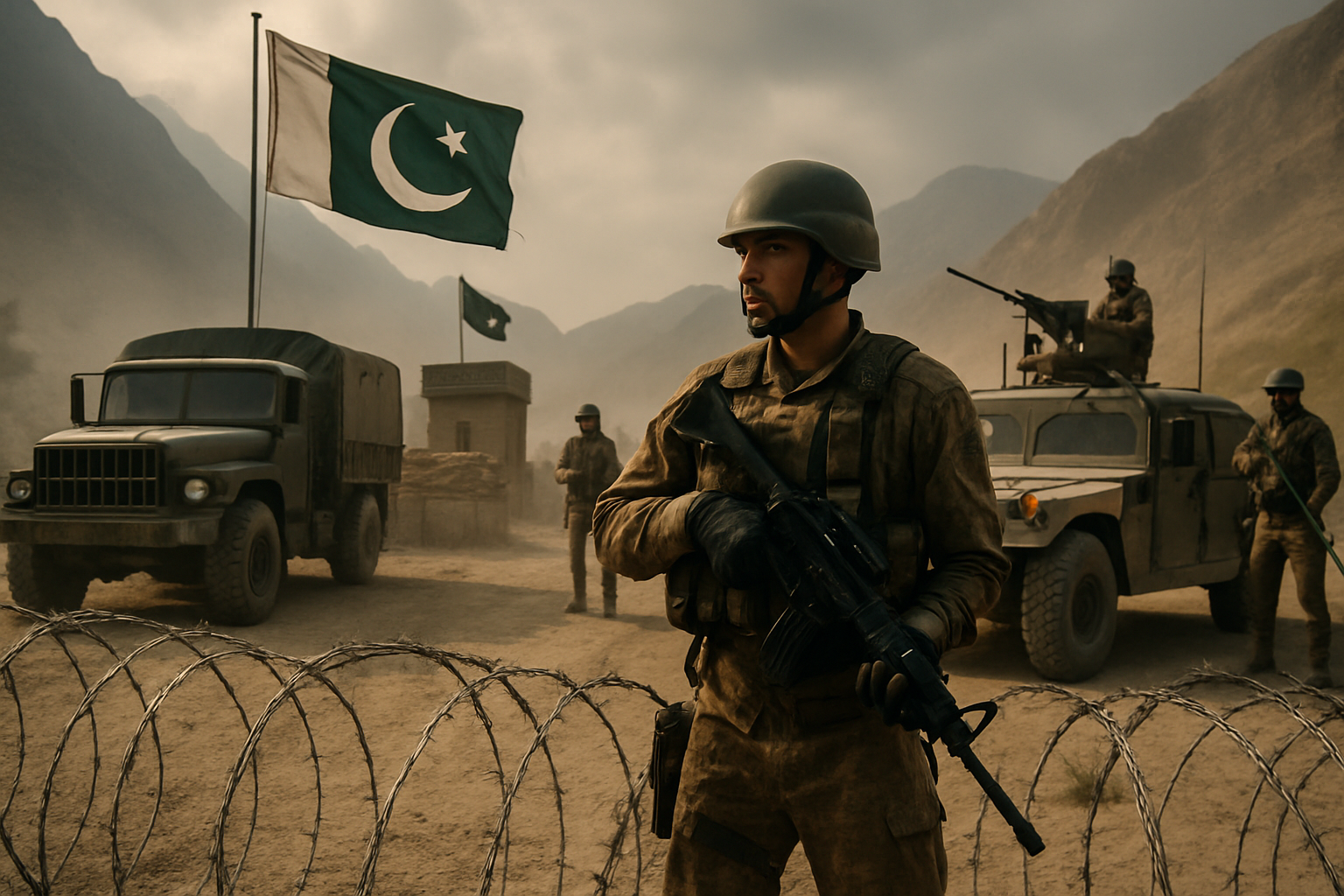
Pakistani military forces have captured border posts in Afghanistan's Khost province and conducted fresh attacks across the region, according to Afghan officials, as the devastating cross-border conflict enters its seventh week with no diplomatic resolution in sight.
Taliban local authorities in Khost confirmed that Pakistani forces engaged in intense fighting with Afghan border troops along the disputed frontier, successfully capturing strategic positions while both sides present sharply conflicting accounts of casualties and battlefield losses. The escalation comes as international mediation efforts have repeatedly failed to establish lasting peace between the nuclear-armed neighbors.
Latest Military Developments
According to reports from Afghan officials, Pakistani forces have intensified their cross-border operations, with fresh clashes erupting in Khost province's frontier areas. The capture of border posts represents a significant tactical development in what has become the most serious Pakistan-Afghanistan military confrontation since the Taliban's return to power in August 2021.
Simultaneously, Afghan authorities report that Pakistani attacks have resulted in mounting civilian casualties across Afghanistan's eastern provinces. Taliban deputy spokesman Hamdullah Fitrat documented that at least 761 civilians have been killed and 626 others wounded in Pakistani attacks across Afghanistan since February 22, highlighting the devastating human cost of nearly seven weeks of escalating cross-border conflict.
"These attacks represent a clear violation of our sovereignty and international law. The targeting of civilian areas is unacceptable and requires immediate international attention."
— Hamdullah Fitrat, Taliban Deputy Spokesman
International Diaspora Response
The deteriorating security situation has prompted widespread condemnation from Afghan communities worldwide. Members of the Afghan diaspora in the United States have joined a growing wave of international protests over recent Pakistani military strikes on Afghan territory, as tensions along the disputed Durand Line continue to escalate.
A group of Afghan citizens in Sacramento gathered this week to denounce the attacks, describing them as violations of sovereignty and threats to civilian lives. Participants issued a formal resolution calling on the international community to investigate the strikes and hold those responsible accountable. The gathering follows similar protests held by Afghan communities across Europe, highlighting growing concern among the diaspora over the deteriorating security situation.
Historical Context and Root Causes
The current crisis began on February 16, 2026, when a Tehreek-e-Taliban Pakistan (TTP) attack in Bajaur killed 11 Pakistani soldiers using a vehicle-borne improvised explosive device. Pakistan responded with airstrikes on February 22, targeting seven alleged terrorist camps and claiming to have killed over 80 militants, though the strikes also resulted in civilian casualties including eight schoolchildren.
The conflict dramatically escalated on February 27 when Pakistani Defense Minister Khawaja Mohammad Asif formally declared "open war" against Afghanistan's Taliban government, launching Operation Ghazab-ul-Haq—the most comprehensive military campaign between the neighbors in decades.
The tensions are rooted in the disputed 2,640-kilometer Durand Line, the colonial-era border established by the British in 1893 that has never been recognized by Afghan governments. Pakistan maintains that TTP operates "with impunity from Afghan soil," while the Taliban categorically denies providing sanctuary to militant groups or allowing Afghan territory to be used for cross-border attacks.
Humanitarian Crisis Deepens
The prolonged military confrontation has created a severe humanitarian emergency across Afghanistan's eastern provinces. According to the UN Office for the Coordination of Humanitarian Affairs (OCHA), over 16,370 families have been newly displaced across 10 provinces since the crisis began.
The UN Assistance Mission in Afghanistan (UNAMA) has documented 185 civilian casualties (56 killed, 129 wounded) from late February through early March alone, with the majority being women and children. The World Health Organization reports that emergency medical oxygen is available at only 23 hospitals, while hundreds of health centers have been forced to close due to security concerns and funding cuts.
The economic impact has been equally devastating. Bilateral trade between Pakistan and Afghanistan has collapsed by 59%, with Pakistani exports dropping from $550 million to $228 million over seven months. The closure of traditional trade routes at Chaman-Spin Boldak and Torkham has severely affected border communities that depend on cross-border commerce for their livelihoods.
Failed Diplomatic Efforts
Despite intensive international mediation efforts, sustainable peace remains elusive. Multiple diplomatic initiatives have failed to address the underlying security challenges that fuel the conflict. A Saudi-mediated prisoner exchange in February 2026 that resulted in the release of three Pakistani soldiers proved insufficient to prevent the military escalation.
Religious diplomacy achieved a temporary breakthrough during Eid al-Fitr (March 18-23) when Saudi Arabia, Qatar, and Turkey successfully mediated a ceasefire using the Ramadan/Eid framework. However, the truce was immediately violated, with Pakistani forces continuing artillery attacks on civilian areas in Kunar province.
Chinese Foreign Minister Wang Yi has been actively engaged in trilateral mediation efforts, while Iran, Turkey, and Russia have all offered mediation services. Even prominent Islamic scholars, including 22 clerics from both countries, have called for extending the ceasefire until Eid al-Adha to foster sustainable peace, but their appeals have gone largely unheeded.
Nuclear Implications and Regional Security
The conflict carries serious implications for regional and global security, as it represents the most serious confrontation involving nuclear-armed Pakistan since the Taliban's return to power. The crisis tests the post-2021 South Asian security architecture and requires careful international monitoring to prevent escalation beyond conventional operations.
Pakistan has acknowledged its diminished influence over Afghanistan compared to wealthier regional powers such as Turkey, the UAE, Qatar, Saudi Arabia, and China, leading to increased reliance on military solutions. Chinese warnings at the UN about the presence of ISIS-K, al-Qaeda, and East Turkestan Islamic Movement (ETIM) in Afghanistan contradict Taliban claims of having defeated terrorism.
Current Positions and Future Prospects
The Taliban maintains that "the path of talks remains open" and continues to seek resolution through "mutual understanding and respect." However, Pakistan has indicated there is "no rush" to end the military campaign until concrete anti-militant measures are implemented by the Afghan authorities.
The capture of border posts in Khost represents a significant tactical escalation that could further complicate diplomatic efforts. The international community faces mounting pressure to develop innovative diplomatic frameworks that can balance security concerns with territorial integrity, civilian protection, and compliance with international law.
Template for 21st-Century Conflict Resolution
The Pakistan-Afghanistan border crisis has become a template-setting conflict for 21st-century challenges where territorial sovereignty intersects with transnational terrorism concerns. The success or failure of diplomatic containment efforts will influence global approaches to similar regional security challenges.
The stakes extend far beyond the bilateral relationship, affecting broader international security architecture and regional stability mechanisms. The crisis demonstrates the persistent challenges of addressing cross-border terrorism while respecting sovereignty principles, particularly in regions with complex ethnic and tribal dynamics.
As the conflict enters its seventh week, the international community continues to seek sustainable solutions that address the root causes of the crisis. The evolution from isolated border incidents to sustained military operations, including the capture of territory and targeting of civilian infrastructure, highlights the urgent need for comprehensive diplomatic engagement.
Without immediate and effective international intervention, the conflict risks further escalation with potentially devastating consequences for regional stability and global security. The world watches as two neighbors, sharing deep historical and cultural ties, struggle to find a path from warfare back to peace.