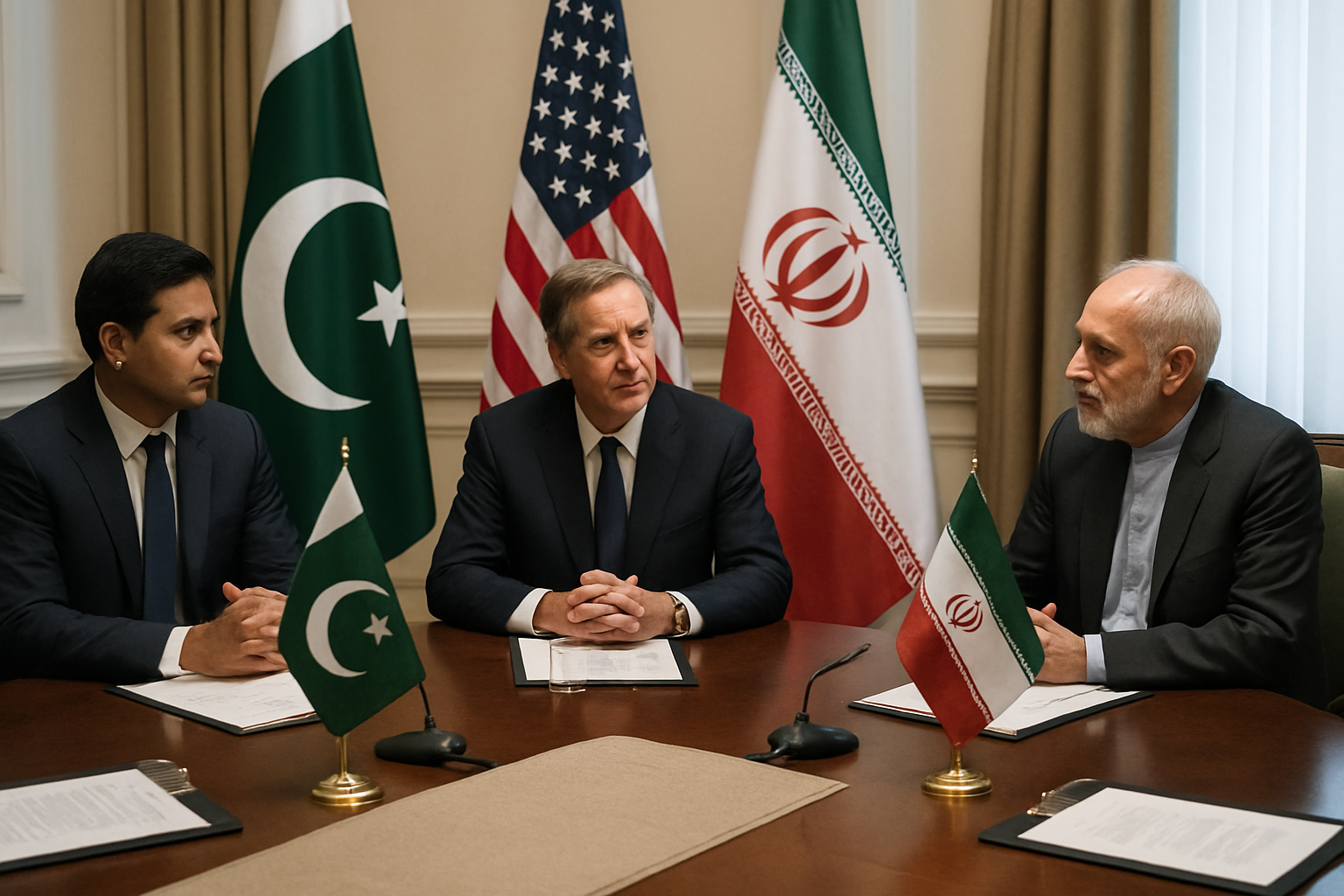
Pakistan has officially confirmed its pivotal role in facilitating indirect communications between the United States and Iran, as both nations attempt to navigate through the most dangerous international crisis since the Cold War. Foreign Minister Ishaq Dar's public acknowledgment marks the first time Pakistan has openly admitted to serving as a diplomatic intermediary in efforts to prevent broader regional warfare.
In a statement posted on social media platform X on Thursday, Deputy Prime Minister and Foreign Minister Ishaq Dar revealed that "US-Iran indirect talks are taking place through messages being relayed by Pakistan." He disclosed that the United States has shared a comprehensive 15-point proposal with Iran, which Tehran is currently deliberating.
"In reality, US-Iran indirect talks are taking place through messages being relayed by Pakistan. In this context, the United States has shared 15 points, being deliberated upon by Iran," Dar stated, addressing what he called "unnecessary speculation in the media regarding peace talks to end ongoing conflict in the Middle East."
Critical Diplomatic Window
The confirmation comes as the Middle East crisis enters its fourth week, with unprecedented global implications affecting energy security, aviation networks, and financial markets worldwide. Over 18,000 flights have been cancelled globally, oil prices have surged past $100 per barrel, and the strategic Strait of Hormuz—through which 40% of global oil transit passes—remains effectively closed by Iranian naval mining operations.
Multiple international sources confirm that Pakistan is not acting alone in these mediation efforts. Turkey, Egypt, and other unnamed countries are "also extending their support to this initiative," according to Dar's statement. This represents a coordinated regional effort to prevent the crisis from escalating into a broader Middle Eastern war with catastrophic global consequences.
The Pakistani Foreign Minister emphasized his country's commitment to regional stability, stating that "Pakistan remains fully committed to promoting peace and continues to make every effort to ensure stability in the region and beyond."
The 15-Point Peace Framework
While the specific details of the American proposal remain classified, diplomatic sources indicate that the 15-point plan addresses comprehensive security arrangements, including Iran's nuclear program, ballistic missile capabilities, regional proxy relationships, and the reopening of the Strait of Hormuz. This represents a significant evolution from earlier "unconditional surrender" demands that had characterized the Trump administration's position.
Iran's consideration of the proposal marks a potentially crucial shift in the crisis trajectory. However, Iranian officials have simultaneously maintained that any peace agreement must address their core demands, including complete cessation of attacks, concrete guarantees against future military action, full war damage reparations, and recognition of Iranian sovereignty over the Strait of Hormuz.
The contradictory signals from both Washington and Tehran underscore the complexity of the current diplomatic moment. While President Trump has claimed "very good and productive conversations" with Iran over recent days, Iranian parliamentary officials have categorically denied any direct communications, calling such claims "fake news."
Pakistan's Strategic Positioning
Pakistan's emergence as a primary mediator reflects the country's unique diplomatic positioning in the current crisis. Prime Minister Shehbaz Sharif has formally offered Pakistan to host "meaningful and conclusive talks" for a comprehensive settlement, leveraging long-standing relationships with both Washington and Tehran.
Diplomatic coordination has intensified significantly, with Pakistani officials maintaining regular contact with their counterparts. Foreign Minister Dar has held telephonic conversations with Turkish Foreign Minister Hakan Fidan to discuss rapidly evolving regional developments, while Prime Minister Sharif has engaged directly with Iranian leadership to explore potential frameworks for peace.
The coordinated mediation effort extends beyond Pakistan's borders. According to European diplomatic sources, multiple regional powers are providing crucial communication channels despite the absence of formal negotiations. This network approach represents a sophisticated diplomatic innovation designed to maintain dialogue even amid active military confrontation.
Historical Context and Stakes
The current crisis stems from the complete collapse of nuclear diplomacy despite achieving what observers called the most significant progress since the 2018 JCPOA breakdown. Geneva talks in February 2026 had established "broad agreement on guiding principles," but fundamental scope disagreements proved insurmountable—Iran demanded nuclear-only discussions excluding ballistic missiles and regional proxies as "red lines," while the US insisted on comprehensive arrangements addressing missiles, armed groups, and human rights.
This diplomatic breakdown led to "Operation Epic Fury," the largest US-Israeli military campaign since 2003, which resulted in the death of Iran's Supreme Leader Ali Khamenei on March 1, 2026. Iran's massive retaliation through "Operation True Promise 4" has caused regional casualties across Gulf states and marked the first attack on European territory since World War II when Iranian drones struck RAF Akrotiri in Cyprus.
The succession crisis in Iran has added another layer of complexity. Mojtaba Khamenei, son of the deceased Supreme Leader, has emerged as the favored successor—representing the first hereditary succession in the Islamic Republic's 47-year history and indicating a shift toward military governance under Revolutionary Guards influence.
Global Economic and Security Implications
The crisis has exposed fundamental vulnerabilities in global systems. The closure of the 21-mile Strait of Hormuz represents a geographic single-point failure for modern logistics, affecting not just energy supplies but consumer goods and industrial materials worldwide. Major shipping companies Maersk and MSC have suspended Persian Gulf operations entirely, stranding over 150 oil and LNG tankers worth billions in cargo.
Financial markets have experienced severe disruption, with Pakistan's KSE-100 suffering its largest single-day decline in history (-8.97%), while South Korean markets triggered circuit breakers as the won hit 17-year lows. The aviation crisis has forced fundamental reconsideration of route planning and risk assessment, with Middle Eastern airspace closures severing critical Europe-Asia corridors.
Energy security implications extend far beyond the Middle East. Natural gas prices have surged 24% in Europe and 78% in the United States, while countries from Bangladesh to Bosnia-Herzegovina face fuel rationing and emergency reserves depletion. The International Energy Agency has authorized the largest strategic petroleum reserve release in its 50-year history—400 million barrels across 32 countries.
Regional Coalition Under Pressure
The unprecedented Saudi-UAE-Qatar-Egypt coalition supporting diplomatic solutions faces severe strain as Iranian retaliation has directly targeted member territories. One civilian was killed in Abu Dhabi, 32 people were injured in Kuwait airport strikes, and Qatar intercepted 65 missiles and 12 drones, resulting in 8 injuries from debris.
Egyptian President Abdel Fattah el-Sisi condemned attacks on "sisterly Arab countries," warning of "comprehensive chaos" if the conflict expands further. The coalition's cohesion represents a critical factor in containing the crisis, as fractures could accelerate regional war dynamics with global implications.
Nuclear Governance at a Crossroads
The crisis occurs amid a broader breakdown of nuclear governance mechanisms. The New START treaty between the United States and Russia expired in February 2026—the first time in over 50 years without bilateral nuclear constraints—while China continues nuclear expansion and Iran maintains uranium enrichment at 60% purity with over 400 kilograms of weapons-grade material sufficient for multiple weapons.
UN Secretary-General António Guterres has described current nuclear risks as the "highest in decades," characterizing the situation as the "greatest test of multilateral cooperation and crisis management in the modern era." The outcome of Pakistani-mediated talks could establish template-setting precedents for 21st-century nuclear crisis resolution.
The Path Forward
The success or failure of Pakistan's mediation efforts carries implications extending far beyond the immediate crisis. As diplomatic channels remain open despite active military operations, the international community faces a critical test of whether innovative diplomatic solutions can bridge decade-old disagreements or whether military approaches will reshape Middle Eastern geopolitics for decades.
Pakistani officials emphasize that their mediation role reflects broader regional investment in preventing catastrophic war. With global energy security, nuclear governance credibility, and international law enforcement all at stake simultaneously, the coming days may determine whether diplomatic or military solutions establish precedents for future territorial and nuclear disputes worldwide.
The template-setting nature of this crisis extends beyond bilateral US-Iran relations. Success in containing escalation could provide frameworks for future nuclear crisis resolution and strengthen diplomatic credibility globally. Failure, however, may accelerate military solutions and encourage nuclear proliferation, fundamentally undermining the post-World War II international order.
As Pakistan continues its delicate balancing act between two nuclear powers, the world watches to see whether 21st-century diplomacy can prevent the most dangerous international crisis since the Cold War from spiraling into broader conflict with implications lasting decades beyond current events.