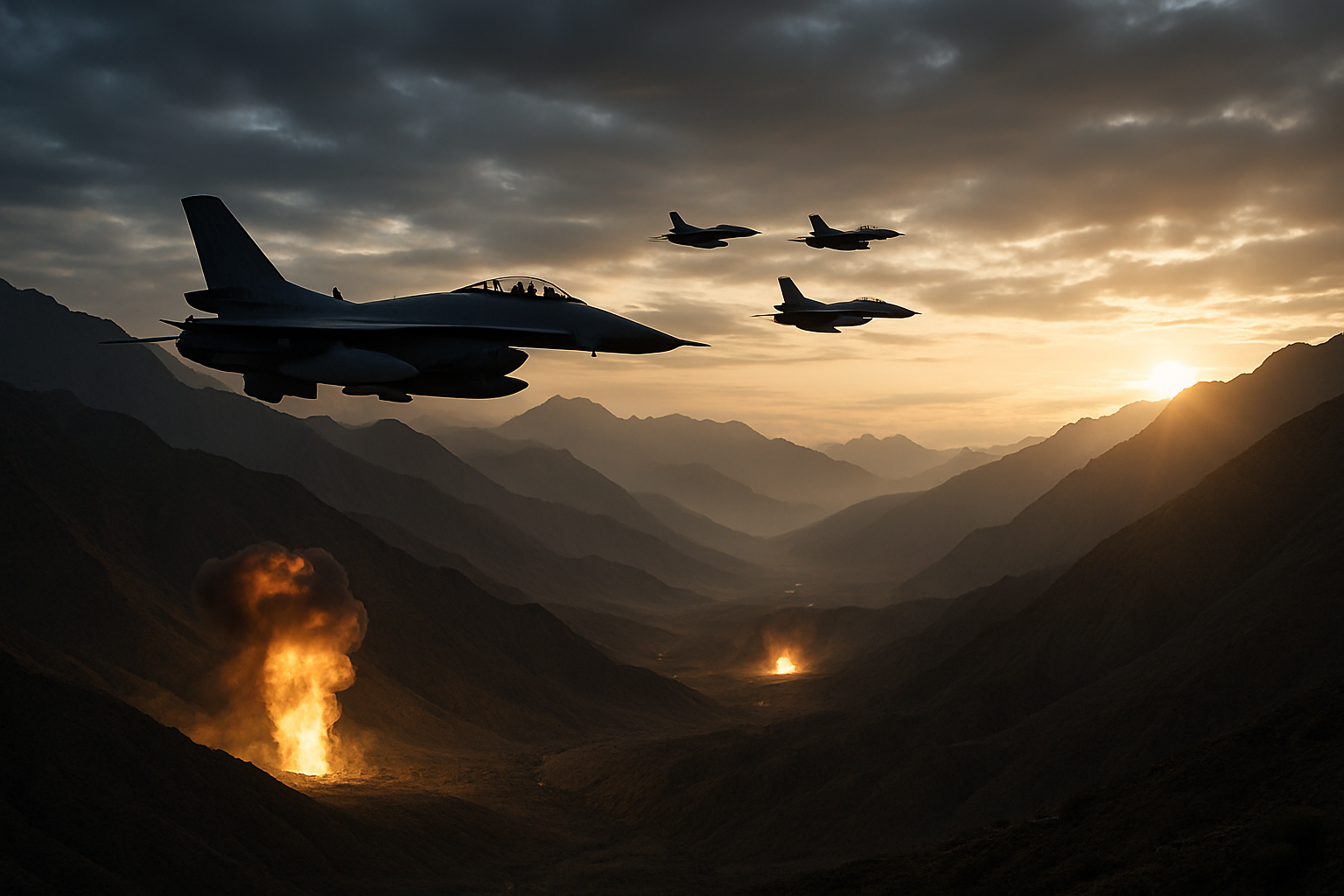
Pakistan launched coordinated airstrikes across eastern Afghanistan early Sunday morning, targeting what Islamabad claimed were terrorist camps and hideouts, but local officials report dozens of civilians killed including women and children in the deadliest cross-border violence in months.
The overnight operations, conducted around 1:00 a.m. on February 22, 2026, struck multiple locations in Nangarhar, Paktika, and Khost provinces during the Muslim holy month of Ramadan. Pakistan's Ministry of Information justified the strikes as "intelligence-based attacks on seven selective terrorist camps" belonging to Tehrik-i-Taliban Pakistan (TTP), also known as "Fitna al Khwarij," and ISIS-Khorasan Province.
Taliban spokesman Zabihullah Mujahid condemned the attacks, stating that "dozens" of people were killed and wounded, while local officials in Nangarhar province reported particularly devastating casualties. Sayed Tayeb Hamad, spokesman for the Taliban police command in Nangarhar, confirmed that 18 members of a single family were killed in the Behsud district strikes.
Civilian Casualties Mount
The most devastating impact occurred in Nangarhar's Gardi Kas village, where local sources report that nine victims were buried on Sunday while rescue operations continue. Quraishi Badlon, the Taliban's information chief in Nangarhar, said six bodies had been recovered, but more remain trapped under rubble from the airstrikes.
"At least 23 people are trapped under rubble in Nangarhar's Behsud district," local residents told Afghan media, highlighting the ongoing humanitarian crisis as rescue efforts face significant challenges in the mountainous terrain.
The strikes targeted residential areas including a religious madrasa and civilian homes, according to Taliban officials who described the attacks as violations of Afghan airspace, sovereignty, international law, and Islamic principles.
Pakistan Justifies Military Action
Pakistan's military framed the operations as a necessary response to recent terrorist attacks, including the February 16 Bajaur district assault that killed 11 Pakistani soldiers and a devastating February 6 ISIS-K bombing at an Islamabad mosque that claimed 31 lives.
"Pakistan has conclusive evidence that these acts of terrorism were perpetrated by Khwarij on the behest of their Afghanistan-based leadership and handlers," the Pakistani Ministry of Information stated.
— Pakistan Ministry of Information
The ministry claimed responsibility for the attacks was taken by Afghanistan-based Pakistani Taliban and their affiliates, as well as ISIS-Khorasan Province, justifying the cross-border military response.
Escalating Diplomatic Crisis
The airstrikes have drawn sharp condemnation from prominent Afghan political figures, creating a significant diplomatic crisis between the neighboring countries. Former President Hamid Karzai called the attacks a "clear violation of Afghanistan's sovereignty" and urged Pakistan to adopt a "civilized, neighborly policy."
Dr. Abdullah Abdullah, former head of the High Council for National Reconciliation, expressed similar concerns, describing the strikes as violations of national sovereignty that could escalate regional instability.
The Taliban government has vowed a "measured and appropriate response at suitable time," marking a significant escalation in rhetoric following previous diplomatic efforts. Officials described the protection of sovereignty and population as religious obligations and national duties.
Historical Context of Border Tensions
The strikes represent the culmination of months of escalating tensions along the Pakistan-Afghanistan border. Despite a February 2026 Saudi-mediated prisoner exchange that saw the Taliban release three Pakistani soldiers captured in October 2025 clashes, diplomatic efforts have proven insufficient to address underlying security challenges.
Pakistan Defense Minister Khawaja Asif had previously threatened airstrikes if cross-border attacks continued, warning that Pakistan would not hesitate to take military action if militants continued operating from Afghan soil. The minister had also made controversial allegations about "proxy conflict" involving Afghan authorities and India, adding regional geopolitical complexity to the security calculus.
Pakistan has been conducting intensive counter-terrorism operations, eliminating over 400 militants in Balochistan operations during February 2026 alone, demonstrating the sustained pressure on security forces from multiple fronts.
International Implications
The timing of the strikes during Ramadan carries additional significance, as recent terrorist attacks have deliberately exploited religious periods for maximum psychological impact. The February attacks specifically targeted Friday prayers and religious gatherings, highlighting the sectarian dimension of the violence.
International observers have noted Chinese UN warnings about the continued presence of ISIS-K, al-Qaeda, and other terrorist groups in Afghanistan, which contradict Taliban claims of having "defeated terrorism." The persistence of cross-border militancy continues despite Taliban assurances and repeated diplomatic initiatives.
Regional powers including Saudi Arabia have attempted mediation, but diplomatic solutions appear limited when cross-border attacks persist, forcing Pakistan to consider military options as demonstrated by these latest strikes.
Regional Security Architecture Under Strain
The airstrikes test both the Taliban's capability and willingness to control militant groups operating from Afghan territory, as well as Pakistan's resolve in using military action to secure its borders. The attacks represent a significant challenge to the post-2021 Afghanistan security situation, where international terrorism concerns intersect with Taliban governance limitations and Pakistan's legitimate security needs.
Intelligence suggests the targeted camps in Nangarhar and Paktika provinces provided sanctuary for militants planning attacks against Pakistani forces and civilians. The sophisticated nature of recent attacks, including coordinated assaults and vehicle-borne improvised explosive devices, demonstrates retained operational capabilities despite sustained military pressure.
The difficult terrain, limited governance capacity, and complex tribal dynamics in border regions continue to create challenges for militant sanctuary elimination, requiring comprehensive approaches beyond immediate military responses.
Humanitarian Concerns
The civilian casualties documented in the airstrikes highlight the complex challenges of conducting precision military operations in populated areas. The targeting of religious schools and residential compounds raises serious questions about adherence to international humanitarian law and the protection of non-combatants.
Local medical facilities are reportedly overwhelmed treating the wounded, while rescue operations continue in areas where civilians remain trapped under debris. The humanitarian impact extends beyond immediate casualties to include displacement of families and disruption of essential services in affected communities.
The strikes occurred in border regions already struggling with poverty and limited access to basic services, compounding the humanitarian challenges facing local populations caught between competing security imperatives.
Future Implications
These airstrikes mark a significant escalation in Pakistan-Afghanistan relations and could set important precedents for regional conflict management. The success or failure of this military approach in addressing cross-border terrorism will likely influence future policy decisions and regional security architectures.
The international community faces pressure to develop effective mechanisms for addressing cross-border terrorism while respecting sovereignty and protecting civilian populations. The balance between legitimate security concerns and humanitarian obligations remains a critical challenge requiring sustained diplomatic engagement.
The resolution of this crisis may provide a template for addressing similar regional challenges where territorial sovereignty intersects with transnational terrorism, determining whether diplomatic solutions can prevail over military escalation in contemporary conflict management.