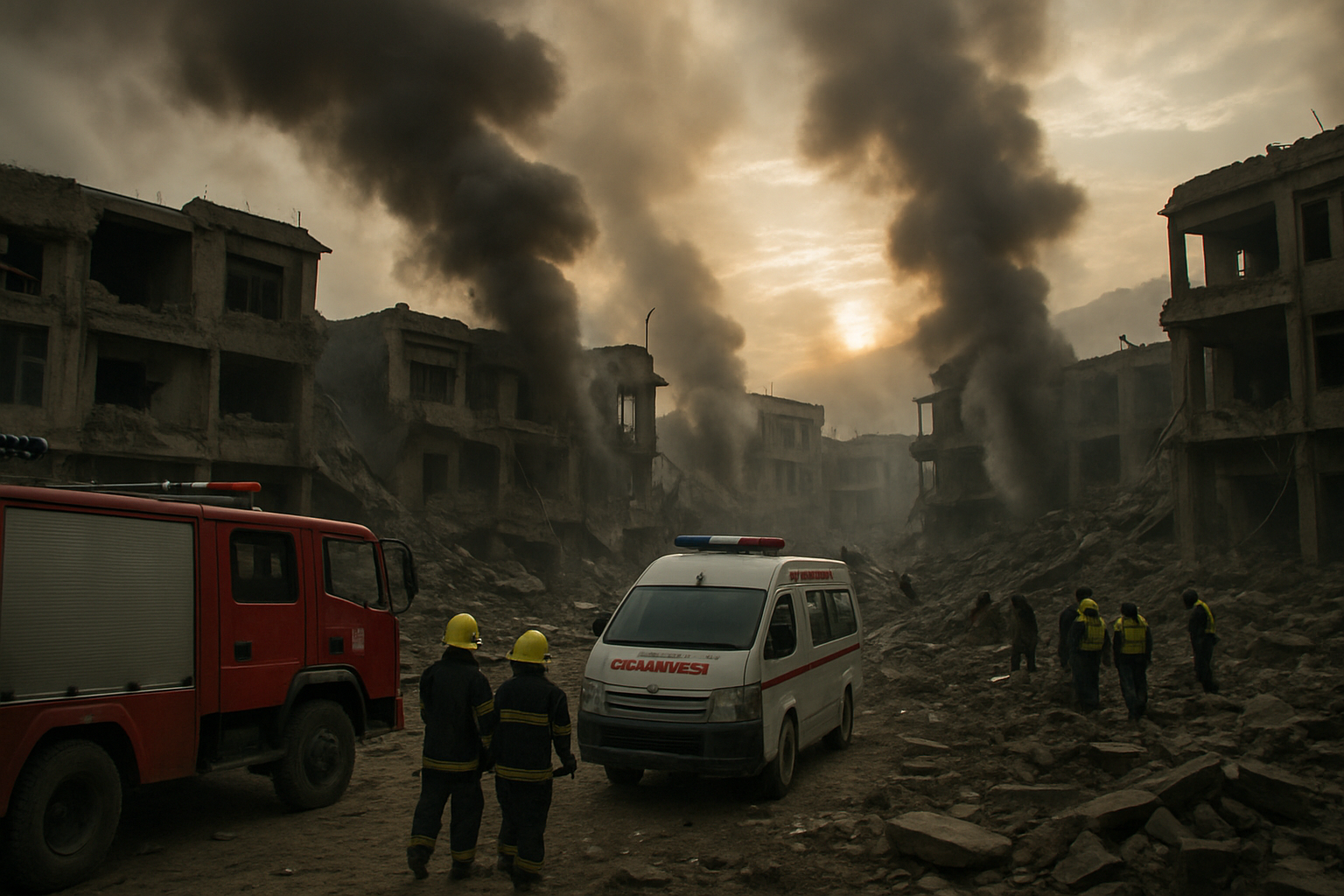
Pakistan has launched deadly airstrikes targeting multiple provinces across Afghanistan, with conflicting casualty reports emerging as the most serious military confrontation since the Taliban's return to power in 2021 reaches dangerous new heights.
The latest strikes hit Nangarhar province in eastern Afghanistan, targeting Jalalabad Airport and the districts of Achin, Khogyani, and Shinwari, according to local sources. Pakistani officials confirmed the operations were part of their ongoing "Operation Ghazab lil-Haq," specifically targeting what they describe as militant hideouts and terrorist infrastructure.
Disputed Casualty Claims Fuel International Concern
The most shocking claims come from Taliban officials, who report that a Pakistani strike on a drug rehabilitation hospital in Kabul killed 400 people and injured 250 others. Hamdullah Fitrat, deputy spokesman for the Taliban government, said the airstrike hit the Omid Addiction Treatment Hospital, a 2,000-bed facility dedicated to treating drug addiction.
"As a result of the attack, large sections of the hospital have been destroyed, and there are serious concerns about a high number of casualties. Unfortunately, the death toll has so far reached 400, while around 250 others have been reported injured," Fitrat announced on social media.
However, Pakistan has categorically rejected these claims as "false and misleading." Pakistani Information Minister Attaullah Tarar maintained that the strikes "precisely targeted military installations and terrorist support infrastructure," adding that "the visible secondary detonations after the strikes clearly indicate the presence of large ammunition depots."
Fourth Week of Unprecedented Military Confrontation
The current crisis represents the fourth week of sustained military confrontation between the nuclear-armed neighbors, beginning with a February 16 attack in Bajaur that killed 11 Pakistani soldiers. The escalation reached a historic milestone on February 27 when Pakistani Defense Minister Khawaja Asif formally declared "open war" against Afghanistan's Taliban government.
The conflict has since evolved from border skirmishes to attacks on strategic installations and capitals on both sides. Pakistani forces have targeted Kabul and struck the strategic Bagram Airfield, while Taliban forces claim to have captured multiple Pakistani military posts and conducted drone strikes on Pakistani territory.
"War has never been our first option, but anyone who sets eyes on Afghan soil with ill intent has been met with a firm response."
— Enayatullah Khwarazmi, Taliban Defense Ministry Spokesperson
Massive Humanitarian Crisis Emerges
The UN Assistance Mission in Afghanistan (UNAMA) has documented devastating civilian casualties, reporting 185 casualties (56 killed, 129 wounded) between February 26 and March 5 alone, with the majority being women and children. The Office for the Coordination of Humanitarian Affairs (OCHA) reports that 16,370 families have been newly displaced across 10 provinces, with the largest concentrations in Paktia (7,000 families), Kunar (3,500), and Khost/Nangarhar (2,500 each).
The healthcare system is overwhelmed, with the World Health Organization delivering emergency medical oxygen to only 23 hospitals while hundreds of health centers have been forced to close due to funding cuts and security concerns. The crisis compounds Afghanistan's existing humanitarian emergency, where 88% of female-headed households are unable to meet minimum living requirements.
Economic Devastation Compounds Crisis
The military confrontation has triggered a complete collapse in bilateral trade, with Pakistan's exports to Afghanistan dropping by 59% from $550 million to $228 million over seven months. Traditional trade routes through Chaman-Spin Boldak and Torkham have faced repeated closures, severely affecting border communities dependent on cross-border commerce.
This economic warfare adds another dimension to the crisis, with local populations bearing the brunt of decisions made in distant capitals. The trade collapse particularly affects the already struggling Afghan economy, which has been under international sanctions since the Taliban's return to power.
International Mediation Efforts Fall Short
Despite intensive international mediation efforts, the crisis continues to escalate. Saudi Arabia facilitated a prisoner exchange in February 2026, releasing three Pakistani soldiers captured in earlier clashes. Iran, Turkey, Russia, and China have all offered mediation services, with Turkish Foreign Minister Hakan Fidan and Russian Special Envoy Zamir Kabulov actively shuttling between the countries.
Chinese Foreign Minister Wang Yi recently expressed readiness to assist in resolution through diplomatic channels, emphasizing that "China hopes both sides maintain calm, conduct face-to-face talks as soon as possible, establish a ceasefire, and resolve disputes through dialogue."
However, these diplomatic initiatives have proven insufficient to halt the military escalation. Pakistan maintains that the Tehreek-e-Taliban Pakistan (TTP) operates "with impunity from Afghan soil," while the Taliban categorically denies providing sanctuary to militant groups.
The Durand Line: Colonial Legacy Fuels Modern Conflict
At the heart of the crisis lies the disputed Durand Line, a 2,640-kilometer border established by British colonial authorities in 1893. No Afghan government has ever formally recognized this boundary, viewing it as an artificial division of Pashtun tribal lands. The porous mountainous terrain provides natural sanctuaries that complicate border control efforts by both sides.
Pakistan acknowledges its diminished influence in Afghanistan compared to wealthier powers like Turkey, the UAE, Qatar, Saudi Arabia, and China, which has forced Islamabad to increasingly rely on military solutions rather than diplomatic leverage.
Nuclear Implications Raise Global Stakes
The involvement of nuclear-armed Pakistan adds a dangerous dimension to the crisis that requires careful international monitoring. This represents the most serious confrontation between the neighbors since the Taliban's return and serves as a critical test of the post-2021 South Asian security architecture.
Chinese warnings at the UN about the presence of ISIS-K, al-Qaeda, and the East Turkestan Islamic Movement (ETIM) in Afghanistan contradict Taliban claims about defeating terrorism, adding to international concerns about the region's stability.
Religious and Political Condemnation Mounts
Former Afghan President Hamid Karzai has strongly condemned the Pakistani airstrikes, particularly those targeting civilian areas in Kabul. "Continued Pakistani attacks would not achieve their objectives and would ultimately harm Pakistan itself, escalating regional tensions further," Karzai warned.
Islamic scholars have issued fatwas calling for a ceasefire during Ramadan, emphasizing that fighting between Muslim nations contradicts Islamic teachings. However, military operations have continued despite these religious appeals.
Template for 21st Century Conflict Resolution
The Pakistan-Afghanistan crisis has become a template-setting confrontation for 21st-century challenges where territorial sovereignty intersects with transnational terrorism concerns. The success or failure of diplomatic containment efforts will influence how similar conflicts are managed globally.
The Taliban maintains that the "path of talks remains open" and seeks resolution through "mutual understanding and respect." Meanwhile, Pakistan indicates there is "no rush" to end its military campaign until concrete anti-militant measures are implemented by Afghanistan.
Coming Days Critical for Regional Stability
As the crisis enters its fourth week, the international community faces mounting pressure to develop effective conflict prevention mechanisms before the confrontation escalates into a broader regional war. The involvement of nuclear-armed neighbors adds urgency to diplomatic efforts.
The conflict's resolution will have implications far beyond bilateral Pakistan-Afghanistan relations, affecting regional stability mechanisms, international law enforcement, and the global security architecture's adaptation to contemporary threats. Success in containing the crisis could provide a methodology for complex multilateral negotiations despite fundamental disagreements, while failure risks prolonged confrontations with far-reaching implications for regional and global stability.
With civilian casualties mounting, economies collapsing, and military operations expanding, the need for innovative diplomatic frameworks has never been more urgent. The world watches as two of its most complex nations navigate the dangerous intersection of historical grievances, modern terrorism, and nuclear capabilities in an increasingly interconnected world.