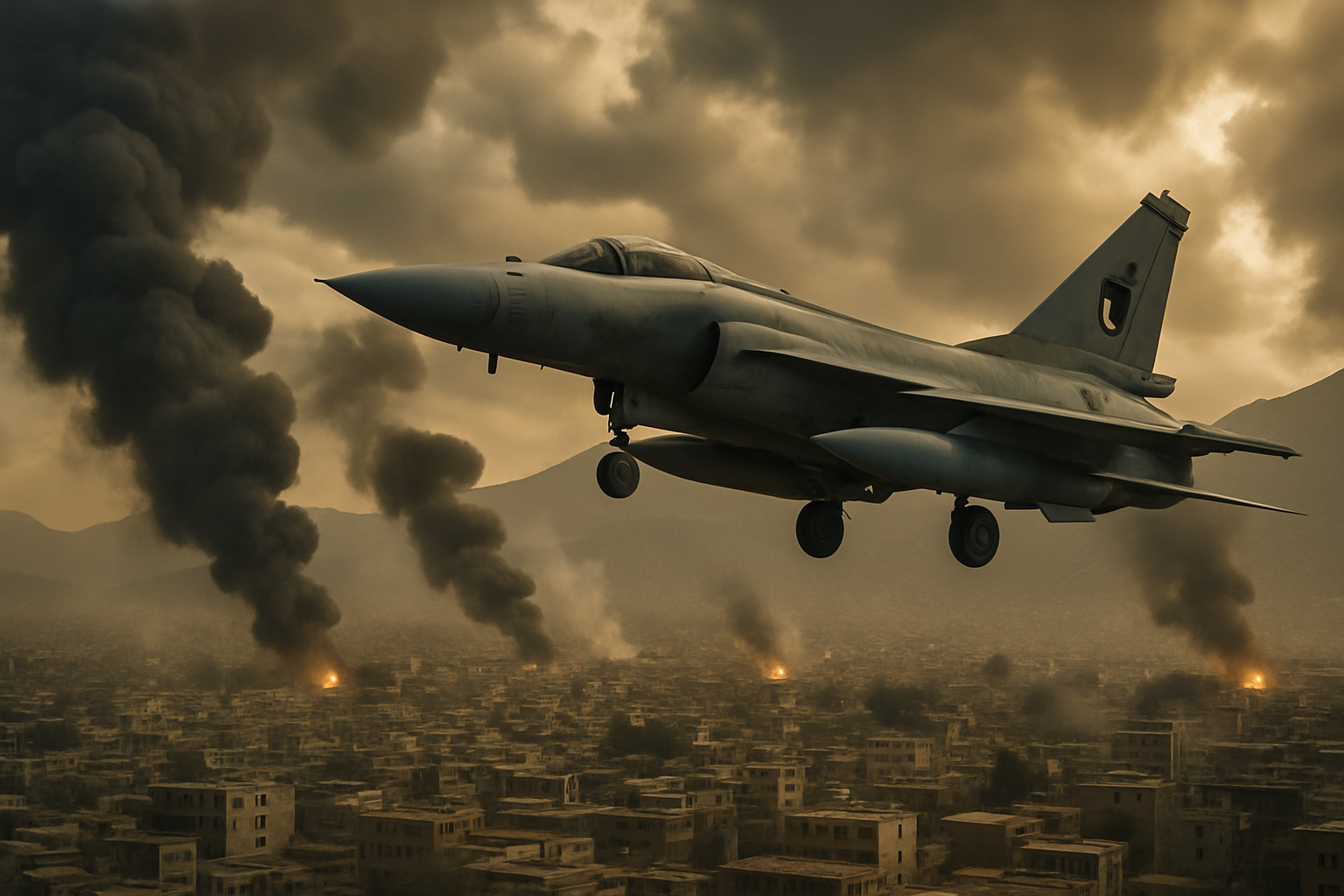
Pakistan conducted deadly airstrikes on Afghanistan's capital Kabul on Monday evening, with Taliban officials claiming over 400 casualties including civilians at a drug rehabilitation hospital, representing the most serious escalation in a month-long military confrontation between the neighboring countries.
Taliban spokesman Zabihullah Mujahid confirmed the strikes, stating that a drug treatment facility housing over 3,000 patients from across Afghanistan was hit, resulting in what he described as a "violation of Afghanistan's sovereignty" and "serious breach of humanitarian principles."
The latest attacks mark a dramatic intensification of the crisis that began February 16 when a Tehreek-e-Taliban Pakistan (TTP) assault killed 11 Pakistani soldiers in Bajaur district using a vehicle-borne improvised explosive device. The escalation reached unprecedented levels when Pakistani Defense Minister Khawaja Mohammad Asif formally declared "open war" against the Taliban government on February 27.
Massive Civilian Casualties Reported
Afghan authorities provided conflicting casualty figures throughout Monday evening and early Tuesday. Government spokesman Hamdullah Fitrat reported the death toll at over 400, with an additional 250 wounded. Earlier in the evening, Afghan health ministry spokesperson Sharafat Zaman had reported over 200 killed and 200 wounded.
The Taliban maintains the strikes specifically targeted a drug rehabilitation hospital in Kabul, contradicting Pakistani claims that the operations targeted "military installations and terrorist infrastructure." According to Taliban officials, the facility was providing treatment for drug addiction to patients from throughout Afghanistan when it was struck.
"Pakistan's military regime has once again violated our country's airspace and targeted a drug treatment hospital in Kabul, causing a number of patients under treatment to be martyred and wounded," Mujahid said in an official statement.
— Zabihullah Mujahid, Taliban Spokesman
The UN Assistance Mission in Afghanistan (UNAMA) has documented 185 civilian casualties (56 killed, 129 wounded) since the conflict began in late February, with the majority being women and children. The latest strikes would represent a catastrophic escalation in civilian harm.
Pakistan's Military Justification
Pakistani security sources confirmed Monday night's operations as part of the ongoing "Operation Ghazab lil-Haq" (Operation Divine Wrath), which Pakistan launched following the February 16 Bajaur attack. Pakistani officials maintain they are conducting "intelligence-based selective targeting" against TTP and ISIS-K positions that operate "with impunity from Afghan soil."
According to Pakistani security sources, Monday's strikes destroyed technical support infrastructure and ammunition storage at two locations in Kabul, while also targeting Taliban military installations at four spots in Nangarhar province. Pakistan claims the operations also destroyed a drone assembly workshop and logistics facilities adjacent to the targeted installations.
However, Pakistan has categorically rejected Taliban claims about targeting a hospital, with officials describing such allegations as "false and fabricated" propaganda designed to mislead international opinion.
Economic and Humanitarian Catastrophe
The sustained military confrontation has created a comprehensive humanitarian crisis. The UN Office for the Coordination of Humanitarian Affairs (OCHA) reports that 16,370 families have been newly displaced across 10 Afghan provinces since late February, with Paktia province alone accounting for 7,000 displaced families.
Bilateral trade between the countries has collapsed by 59%, with Pakistani exports to Afghanistan dropping from over $550 million to $228 million over seven months. Traditional trade routes through Chaman-Spin Boldak and Torkham have faced repeated closures, devastating border communities that depend on cross-border commerce.
The World Health Organization (WHO) is providing emergency medical oxygen to only 23 hospitals across Afghanistan, while hundreds of health centers have been forced to close due to funding cuts and security concerns. This healthcare crisis compounds the existing humanitarian emergency, where 88% of female-headed households are unable to meet minimum living requirements according to UN data.
International Mediation Efforts Failing
Despite intensive international diplomatic efforts, the crisis continues to escalate. Multiple mediation attempts have proved insufficient, including a Saudi-mediated prisoner exchange in February 2026 that resulted in the release of three Pakistani soldiers from Taliban custody, as well as mediation offers from Iran, Turkey, Russia, and China.
Islamic scholars have issued fatwas calling for an immediate ceasefire during the holy month of Ramadan, arguing that fighting between Muslim nations contradicts Islamic teachings. However, military operations have continued despite these religious appeals.
Pakistan acknowledges that it has lost traditional influence over Afghanistan to wealthier regional powers including Turkey, the UAE, Qatar, Saudi Arabia, and China, forcing it to rely increasingly on military solutions to address security concerns.
The Durand Line Dispute
At the heart of this conflict lies the disputed 2,640-kilometer Durand Line, the colonial-era border established by the British in 1893 that has never been formally recognized by any Afghan government. Afghanistan views the border as an artificial division of Pashtun tribal lands, while Pakistan maintains it as its legitimate international boundary.
The porous mountainous terrain along this disputed border has long provided sanctuary for militant groups, complicating security operations on both sides. Pakistan maintains that TTP operates "with impunity from Afghan soil," while the Taliban categorically denies providing sanctuary to militant groups or allowing Afghan territory to be used against neighboring countries.
Nuclear Implications and Regional Security
The confrontation represents the most serious military crisis between Pakistan and Afghanistan since the Taliban's return to power in August 2021. The involvement of nuclear-armed Pakistan adds a dangerous dimension that requires careful international monitoring to prevent escalation beyond conventional military operations.
Chinese warnings at the UN about the presence of ISIS-K, al-Qaeda, and the East Turkestan Islamic Movement (ETIM) in Afghanistan contradict Taliban claims of having "defeated terrorism." This contradiction highlights the complex security challenges facing the region and the difficulty of addressing cross-border terrorism while respecting territorial sovereignty.
Diplomatic Prospects Uncertain
Despite the military escalation, Taliban officials maintain that the "path of talks remains open," seeking resolution through "mutual understanding and respect." However, Pakistani officials have stated there is "no rush" to end the military campaign until concrete measures are taken against militant groups operating from Afghan soil.
The crisis represents a critical test of whether innovative diplomatic frameworks can manage the complex intersection of territorial sovereignty disputes, cross-border terrorism concerns, and humanitarian obligations in the 21st century.
Coming days will be decisive in determining whether diplomatic engagement can prevent broader regional confrontation or whether the situation will continue to deteriorate into prolonged warfare between nuclear-armed neighbors, with potentially global implications for regional stability and international conflict resolution mechanisms.
The international community faces mounting pressure to develop effective conflict prevention mechanisms before this bilateral crisis expands into a broader regional conflagration that could destabilize South Asia and beyond.