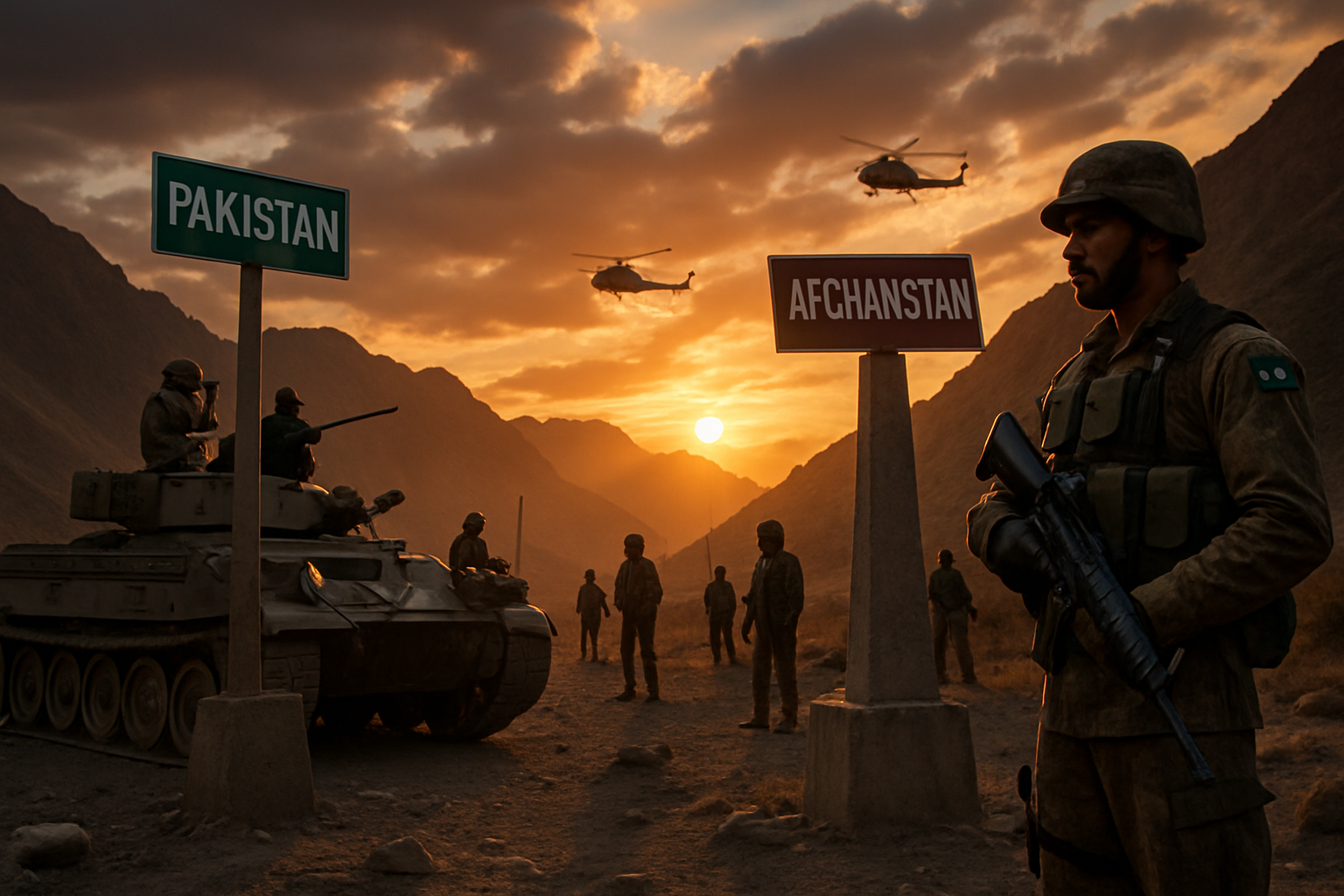
Pakistan's Defense Minister Khawaja Asif declared "open war" against Afghanistan's Taliban government on February 27, 2026, following a series of devastating military strikes that have killed hundreds and pushed the nuclear-armed neighbors toward their most serious confrontation since the Taliban's return to power.
The declaration came as Pakistani forces launched "Operation Ghazab-ul-Haq," conducting coordinated airstrikes across multiple Afghan provinces including Kabul, Kandahar, Paktia, and Nangarhar. The operations, which began in the early hours of February 26, represent the most significant cross-border military escalation in recent years.
"Our patience has reached its limit. From now on, it is open war between us and you," Asif announced on social media platform X, marking a dramatic escalation from previous diplomatic protests to direct military confrontation.
Unprecedented Military Operations
According to Pakistani military sources, Operation Ghazab-ul-Haq targeted Taliban military facilities across eastern Afghanistan, with officials claiming to have eliminated 133 Taliban fighters and wounded over 200 others. The strikes also reportedly destroyed more than 80 tanks, artillery guns, and armored personnel carriers belonging to Taliban forces.
Taliban spokesman Zabihullah Mujahid confirmed the attacks but disputed casualty figures, claiming "no casualties were reported" despite what he described as extensive bombing across Kabul, Kandahar, Paktia, and Nangarhar provinces. The Taliban characterized the strikes as acts of "cowardly Pakistani forces."
The military confrontation escalated dramatically at the Torkham border crossing, where heavy fighting erupted between Taliban and Pakistani forces. Reports indicate that a returnees' camp in Nangarhar province came under shelling, wounding at least seven people, including a woman, and forcing the evacuation of dozens of families.
"The Taliban began the current conflict but Pakistan will determine how it ends."
— Faisal Karim Kundi, Governor of Khyber Pakhtunkhwa
Escalating Cross-Border Violence
The current crisis represents the culmination of months of deteriorating relations between Pakistan and the Taliban government. The immediate trigger was a February 16 attack in Pakistan's Bajaur district that killed 11 Pakistani soldiers, carried out by the banned Tehreek-i-Taliban Pakistan (TTP) operating from Afghan soil.
Pakistan responded with airstrikes on February 22, targeting what it claimed were seven terrorist camps in Afghanistan's Nangarhar and Paktika provinces. While Pakistani officials claimed to have eliminated over 80 militants, the strikes also resulted in significant civilian casualties, including eight schoolchildren aged 5-15 years in Behsud district.
Former Afghan President Hamid Karzai condemned the Pakistani airstrikes, calling them "clear violations of Afghanistan's sovereignty" and urging Pakistan to "stop airstrikes and embrace mutual respect." The Taliban government filed a formal complaint with the UN Security Council, describing the attacks as violations of international law.
International Concerns Mount
UN Secretary-General António Guterres expressed "deep concern" over the escalating tensions, warning that the conflict risks regional instability and calling on both sides to pursue dialogue while protecting civilians. The international community has watched with growing alarm as the situation spiraled from diplomatic tensions to active military confrontation.
Iran's Foreign Ministry spokesman Esmaeil Baghaei offered mediation services, warning that escalation "could affect the broader region." Iranian Ambassador Reza Amiri-Moghaddam urged both sides to exercise restraint and pursue dialogue, reflecting broader regional concerns about spillover effects.
The crisis has also highlighted the failure of previous diplomatic initiatives, including a Saudi-mediated prisoner exchange in February 2026 that saw the Taliban release three Pakistani soldiers captured during October 2025 border clashes. These confidence-building measures proved insufficient to address underlying security challenges.
Economic and Humanitarian Impact
The military escalation has coincided with a devastating collapse in bilateral trade, with Pakistan's exports to Afghanistan plummeting by 59% from over $550 million to $228 million in the first seven months of the current fiscal year. This decline affects border communities dependent on cross-border commerce and compounds Afghanistan's ongoing humanitarian crisis.
According to UN assessments, 88% of female-headed households in Afghanistan are unable to meet minimum living requirements, compared to 75% of the general population. The conflict threatens to worsen these conditions, particularly for vulnerable populations in border areas.
The violence has also disrupted traditional trade routes through Chaman-Spin Boldak and Torkham, which have faced repeated closures. These disruptions have serious implications for Afghanistan's already struggling economy and Pakistan's regional trade connections.
Regional Security Architecture Under Threat
The Pakistan-Afghanistan conflict represents a critical test of the post-2021 South Asian security architecture. Pakistan has acknowledged its diminished regional influence compared to wealthier powers like Turkey, UAE, Qatar, Saudi Arabia, and China, which has increased its reliance on military solutions to address security concerns.
Chinese officials have previously warned the UN Security Council about the presence of ISIS-K, al-Qaeda, and the East Turkestan Islamic Movement (ETIM) in Afghanistan, contradicting Taliban claims of having "defeated terrorism." Pakistan maintains that TTP leadership operates "with impunity from Afghan soil" despite repeated Taliban assurances.
The crisis also occurs against the backdrop of Pakistan's broader counter-terrorism campaign, which has seen over 400 militants eliminated in Balochistan operations during February 2026 alone. Recent attacks, including the February 6 ISIS-K bombing at an Islamabad mosque that killed 31 people, have intensified pressure on the Pakistani government to take decisive action.
Historical Context and Border Disputes
The current confrontation is rooted in longstanding disputes over the 2,640-kilometer Durand Line, the colonial-era border established by Britain in 1893. The Taliban and previous Afghan governments have never formally recognized this boundary, viewing it as an artificial division of Pashtun tribal territories.
The unmarked mountainous border, with its difficult terrain and limited government control on both sides, has long provided sanctuary for militant groups. This geographical reality, combined with tribal dynamics and economic factors, has complicated bilateral relations and security cooperation efforts.
Pakistan's February 2026 operations represent an evolution from previous airstrikes to what appears to be a sustained military campaign. The use of the operation name "Ghazab-ul-Haq" (Divine Wrath/Justice) suggests Pakistani forces view this as more than a limited tactical response.
International Diplomatic Implications
The conflict poses significant challenges for the international community's engagement with Taliban-controlled Afghanistan. Regional powers and global stakeholders who have invested in diplomatic relationships with the Taliban now face the complexity of managing relations with both parties to an active military conflict.
The crisis also threatens to undermine counter-terrorism cooperation in the region, as military confrontation makes intelligence sharing and coordinated operations more difficult. This could have implications for efforts to combat transnational terrorist groups that operate across the porous border.
European and American policymakers are closely monitoring the situation, given its potential impact on regional stability and the effectiveness of counter-terrorism efforts. The conflict also raises questions about the Taliban's ability to control militant groups within Afghanistan, a key international concern since their return to power.
Looking Forward
The declaration of "open war" by Pakistan's Defense Minister represents a significant escalation that could reshape South Asian geopolitics. The success or failure of diplomatic efforts to contain this crisis will likely influence how similar territorial sovereignty and transnational terrorism challenges are addressed in the 21st century.
Coming weeks will be critical in determining whether the international community can develop effective mechanisms to prevent the conflict from spiraling into a broader regional confrontation. The stakes extend beyond the immediate bilateral dispute to encompass regional stability, international law enforcement, and the credibility of diplomatic solutions to contemporary security challenges.
As both sides appear entrenched in their positions, with Pakistan demanding concrete action against militant groups and the Taliban rejecting sovereignty violations, the path forward remains uncertain. The humanitarian cost continues to mount, with civilian casualties and economic disruption affecting millions on both sides of the disputed border.
The crisis represents a watershed moment for post-2021 Afghanistan and regional security architecture, testing whether diplomatic engagement can prevail over military confrontation in one of the world's most volatile regions.