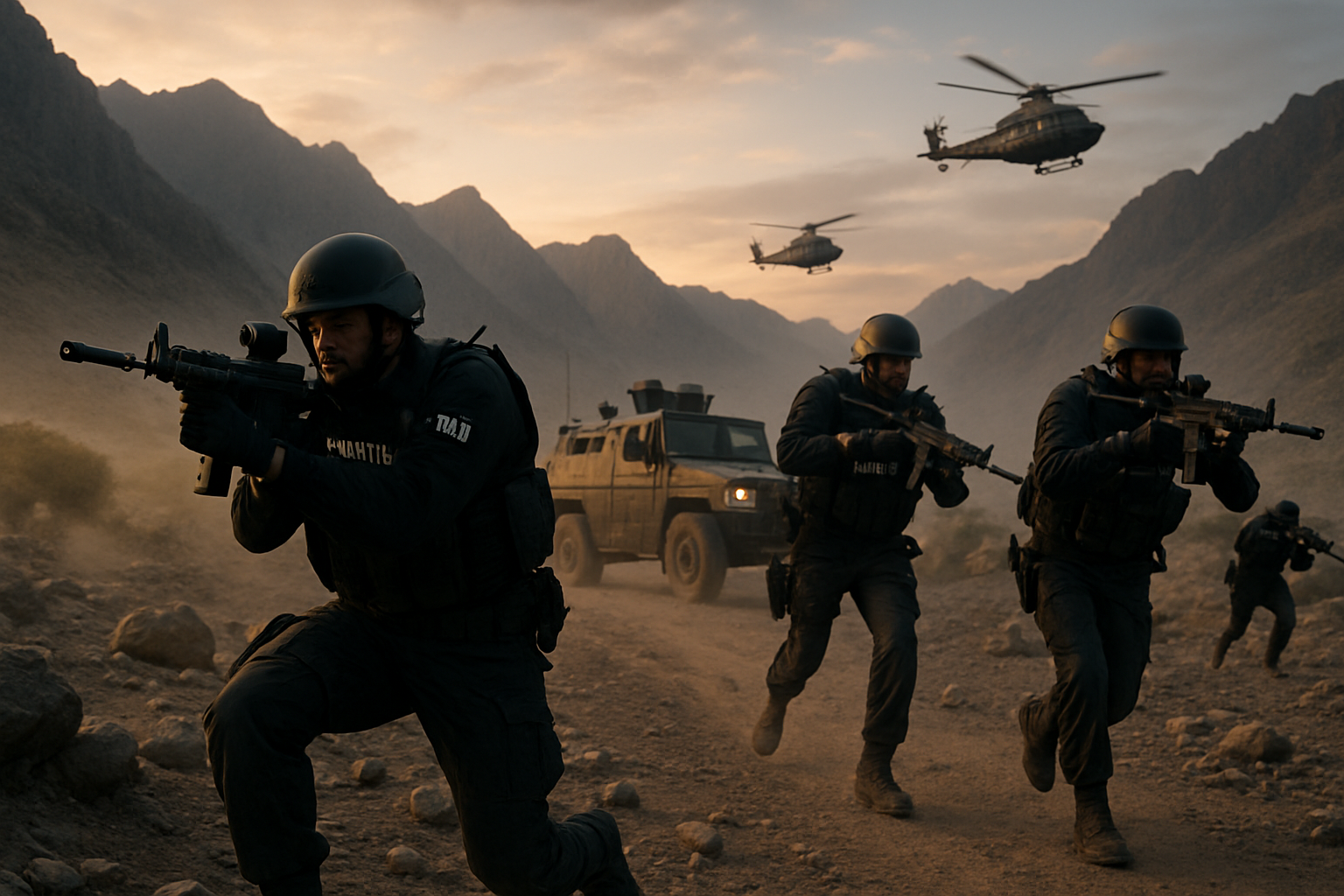
Pakistani security forces have killed 145 separatist militants during a massive 40-hour counter-operation across Balochistan province, following coordinated attacks by the Baloch Liberation Army (BLA) that left 48 people dead, including 31 civilians and 17 security personnel.
Balochistan Chief Minister Sarfraz Bugti confirmed the militant death toll during a press conference in Quetta on Sunday, describing the operation as one of the most extensive counter-terrorism efforts in the province's recent history. The military operation was launched in response to simultaneous attacks that targeted multiple cities across the resource-rich but restive southwestern province.
Coordinated Assault Across Multiple Cities
The initial attacks, carried out by militants from the Baloch Liberation Army, struck at least 12 towns and cities across Balochistan on Saturday. The coordinated assault targeted police stations, paramilitary installations, and civilian areas in Quetta, Mastung, Nushki, Dalbandin, Kharan, Panjgur, Tump, Gwadar, and Pasni.
According to Pakistani military sources, the attacks were carried out by groups operating under what the state has designated as "Fitna-al-Hindustan," a term used by Pakistani authorities to describe Balochistan-based terrorist organizations. The military's media wing, Inter-Services Public Relations (ISPR), initially reported killing 92 militants in the immediate response operations.
The most devastating single incident occurred in Gwadar, where Chief Minister Bugti confirmed that militants killed five women and three children from a Baloch family originally from Khuzdar district. The attack has drawn particular condemnation from Pakistani officials, who described it as targeting innocent civilians.
Casualties and Impact
The violence has extracted a heavy toll on both security forces and civilians. Pakistani authorities report that 17 security personnel were martyred during the attacks, while 31 civilians lost their lives. The death toll represents one of the deadliest episodes of violence in Balochistan in recent months.
"These were not ordinary terrorists but highly organized groups with foreign backing,"
— Interior Minister Mohsin Naqvi
The attacks disrupted normal life across the affected areas, with authorities imposing security cordons and launching extensive search operations. The scale and coordination of the assault has raised concerns about the operational capabilities of separatist groups in the region.
Military Response and Operations
Pakistani security forces launched immediate counter-operations based on intelligence reports about the planned terrorist attacks. The military response involved multiple branches of the armed forces and paramilitary units, conducting operations across the vast terrain of Balochistan province.
Chief Minister Bugti emphasized the state's resolve in combating terrorism, stating during his press conference that authorities would continue operations until all terrorist elements are eliminated. The 40-hour operation represents one of the most sustained military engagements in the province in recent years.
The death toll of 145 militants includes those killed in the initial raids on Friday and Saturday, as well as additional militants eliminated during ongoing clearance operations. Military sources indicate that operations are continuing in some areas to ensure complete neutralization of remaining threats.
Allegations of Foreign Involvement
Pakistani officials have leveled serious accusations of foreign involvement in the attacks, specifically pointing to India as a supporter of separatist activities in Balochistan. Chief Minister Bugti condemned what he described as "hostile elements trying to destabilize Pakistan at the behest of India."
Interior Minister Mohsin Naqvi described the attackers as highly organized and claimed foreign involvement in their operations. These allegations reflect long-standing tensions between Pakistan and India, with Pakistani authorities regularly accusing India of supporting insurgent activities in Balochistan province.
India has not officially responded to these latest accusations. The allegations come amid broader regional tensions and Pakistan's ongoing efforts to combat separatist movements in its southwestern province.
The Baloch Separatist Movement
The Baloch Liberation Army, which claimed responsibility for the attacks, is one of several separatist organizations operating in Balochistan province. The group has been involved in a long-running insurgency seeking independence for the Baloch people and greater control over the province's abundant natural resources.
Balochistan, Pakistan's largest province by area, is rich in natural gas, minerals, and other resources, but remains one of the country's least developed regions. The province has experienced periodic insurgencies, with separatist groups arguing that local populations have not benefited from resource extraction.
Chief Minister Bugti questioned whether the BLA could be considered a legitimate political entity for potential negotiations, suggesting that the government views the organization purely as a terrorist group rather than a political movement.
Regional Security Implications
The scale and coordination of the latest attacks highlight ongoing security challenges in Balochistan, a strategically important province that borders both Iran and Afghanistan. The region's security situation has implications for major infrastructure projects, including the China-Pakistan Economic Corridor, which includes significant investments in Balochistan.
The port city of Gwadar, which was among the targets of the recent attacks, is particularly significant as a key component of Chinese Belt and Road Initiative projects in Pakistan. Security concerns in the region have previously affected development projects and international investment.
Pakistani authorities have emphasized their commitment to maintaining security and eliminating terrorist threats in the province. The military's extensive response to the latest attacks demonstrates the government's determination to counter separatist activities through force.
Ongoing Security Measures
Following the 40-hour operation, Pakistani authorities have maintained heightened security measures across Balochistan province. Additional security personnel have been deployed to key installations and urban areas to prevent further attacks.
The government has reiterated its policy of not negotiating with terrorist organizations, with Chief Minister Bugti specifically questioning the legitimacy of engaging with groups like the BLA. This stance suggests that military operations will remain the primary response to separatist activities in the province.
As clearance operations continue in some areas, authorities are working to restore normal services and ensure the safety of civilian populations. The extensive nature of the military response reflects both the scale of the initial attacks and the government's determination to prevent future incidents of similar magnitude.