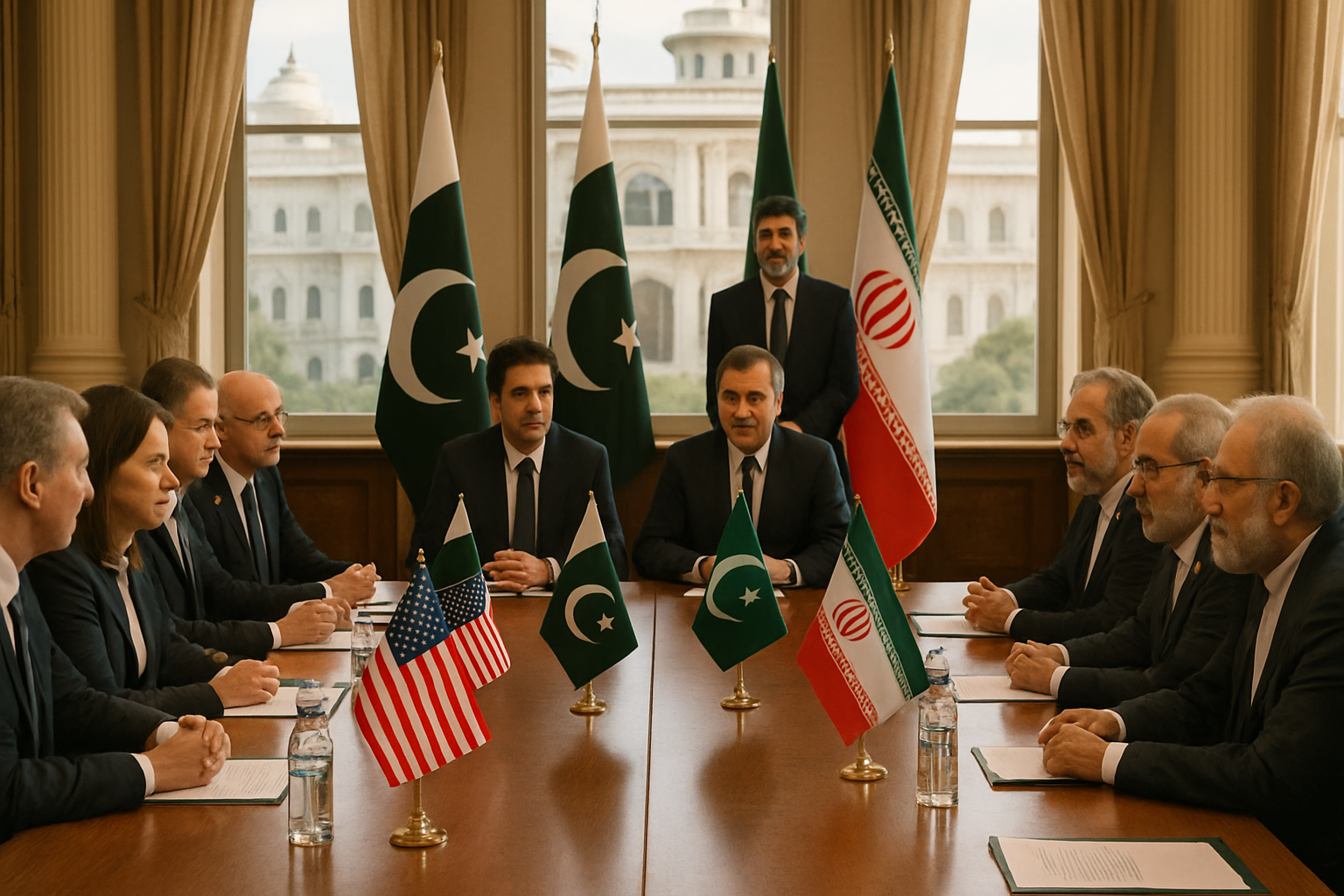
Pakistan has emerged as a crucial diplomatic mediator in the historic peace talks between the United States and Iran, following its successful brokering of a breakthrough ceasefire that ended what experts called the most dangerous international crisis since the Cold War.
Prime Minister Shehbaz Sharif and Field Marshal Asim Munir played instrumental roles in mediating the "Islamabad Accord" framework that brought about a two-week ceasefire just 88 minutes before President Trump's "whole civilization will die tonight" deadline on April 8, 2026.
Pakistan's Diplomatic Breakthrough
The breakthrough came after weeks of intensive diplomatic efforts, with Pakistan serving as a crucial "message relay system" between Washington and Tehran when direct communication proved impossible. Foreign Minister Ishaq Dar confirmed that Pakistan had been facilitating indirect talks, stating that "the United States shared 15 points, being deliberated by Iran."
The dramatic intervention prevented what could have been catastrophic escalation, as oil prices crashed nearly 20% from $119.50 Brent to below $100 following the ceasefire announcement - the steepest decline in six years.
"This breakthrough was the result of an intense diplomatic effort that was in progress over the past few weeks. Pakistan's role was underpinned by trust from all sides, careful consultations, and a commitment to discretion."
— Rizwan Saeed Sheikh, Pakistan's Envoy to Washington
Islamabad Preparations for High-Stakes Talks
As delegations prepare to arrive in Islamabad for formal negotiations, Pakistani authorities have implemented comprehensive security measures. Two local holidays were declared in Islamabad and Rawalpindi on April 9 and 10 to ensure security for the scheduled peace talks.
A hotel within the Red Zone has been exclusively reserved for the delegations and evacuated under government instructions, with heightened security deployed in and around the premises. The Serena Hotel is reported to be the most likely venue for the historic negotiations.
Traffic plans have been arranged by Islamabad police to accommodate the arrival and departure of foreign delegations, with citizens requested to follow alternate routes to avoid inconvenience during this critical diplomatic period.
International Support and Framework
China's Foreign Minister Wang Yi expressed "full support" for Pakistan's mediation initiative, calling the peace talks "conducive to restoring normal navigation" in the Strait of Hormuz. Germany also noted "positive signs" that direct US-Iran talks may begin soon at the Pakistan venue.
The negotiations follow Pakistan's success in brokering a comprehensive ceasefire that covers "all fronts including Lebanon," according to Prime Minister Sharif. Iran has agreed to reopen the Strait of Hormuz for "safe passage" during the two-week period "in coordination with Iranian armed forces."
Crisis Context and Resolution
The diplomatic intervention came at the height of a global crisis that had seen:
- 18,000+ flights cancelled worldwide in COVID-scale aviation disruption
- Eight Middle Eastern countries simultaneously closing their airspace
- The Strait of Hormuz effectively closed, affecting 40% of global oil transit
- Dubai International Airport shuttered due to missile damage
- The IEA's largest strategic reserve release in 50-year history
High-Level Delegations Expected
The United States is expected to send a high-level delegation potentially including Vice President JD Vance, along with Steve Witkoff and Jared Kushner. Iranian President Pezeshkian has confirmed participation following what was described as a "warm and cordial" 45-minute call with PM Sharif.
This represents the most direct US-Iran diplomatic engagement in decades, with Iran's 10-point proposal addressing Hormuz protocols, sanctions relief, regional conflicts, and security guarantees being accepted as a "workable basis for negotiations" by the Trump administration.
Regional Coalition Dynamics
Despite significant strain during the crisis, the unprecedented Saudi Arabia, UAE, Qatar, and Egypt coalition supporting diplomatic solutions has been preserved. The Iranian attacks during the conflict had resulted in casualties - one civilian killed in Abu Dhabi, 32 injured in Kuwait, and 8 wounded in Qatar - but the coalition maintained its diplomatic support throughout.
Egyptian President Sisi's warnings of "comprehensive chaos" were heeded, with the coalition continuing to back the Pakistani mediation process even as Iranian "Operation True Promise 4" systematically targeted member territories.
Nuclear Diplomacy Window
The current crisis emerged from the complete collapse of Geneva nuclear talks despite achieving "broad agreement on guiding principles" - the most progress since the 2018 JCPOA breakdown. Iran continues 60% uranium enrichment with 400kg+ of weapons-grade material, but the ceasefire has created a critical diplomatic window.
The timing is particularly significant given the expiration of the New START treaty in February 2026, marking the first time in over 50 years without US-Russia nuclear constraints, making this diplomatic precedent crucial for global nuclear governance.
Template for 21st-Century Diplomacy
UN Secretary-General António Guterres had described the crisis as the "greatest test of multilateral cooperation in the modern era." Pakistan's successful mediation demonstrates that middle powers can effectively bridge divides between major adversaries when traditional diplomatic mechanisms fail.
The "Islamabad Accord" framework provides a template for 21st-century conflict resolution, showing that diplomatic innovation is possible even in the "darkest hours" when maximum stakes affect energy security, nuclear governance, and international law enforcement simultaneously.
"Pakistan has emerged as a key mediator between the US and Iran, playing a crucial role in brokering the two-week ceasefire agreement and working with both camps, as well as regional powers, to end the war."
— France 24 International News
Economic and Energy Implications
The immediate economic relief has been substantial, with Asian stock markets experiencing explosive rallies and Pakistan's KSE-100 achieving a record 8.15% surge. Airlines are planning resumption of Middle East routes, and shipping companies are mobilizing to free 150+ stranded tankers worth billions in cargo.
Consumer relief is anticipated globally, with Bangladesh reviewing fuel rationing for 170 million people and Pakistan considering reversal of wartime austerity measures. The crisis exposed dangerous over-dependence on strategic chokepoints, highlighting the urgent need for supply diversification and renewable energy transitions.
Critical Two-Week Window
The success or failure of the Islamabad talks will determine whether this represents a lasting peace framework or merely temporary respite. The stakes extend far beyond the immediate US-Iran relationship, affecting territorial sovereignty enforcement, energy security paradigms, and conflict resolution approaches globally.
As the world watches, Pakistan's emergence as a crucial mediator demonstrates that diplomatic innovation is possible even in the most dangerous circumstances, providing hope that multilateral cooperation can triumph over military confrontation in an increasingly volatile and interconnected world.
The historic nature of these talks - representing the most comprehensive US-Iran framework since the 2015 nuclear deal - makes the coming days critical not just for regional stability, but for establishing precedents in 21st-century international relations and crisis management.